

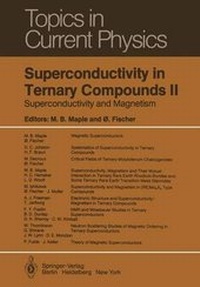
Superconductivity in Ternary Compounds II
Superconductivity and Magnetism
Published on 1. October 1982
Book
Hardback
XVI, 308 pages
978-3-540-11814-5 (ISBN)
Description
With contributions by numerous experts
More details
Other editions
Additional editions
Book
12/2011
Springer
€53.49
Shipment within 7-9 days
Content
1. Magnetic Superconductors.- 1. 1 Introduction.- 1. 2 How The Problem of Magnetic Superconductors Originated.- 1. 3 Pairbreaking Effects - Impurities and External Fields.- 1. 4 Impact of Ternary Rare Earth Compounds.- 1. 5 Antiferromagnetic Superconductors.- 1. 6 Ferromagnetism and Superconductivity.- 1. 7 Superconductivity and Competing Magnetic Interactions.- 1. 8 Concluding Remarks.- References.- 2. Systematics of Superconductivity in Ternary Compounds.- 2. 1 Review of Superconductivity in Ternary Compounds by Structure Class.- 2. 1. 1 Compounds with MT4B4 Stoichiometry.- a) Primitive Tetragonal CeCo4B4 Structure.- b) Body-Centered-Tetragonal LuRu4B4 Structure.- c) Orthorhombic LuRh4B4 Structure.- d) Other MT4B4 Structure Types.- 2. 1. 2 Orthorhombic LuRuB2 Structure.- 2. 1. 3 CeCo3B2 and Related Structures.- a) Hexagonal CeCo3B2 Structure.- b) Monoclinic ErIr3B2 Structure.- c) Hexagonal Ba2/3Pt3B2 and LaRu3Si2 Structures.- d) Other MT3B2 Variants.- e) Hexagonal ZrRuSi Structure.- 2. 1. 4 Primitive Cubic Pr3Rh4Sn13 and Related Structures.- a) Pr3Rh4Sn13 Structure.- b) Ternary Compounds Related to Pr3Rh4Sn13-Type Materials.- 2. 1. 5 Primitive Tetragonal Sc2Fe3Si5 Structure.- 2. 1. 6 Primitive Tetragonal Sc5Co4Si10 Structure.- 2. 2 Concluding Remarks.- 2A. Appendix: Tables of Crystallographic, Superconducting and Magnetic Data for 14 Classes of Ternary Compounds.- References.- 3. Critical Fields of Ternary Molybdenum Chalcogenides.- 3. 1 Overview of Experimental Results.- 3. 2 Summary of Theory.- 3. 2. 1 Ginzburg-Landau Theory.- 3. 2. 2 Microscopic Theory.- a) Isotropic, Weak Coupling Superconductors.- b) Strong-Coupling and Exchange Effects.- c) Anisotropy and Multiband Effects.- 3. 3 The Role of Impurities.- 3. 3. 1 Mo6Se8.- 3. 3. 2 PbMo6S8.- 3. 4 Anisotropy.- 3. 4. 1 MxMo6X8 Compounds.- 3. 4. 2 T?2Mo6Se6.- 3. 5 The Temperature Dependence of Hc2 and the Question of the Paramagnetic Limitation.- 3. 6 Compounds with Magnetic Ions. The Jaccarino-Peter Effect.- 3. 7 Critical Currents and the Problem of Wire Production.- References.- 4. Superconductivity, Magnetism and Their Mutual Interaction in Ternary Rare Earth Rhodium Borides and Some Ternary Rare Earth Transition Metal Stannides.- 4. 1 Background.- 4. 2 Ternary RERh4B4 Compounds.- 4. 2. 1 Nonmagnetic Superconducting RERh4B4 Compounds: RE = Lu, Y.- 4. 2. 2 Rate of Depression of Tc in (Lu1?xREx)Rh4B4.- 4. 2. 3 Ferromagnetic Nonsuperconducting RERh4B4 Compounds: RE = Gd, Tb, Dy, Ho.- 4. 2. 4 Ferromagnetic Superconducting RERh4B4 Compounds: RE = Er.- 4. 2. 5 Antiferromagnetic Superconducting RERh4B4 Compounds: RE = Nd, Sm, Tm.- 4. 3 Pseudoternary RERh4B4 Compounds.- 4. 3. 1 (RE1?xREx')Rh4B4 Compounds.- 4. 3. 2 RE(MxRh1?x)4B4 Compounds.- 4. 4 Ternary REMxSny Compounds.- 4. 5 Summary.- References.- 5. Superconductivity and Magnetism in (RE)Mo6X8 Type Compounds.- 5. 1 Ternaries.- 5. 1. 1 Re-Entrant Superconductors.- 5. 1. 2 Antiferromagnetic Superconductors.- 5. 1. 3 Other Ternaries with Ce, Eu, Tm and Yb.- 5. 2 Pseudoternaries.- 5. 3 Analysis of Upper Critical Field Curves.- 5. 4 Overview of Exchange Interactions in (RE)Mo6X8 Compounds.- 5. 5 Summary.- References.- 6. Electronic Structure and Superconductivity/Magnetism in Ternary Compounds.- 6. 1 Theoretical Approach.- 6. 1. 1 Local Density and Local Spin-Density Formalism.- 6. 1. 2 Linearized Muffin-Tin Orbital Method.- 6. 2 Chevrel Phase Compounds.- 6. 2. 1 Energy Band Calculations.- 6. 2. 2 Results for the Paramagnetic States.- a) Band Structure, Density of States and Resulting Properties.- b) Intra-Cluster Versus Inter-Cluster Effects and Superconductivity.- c) Charge Transfer and Magnetic Isolation.- d) Magnetic Response of Conduction Electrons: Stoner Factor.- e) Superconductivity: Calculation of Electron-Phonon Coupling Parameter ?.- 6. 2. 3 Results for Ferromagnetic Structures.- a) Spin-Polarized Band Structure and Magnetization.- b) Increase of Hc2 with Doping of Magnetic Impurities: Jaccarino-Peter Mechanism.- c) Hyperfine Fields.- 6. 3 Ternary Rhodium Borides.- 6. 3. 1 Energy Band Calculations.- 6. 3. 2 Energy Band Results.- 6. 3. 3 Magnetic Ordering.- 6. 3. 4 Superconductivity.- 6. 3. 5 Effect of Local Moments on Tc.- 6. 3. 6 Re-Entrant Magnetism in ErRh4B4.- 6. 3. 7 Mixed State of Magnetism and Superconductivity in ErRh4B4.- References.- 7 NMR and Mössbauer Studies in Ternary Superconductors.- 7. 1 Mössbauer Effect Studies of Local Vibrational Modes.- 7. 2 Conduction Electron-Local Moment Interactions in Paramagnetic Ternary Compounds.- 7. 2. 1 Chevrel Phases.- 7. 2. 2 Rhodium Borides.- 7. 3 Local Moments in Magnetically Ordered Rare-Earth Compounds.- 7. 3. 1 Hyperfine Fields and Magnetic Moments.- 7. 3. 2 Rare-Earth Rhodium Borides.- 7. 3. 3 Ternary Silicides.- 7. 3. 4 Ternary Stannides and Chevrel Phase Compounds.- 7. 4 Crystal Chemistry and Charge Transfer.- 7. 5 Conclusions.- References.- 8. Neutron Scattering Studies of Magnetic Ordering in Ternary Superconductors.- 8. 1 Neutron Scattering Theory.- 8. 1. 1 Coherent Bragg Diffraction.- 8. 1. 2 Phase Transitions and Critical Scattering.- 8. 2 Antiferromagnetic Superconductors.- 8. 2. 1 Magnetic Structures.- 8. 2. 2 Magnetic Moment and Spin Direction.- 8. 2. 3 Magnetic Field Dependence.- 8. 3 Ferromagnetic Superconductors.- 8. 3. 1 Ferromagnetic State.- 8. 3. 2 Oscillatory Behavior.- References.- 9. Theory of Magnetic Superconductors.- 9. 1 Influence of Spin Scattering on Superconductivity.- 9. 1. 1 Electron-Spin Susceptibility.- a) No Spin-Orbit and Exchange Scattering.- b) Finite Spin-Orbit and Exchange Scattering.- 9. 1. 2 Paramagnetic Phase.- a) Static Approximation.- b) Dynamic Correlations.- 9. 1. 3 Magnetically-Ordered Systems.- a) Uniform Exchange Field.- b) Antiferromagnetic Order.- 9. 2 Magnetic Structures in Superconductors Resulting From Exchange Interactions.- 9. 2. 1 Anderson-Suhl Cryptoferromagnetism.- 9. 2. 2 Ginzburg-Landau Regime.- 9. 2. 3 Phase Diagram for Cryptoferromagnetic Spin Structures.- 9. 3 The Magnetic State in the Presence of Electromagnetic Coupling.- 9. 3. 1 Ginzburg-Landau Functional.- 9. 3. 2 Survey of Solutions of the Ginzburg-Landau Equations.- 9. 3. 3 Inhomogeneous Phases.- a) Blount-Varma Theory.- b) Vortex States.- c) Influence of Fluctuations.- 9. 4 Alternative Forms of Pairing States.- 9. 4. 1 Ground States with Finite Pairing Momentum.- 9. 4. 2 P-Wave Pairing.- References.- Additional References with Titles.