

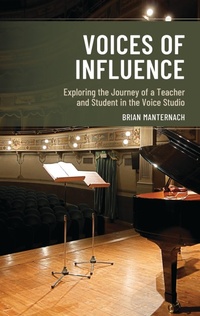
Voices of Influence
Exploring the Journey of a Teacher and Student in the Voice Studio
Published on 13. November 2025
Book
Hardback
200 pages
979-8-7651-4612-5 (ISBN)
Description
Brian Manternach examines the dynamic relationship of influence between teacher and student in the voice studio. Relating personal stories and formative experiences, the book is part pedagogical guide, part memoir, and part exploration of how vocal philosophies and practices evolve as they are passed from teacher to student.
Part One introduces readers to noted voice professor Robert J. Harrison, exploring biographical elements that have formed how he thinks, what he believes, and how that has informed his life as an artist and as a teacher. Part Two examines Harrison's teaching approaches, including tactics he used in the voice studio to address aspects of respiration, phonation, resonance, registration, and articulation. It also discusses how Harrison taught artistry, from how he defines his own musical tastes and sensibilities to how he taught communicative singing. Part Three presents the complicated idea of "legacy," considering how we might remember teachers and their influence once their formal instruction has concluded. Manternach also considers how to contextualize the work of teachers from previous generations to fairly assess their contributions.
Along the way, Manternach describes how he has been influenced by Harrison now that he is a teacher himself. He outlines areas of pedagogical agreement as well as disagreement and indicates how-through the educational chain of succession-some of Harrison's practices are passed on practically verbatim while others have necessarily evolved in order to serve the current generation of students.
Part One introduces readers to noted voice professor Robert J. Harrison, exploring biographical elements that have formed how he thinks, what he believes, and how that has informed his life as an artist and as a teacher. Part Two examines Harrison's teaching approaches, including tactics he used in the voice studio to address aspects of respiration, phonation, resonance, registration, and articulation. It also discusses how Harrison taught artistry, from how he defines his own musical tastes and sensibilities to how he taught communicative singing. Part Three presents the complicated idea of "legacy," considering how we might remember teachers and their influence once their formal instruction has concluded. Manternach also considers how to contextualize the work of teachers from previous generations to fairly assess their contributions.
Along the way, Manternach describes how he has been influenced by Harrison now that he is a teacher himself. He outlines areas of pedagogical agreement as well as disagreement and indicates how-through the educational chain of succession-some of Harrison's practices are passed on practically verbatim while others have necessarily evolved in order to serve the current generation of students.
Reviews / Votes
Voices of Influence is a beautifully written text that delves into the very personal relationships that are possible between student and teacher. * Journal of Singing * Consider it a deep dive into what we love most about our profession ... Voices of Influence is a welcome outlet to further reflect on influence and legacy and had me wishing that I could call other teachers to thank them. * VoicePrints *More details
Series
Language
English
Place of publication
New York
United States
Publishing group
Bloomsbury Publishing Plc
Target group
Professional and scholarly
Illustrations
1 b/w illustration, 10 b/w photographs
Dimensions
Height: 235 mm
Width: 157 mm
Thickness: 15 mm
Weight
448 gr
ISBN-13
979-8-7651-4612-5 (9798765146125)
Copyright in bibliographic data and cover images is held by Nielsen Book Services Limited or by the publishers or by their respective licensors: all rights reserved.
Schweitzer Classification
Persons
Brian Manternach is an Associate Professor at the University of Utah's Department of Theatre and a Research Associate at the Utah Center for Vocology, where he serves on the faculty of the Summer Vocology Institute. He is an Associate Editor of the Journal of Singing and a columnist for Classical Singer. His research, reviews, articles, and essays have appeared in numerous voice-related publications.
Content
Preface:
Foreword
Acknowledgments
Introduction: Like Teacher, Like Student: Pedagogy Through Story and Personal History
Part One: The Journey
Chapter 1: When the Student is Ready, the Teacher Will Appear: Finding the Right Fit
Chapter 2: Early Influences and Examples: The Importance of Curiosity, Mentors, and Role Models
Chapter 3: Professional Life: Being in the Right Place at the Right Time, Dealing with Rejection, and Personal Sacrifice for Professional Gain
Part Two: Lessons, Philosophies, and Practices
Chapter 4: Embracing Eccentricities: "Sometimes, to make a point, you have to make a circus."
Chapter 5: Developing a Detail-Oriented Mind: Learning via the Senses
Chapter 6: "What is an Art Song Anyway?": Intellectual Enlightenment and Musical Bias
Chapter 7: Teaching Artistry: Seeking Selfless Communication
Chapter 8: Respiration: No Air, No Sound
Chapter 9: Balanced Phonation: SOVTEs, Negotiating the Passaggio, and Exercising the Whole Voice
Chapter 10: A Vowel-Based Approach to Resonance: Assessing Pressure Versus Flow
Chapter 11: Choosing Purposeful Exercises: Listening as the First Step to Problem Solving
Chapter 12: Learning, Questioning, and Dealing with Doubt: "Verify It."
Chapter 13: Prioritizing Teaching: Professing Truth
Chapter 14: What Makes a Good Student? What Makes a Good Teacher?
Part Three: Legacy
Chapter 15: On the Shoulders of Giants: Assessing, Evaluating, and Citing
Chapter 16: How to Fairly Evaluate: Contextualizing a Career
Chapter 17: Judicious Emulation: When to Turn Away from What We Were Taught
Chapter 18: Conclusion: My Teacher's Student
APPENDIX I: Nacht und Traeume
APPENDIX II: A Brief Timeline of the Life and Career of Dr. Robert J. Harrison
APPENDIX III: Final Quotes
Bibliography
About the Contributors
Index
Foreword
Acknowledgments
Introduction: Like Teacher, Like Student: Pedagogy Through Story and Personal History
Part One: The Journey
Chapter 1: When the Student is Ready, the Teacher Will Appear: Finding the Right Fit
Chapter 2: Early Influences and Examples: The Importance of Curiosity, Mentors, and Role Models
Chapter 3: Professional Life: Being in the Right Place at the Right Time, Dealing with Rejection, and Personal Sacrifice for Professional Gain
Part Two: Lessons, Philosophies, and Practices
Chapter 4: Embracing Eccentricities: "Sometimes, to make a point, you have to make a circus."
Chapter 5: Developing a Detail-Oriented Mind: Learning via the Senses
Chapter 6: "What is an Art Song Anyway?": Intellectual Enlightenment and Musical Bias
Chapter 7: Teaching Artistry: Seeking Selfless Communication
Chapter 8: Respiration: No Air, No Sound
Chapter 9: Balanced Phonation: SOVTEs, Negotiating the Passaggio, and Exercising the Whole Voice
Chapter 10: A Vowel-Based Approach to Resonance: Assessing Pressure Versus Flow
Chapter 11: Choosing Purposeful Exercises: Listening as the First Step to Problem Solving
Chapter 12: Learning, Questioning, and Dealing with Doubt: "Verify It."
Chapter 13: Prioritizing Teaching: Professing Truth
Chapter 14: What Makes a Good Student? What Makes a Good Teacher?
Part Three: Legacy
Chapter 15: On the Shoulders of Giants: Assessing, Evaluating, and Citing
Chapter 16: How to Fairly Evaluate: Contextualizing a Career
Chapter 17: Judicious Emulation: When to Turn Away from What We Were Taught
Chapter 18: Conclusion: My Teacher's Student
APPENDIX I: Nacht und Traeume
APPENDIX II: A Brief Timeline of the Life and Career of Dr. Robert J. Harrison
APPENDIX III: Final Quotes
Bibliography
About the Contributors
Index