

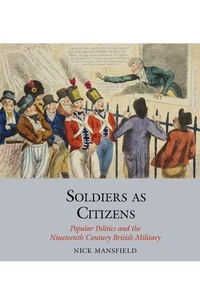
Soldiers as Citizens
Popular Politics and the Nineteenth-Century British Military
Published on 20. September 2019
Book
Hardback
264 pages
978-1-78962-086-3 (ISBN)
Description
Rank and file soldiers were not 'the scum of the earth' but included a cross section of working-class men, who retained their former civilian culture. While they often exhibited pride in regiment and nation, soldiers could also demonstrate a growing class consciousness and support for political radicalism.
The book will challenge assumptions that the British army was politically neutral, if privately conservative, by uncovering a rich vein of liberal and radical political thinking among some soldiers, officers and political commentators. This ranges from the Whig 'militia' tradition, through radical theories on tactics and army reform, to attempted ultra-radical subversion amongst troops, and the involvement of soldiers in riots and risings. Case studies are given of individual 'military radicals', soldiers or ex-soldiers who were reforming and later socialist activists.
Popular anti-French feeling of the Napoleonic Wars is examined, alongside examples of rank and file bravery which fostered widespread loyalty and patriotism. This contributed to soldiers being used successfully in strike breaking, and deployed against rioters or Chartist revolts. By the late Victorian period, popular imperialism was an important part of working-class support for Conservatism. The book explores what impact this had on rank and file soldiers, whilst outlining minority support for socialism.
The book will challenge assumptions that the British army was politically neutral, if privately conservative, by uncovering a rich vein of liberal and radical political thinking among some soldiers, officers and political commentators. This ranges from the Whig 'militia' tradition, through radical theories on tactics and army reform, to attempted ultra-radical subversion amongst troops, and the involvement of soldiers in riots and risings. Case studies are given of individual 'military radicals', soldiers or ex-soldiers who were reforming and later socialist activists.
Popular anti-French feeling of the Napoleonic Wars is examined, alongside examples of rank and file bravery which fostered widespread loyalty and patriotism. This contributed to soldiers being used successfully in strike breaking, and deployed against rioters or Chartist revolts. By the late Victorian period, popular imperialism was an important part of working-class support for Conservatism. The book explores what impact this had on rank and file soldiers, whilst outlining minority support for socialism.
Reviews / Votes
Reviews'A very interesting and insightful book that makes a significant contribution to the fields of both labour and military history.'
Professor Keith Gildart, University of Wolverhampton 'Mansfield challenges the complacent vision of the soldiery as apathetic and complicates the presumption that all military officers were staunchly conservative.'
Joe Cozens, Labour History Review 'There is much to recommend in this book... regarded on its own merits it represents a novel and important contribution to the history of soldiering in the early nineteenth century.'
Loughlin Sweeney, English Historical Review 'The author approaches this undertaking with both aplomb and honesty, and defends his convictions with refreshingly clear prose.'
R. T. Ingoglia, CHOICE
More details
Series
Language
English
Place of publication
Liverpool
United Kingdom
Target group
Professional and scholarly
Illustrations
7 Illustrations, black and white
Dimensions
Height: 162 mm
Width: 241 mm
Thickness: 18 mm
Weight
526 gr
ISBN-13
978-1-78962-086-3 (9781789620863)
Copyright in bibliographic data and cover images is held by Nielsen Book Services Limited or by the publishers or by their respective licensors: all rights reserved.
Schweitzer Classification
Person
Nick Mansfield is Senior Research Fellow in History at the University of Central Lancashire, Preston.
Content
List of Abbreviations List of IllustrationsIntroduction Politics and the military, 1790-1832 Radicalism and the military, 1790-1860Protest and subversion, 1790-1850Military radicals, 1790-1850Overseas military adventurers, 1770-1861Loyalism, nationalism and the army, 1790-1860Popular imperialism, democracy, conservatism and socialism, 1860-1900ConclusionBibliographyIndex