

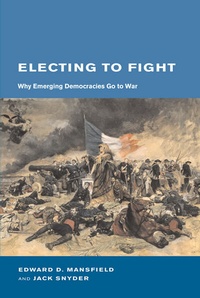
Electing to Fight
Why Emerging Democracies Go To War
Published on 1. April 2005
Book
Hardback
320 pages
978-0-262-13449-1 (ISBN)
Description
Does the spread of democracy really contribute to international peace?
Successive U. S. administrations have justified various policies intended to promote
democracy not only by arguing that democracy is intrinsically good but by pointing
to a wide range of research concluding that democracies rarely, if ever, go to war
with one another. To promote democracy, the United States has provided economic
assistance, political support, and technical advice to emerging democracies in
Eastern and Central Europe, and it has attempted to remove undemocratic regimes
through political pressure, economic sanctions, and military force. In Electing to
Fight, Edward Mansfield and Jack Snyder challenge the widely accepted basis of these
policies by arguing that states in the early phases of transitions to democracy are
more likely than other states to become involved in war.Drawing on both qualitative
and quantitative analysis, Mansfield and Snyder show that emerging democracies with
weak political institutions are especially likely to go to war. Leaders of these
countries attempt to rally support by invoking external threats and resorting to
belligerent, nationalist rhetoric. Mansfield and Snyder point to this pattern in
cases ranging from revolutionary France to contemporary Russia. Because the risk of
a state's being involved in violent conflict is high until democracy is fully
consolidated, Mansfield and Snyder argue, the best way to promote democracy is to
begin by building the institutions that democracy requires -- such as the rule of
law -- and only then encouraging mass political participation and elections. Readers
will find this argument particularly relevant to prevailing concerns about the
transitional government in Iraq. Electing to Fight also calls into question the
wisdom of urging early elections elsewhere in the Islamic world and in
China.
Successive U. S. administrations have justified various policies intended to promote
democracy not only by arguing that democracy is intrinsically good but by pointing
to a wide range of research concluding that democracies rarely, if ever, go to war
with one another. To promote democracy, the United States has provided economic
assistance, political support, and technical advice to emerging democracies in
Eastern and Central Europe, and it has attempted to remove undemocratic regimes
through political pressure, economic sanctions, and military force. In Electing to
Fight, Edward Mansfield and Jack Snyder challenge the widely accepted basis of these
policies by arguing that states in the early phases of transitions to democracy are
more likely than other states to become involved in war.Drawing on both qualitative
and quantitative analysis, Mansfield and Snyder show that emerging democracies with
weak political institutions are especially likely to go to war. Leaders of these
countries attempt to rally support by invoking external threats and resorting to
belligerent, nationalist rhetoric. Mansfield and Snyder point to this pattern in
cases ranging from revolutionary France to contemporary Russia. Because the risk of
a state's being involved in violent conflict is high until democracy is fully
consolidated, Mansfield and Snyder argue, the best way to promote democracy is to
begin by building the institutions that democracy requires -- such as the rule of
law -- and only then encouraging mass political participation and elections. Readers
will find this argument particularly relevant to prevailing concerns about the
transitional government in Iraq. Electing to Fight also calls into question the
wisdom of urging early elections elsewhere in the Islamic world and in
China.
More details
Series
Language
English
Place of publication
Cambridge, Mass.
United States
Publishing group
MIT Press Ltd
Target group
Professional and scholarly
Illustrations
Illustrations
Dimensions
Height: 229 mm
Width: 152 mm
Thickness: 19 mm
Weight
612 gr
ISBN-13
978-0-262-13449-1 (9780262134491)
Copyright in bibliographic data and cover images is held by Nielsen Book Services Limited or by the publishers or by their respective licensors: all rights reserved.
Schweitzer Classification
Persons
Edward D. Mansfield is Hum Rosen Professor of Political Science at the University of Pennsylvania. He is the author of Power, Trade, and War and International Conflict and the Global Economy .
Jack Snyder is the Robert and Renée Belfer Professor of International Relations at Columbia University. He is the author of From Voting to Violence: Democratization and Nationalist Conflict ; Myths of Empire: Domestic Politics and International Ambition ; and The Ideology of the Offensive: Military Decision Making and the Disasters of 1914 .
Jack Snyder is the Robert and Renée Belfer Professor of International Relations at Columbia University. He is the author of From Voting to Violence: Democratization and Nationalist Conflict ; Myths of Empire: Domestic Politics and International Ambition ; and The Ideology of the Offensive: Military Decision Making and the Disasters of 1914 .