

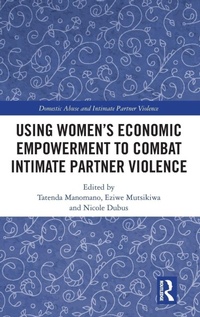
Using Women's Economic Empowerment to Combat Intimate Partner Violence
1st Edition
Published on 18. March 2026
Book
Hardback
280 pages
978-1-041-11341-6 (ISBN)
Description
This book explores the link between women's economic empowerment and intimate partner violence (IPV) reduction by analysing how economic independence and access to resources empower women to address and escape abusive situations.
Examining the systemic barriers that hinder progress, such as cultural norms, legal constraints, and gaps in social protection systems, it offers evidence-based analysis and practical recommendations including microfinance, skill-building initiatives, and community-based programmes, to create a vital resource for policymakers, social workers, and advocates committed to creating safer, more equitable communities. IPV remains a pervasive challenge in the 21st century, profoundly affecting individuals, families, and societies across the globe. Its far-reaching consequences undermine not only the safety and well-being of victims but also broader efforts towards gender equality and social justice.
Combining insights from economics, gender, social work, sociology and development studies as well as mental health, this book offers a way forward and will be of interest to all scholars, students and professionals working in these areas.
Examining the systemic barriers that hinder progress, such as cultural norms, legal constraints, and gaps in social protection systems, it offers evidence-based analysis and practical recommendations including microfinance, skill-building initiatives, and community-based programmes, to create a vital resource for policymakers, social workers, and advocates committed to creating safer, more equitable communities. IPV remains a pervasive challenge in the 21st century, profoundly affecting individuals, families, and societies across the globe. Its far-reaching consequences undermine not only the safety and well-being of victims but also broader efforts towards gender equality and social justice.
Combining insights from economics, gender, social work, sociology and development studies as well as mental health, this book offers a way forward and will be of interest to all scholars, students and professionals working in these areas.
More details
Series
Language
English
Place of publication
London
United Kingdom
Publishing group
Taylor & Francis Ltd
Target group
College/higher education
Professional and scholarly
Postgraduate
Illustrations
1 s/w Photographie bzw. Rasterbild, 9 s/w Zeichnungen, 6 s/w Tabellen, 10 s/w Abbildungen
6 Tables, black and white; 9 Line drawings, black and white; 1 Halftones, black and white; 10 Illustrations, black and white
Dimensions
Height: 240 mm
Width: 161 mm
Thickness: 21 mm
Weight
622 gr
ISBN-13
978-1-041-11341-6 (9781041113416)
Copyright in bibliographic data and cover images is held by Nielsen Book Services Limited or by the publishers or by their respective licensors: all rights reserved.
Schweitzer Classification
Other editions
Additional editions
Tatenda Manomano | Eziwe Mutsikiwa | Nicole Dubus
Using Women's Economic Empowerment to Combat Intimate Partner Violence
E-Book
03/2026
Routledge
€60.49
Available for download
Tatenda Manomano | Eziwe Mutsikiwa | Nicole Dubus
Using Women's Economic Empowerment to Combat Intimate Partner Violence
E-Book
03/2026
Routledge
€60.49
Available for download
Persons
Tatenda Manomano is the discipline lead in Social Work and a senior lecturer in the Australian College of Applied Professions University College, as well as a research fellow at the University of the Free State.
Eziwe Mutsikiwa is a research, monitoring and evaluation and gender expert consultant in Zimbabwe with significant research experience in issues that involve women and intimate partner violence and children.
Nicole Dubus is a Professor of Social Work at San Jose University in the United States of America.
Eziwe Mutsikiwa is a research, monitoring and evaluation and gender expert consultant in Zimbabwe with significant research experience in issues that involve women and intimate partner violence and children.
Nicole Dubus is a Professor of Social Work at San Jose University in the United States of America.
Content
1.Addressing Intimate Partner Violence Globally: Women's Economic Empowerment as a Comprehensive Tool for Prevention and Response. Section I - Foundational Concepts and Contributing Factors to IPV. 2.Understanding Intimate Partner Violence: Fundamental Causes and Systemic Barriers to Support Services. 3.Distinctive characteristics of Intimate Partner Violence and the power dynamics that underpin abusive relationships. 4.The Public Display and Normalisation of Intimate Partner Violence in South Africa. 5.Transformative Education and Awareness. Section II - Exploring Solutions and Empowerment Models. 6.Dimensions of Empowerment: Economic, Social-Cultural, Legal, Psychological, and Political Perspectives. 7.The Role of Empowerment in Addressing Intimate Partner Violence. 8.Building Social Networks and Support systems. 9.Emotional Intelligence in Preventing the Recurrence of Intimate Partner Violence. 10.Economic empowerment tools to support female victims of intimate partner violence: Suggestions for social work support. 11.Interagency Collaboration as a Catalyst for Victim Empowerment in South Africa. 12.Engaging South Sudanese Men and Boys in Breaking the Cycle of Intimate Partner Violence. 13.The role of Men (and boys) in breaking the cycle of intimate partner violence in South Africa. 14.Youth, Gender, and Intimate Partner Violence: Lessons from an Australian Community-Based Intervention. Section III - Critiques, Gaps, and Future Directions. 15.The Role of an Ubuntu Model as a Holistic Approach to Challenging Power Imbalances. 16.Using the victim-survivor approach to empower victim-survivors of IPV in South Africa. 17.The Dark Side of Microfinance: Predatory Lending, Violence Against Women, and Modern Slavery. 18.Strengthening the Homefront: Examining the Potential of Economic Empowerment in Responding to Domestic and Family Violence in Military Families. 19.Recovering and Rebuilding the Lives of Women with Disabilities who are Survivors of Intimate Partner Violence. 20.Holistic Healing, Intimate Partner Violence, and Women's Economic Empowerment. 21.Navigating the Legal Landscape: Federal and State Policy Responses to Domestic and Intimate Partner Violence in the United States. 22.No One Left Behind? Intimate Partner Violence and Australia's Policy Responses and Progress Towards the Sustainable Development Goals. 23.Towards the social inclusion and empowerment of women from refugee and migrant backgrounds in non-metropolitan Australian communities. 24.Empowerment as a Tool for Economic Equity. 25.Roadmap for Future Action. 26.Conclusion.