

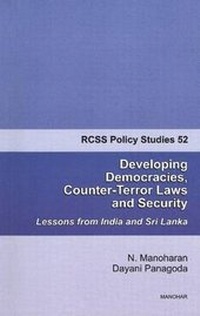
Developing Democracies, Counter-Terror Laws & Security
Lessons from India & Sri Lanka
Published on 25. February 2013
Book
Paperback/Softback
106 pages
978-81-7304-990-3 (ISBN)
Description
Terrorism raises genuine security concerns that the state attempts to address through various measures. The use of counter-terrorism legislation is one such means, employed especially by democracies. The basic rationale is that the legal framework deals with terrorism, which is considered undemocratic, in a democratic way. In other words, legislation ought to adequately deter terrorist groups, but at the same time, prevail on the State from encroaching on human rights of the innocents. The key questions addressed in this study are: Do counter-terrorism laws enhance security? If so, in what manner? If not, why and what are the problems involved? The study assumes that there is an inherent tension between State security and the security of its subjects. Measures like counter-terror legislation imposed for safeguarding State security end up eroding the basic rights of the individuals and ultimately threatening the comprehensive security' of the State. Comparative analyses of linkage between counter-terror laws and security in India and Sri Lanka -- two important cases of 'developing democracies' that witnessed terrorism and political violence -- throw many interesting findings. Jointly undertaken by two leading scholars of India and Sri Lanka, the study intends to fill the gap in the existing literature on legal aspects of terrorism & counter-terrorism. Published in association with Regional Centre for Strategic Studies, Colombo.
More details
Language
English
Place of publication
New Delhi
India
Dimensions
Height: 215 mm
Width: 140 mm
Weight
152 gr
ISBN-13
978-81-7304-990-3 (9788173049903)
Copyright in bibliographic data and cover images is held by Nielsen Book Services Limited or by the publishers or by their respective licensors: all rights reserved.
Schweitzer Classification
Persons
N. Manoharan is currently Senior Fellow & Head, Internal Security Programme, at the Vivekananda International Foundation, New Delhi. His areas of interest include internal security, terrorism, Sri Lanka, Maldives, human rights, ethnic conflicts, multiculturalism, security secor reforms and conflict resolution. His recent books include Security Deficit': A Comprehensive Internal Security Strategy for India (2012) and India's War on Terror (2010). Dayani Panagoda is currently National Technical Advisor attached to the GIZ/FLICT/Ministry of National Languages and Social Integration in Sri Lanka. Her areas of interest are in Counter Terrorism, Insurgency and Civil-Military Relations, Conflict Resolution, Peace Studies (Negotiating and Mediation), International Relations and International Trade Law, Democratization and Human Rights Policy and Strategic Planning on Post War Early Recovery, Disarmament Demobilization and Reintegration, Security Sector Reforms and Social Integration.
Content
Introduction; Counter-Terror Laws & Security in Developing Democracies: An Analytical Construct; India: A Case Study; Sri Lanka: A Case Study; Were Counter-terror Laws Able to Augment Security?; Conclusion.