

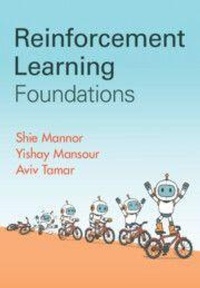
Reinforcement Learning Foundations
Will be published approx. on 31. July 2026
Book
Hardback
350 pages
978-1-009-71110-4 (ISBN)
Description
Bridging the gap between introductory texts and the specialized research literature, this is one of the first truly rigorous yet accessible treatments of modern reinforcement learning. Written by three leading researchers with over a decade of teaching experience, the book uniquely combines mathematical precision with practical insights. It progresses naturally from planning (dynamic programming, MDPs, value and policy iteration) to learning (model-based and model-free algorithms, function approximation, policy gradients, and regret minimization). Each concept is developed from first principles with complete proofs, making the material self-contained. The modular chapter organization enables flexible course design. The book's website offers battle-tested exercises refined through years of classroom use. Combining mathematical rigor with practical applications, this definitive text is ideal for advanced undergraduate and graduate students as well as practitioners seeking a deep understanding of sequential decision-making and intelligent agent design.
Reviews / Votes
'Written by world-class experts Mannor, Mansour, and Tamar, Reinforcement Learning: Foundations is a masterclass in the field. It covers essential topics comprehensively and accessibly, while brilliantly conveying the underlying intuition behind complex concepts, proofs, and algorithms. This is an essential, self-contained guide for both students and researchers.' Mehryar Mohri, Google Research and Courant Institute of Mathematical Sciences 'Reinforcement Learning Foundations offers a rare combination of rigor, clarity, and insight. It builds a deep understanding of the principles that underlie modern reinforcement learning, making it essential reading not only for students and researchers, but also for practitioners who want to move beyond recipes and gain real conceptual understanding of the field.' Pieter Abbeel, University of California, Berkeley 'This book is a clear, rigorous, and remarkably comprehensive treatment of reinforcement learning. Starting from fundamental concepts such as shortest paths on graphs and Markov chains, the authors connect planning, learning, approximation, and regret minimization with exceptional pedagogical skill. It will be invaluable to students, researchers, and instructors seeking a principled introduction to modern RL.' Nicolo Cesa-Bianchi, University of Milan, ItalyMore details
Language
English
Place of publication
Cambridge
United Kingdom
Target group
College/higher education
Professional and scholarly
Illustrations
Worked examples or Exercises
ISBN-13
978-1-009-71110-4 (9781009711104)
Copyright in bibliographic data and cover images is held by Nielsen Book Services Limited or by the publishers or by their respective licensors: all rights reserved.
Schweitzer Classification
Persons
Shie Mannor is a professor at Technion's Electrical and Computer Engineering faculty, Chief Scientist and co-founder of Jether Energy Research, Distinguished Scientist at Nvidia, and an IEEE Fellow. A pioneer in reinforcement learning, planning, and control, he bridges theory and practice with over 330 papers and 35,000 citations. Yishay Mansour is a professor at the Blavatnik School of Computer Science, Tel Aviv University, and is an ACM Fellow. An early pioneer in machine learning theory, reinforcement learning, algorithmic game theory, and theory of computing at large, he has authored over 300 papers with over 40,000 citations on those topics. Aviv Tamar is Associate Professor of Electrical and Computer Engineering at the Technion. He studies how machines learn to act and perceive. His research in reinforcement learning, representation learning, and robotics has led to over 70 publications, 17,000 citations, and multiple best-paper awards and distinctions.
Content
1. Introduction and overview; 2. Preface to the planning chapters; 3. Deterministic decision processes; 4. Markov chains; 5. Markov decision processes and finite horizon dynamic programming; 6. Discounted Markov decision processes; 7. Episodic Markov decision processes; 8. Linear programming solutions; 9. Preface to the learning chapters; 10. Reinforcement learning: model based; 11. Reinforcement learning: model free; 12. Large state spaces: value function approximation; 13. Large state space: policy gradient methods; 14. Regret minimization; A. Dynamic programming; B. Ordinary differential equations; References; Index.