

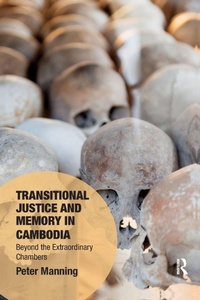
Transitional Justice and Memory in Cambodia
Beyond the Extraordinary Chambers
1st Edition
Published on 18. October 2018
Book
Paperback/Softback
180 pages
978-0-367-08548-3 (ISBN)
Description
Memories of violence, suffering and atrocities in Cambodia are today being pulled in different directions. A range of transitional justice practices have been put to work in the name of redressing, restoring and renewing memory. At the centre of this stage is the Extraordinary Chambers in the Courts of Cambodia (ECCC), a hybrid tribunal established to prosecute the leaders of the Khmer Rouge regime, under which 1.6 million Cambodians died of hunger or disease or were executed.
This book unpicks the way memory is reconstructed through appeals to a national memory, the legal reframing and coding of memories as crimes, and bids to locate personal memories within collective biographies. Analysing the techniques and interventions of the ECCC, as well as exploring the role of non-governmental organisations (NGOs), the book explores the relationships in which Cambodian communities navigate memories of political violence. This book is essential for understanding transitional justice in Cambodia in, and beyond, the courtroom. Transitional Justice and Memory in Cambodia shows that the governing logic of transitional justice interventions - that societies are unable to 'deal with' memories of atrocity and violence without some form of transitional justice mechanism - neglects the complexity of memory and remembering in post-atrocity contexts and the agency of the subjects to which such mechanisms are addressed.
Drawing on documentary sources, legal transcripts, interviews and participant observation data, the book situates transitional justice processes in Cambodia within a wider context of social and cultural memory politics, examining (old and new) conflicts of memory that have emerged between the varied accounts and uses of the past that exist in Cambodia now. As such, it will appeal to students and scholars in sociology, human rights, law and criminology.
This book unpicks the way memory is reconstructed through appeals to a national memory, the legal reframing and coding of memories as crimes, and bids to locate personal memories within collective biographies. Analysing the techniques and interventions of the ECCC, as well as exploring the role of non-governmental organisations (NGOs), the book explores the relationships in which Cambodian communities navigate memories of political violence. This book is essential for understanding transitional justice in Cambodia in, and beyond, the courtroom. Transitional Justice and Memory in Cambodia shows that the governing logic of transitional justice interventions - that societies are unable to 'deal with' memories of atrocity and violence without some form of transitional justice mechanism - neglects the complexity of memory and remembering in post-atrocity contexts and the agency of the subjects to which such mechanisms are addressed.
Drawing on documentary sources, legal transcripts, interviews and participant observation data, the book situates transitional justice processes in Cambodia within a wider context of social and cultural memory politics, examining (old and new) conflicts of memory that have emerged between the varied accounts and uses of the past that exist in Cambodia now. As such, it will appeal to students and scholars in sociology, human rights, law and criminology.
More details
Series
Language
English
Place of publication
London
United Kingdom
Publishing group
Taylor & Francis Ltd
Target group
College/higher education
Dimensions
Height: 234 mm
Width: 156 mm
Thickness: 10 mm
Weight
286 gr
ISBN-13
978-0-367-08548-3 (9780367085483)
Copyright in bibliographic data and cover images is held by Nielsen Book Services Limited or by the publishers or by their respective licensors: all rights reserved.
Schweitzer Classification
Other editions
Additional editions
E-Book
06/2017
Routledge
€64.49
Available for download
E-Book
06/2017
Routledge
€64.49
Available for download
Book
05/2017
1st Edition
Routledge
€237.70
Shipment within 10-20 days
Person
Peter Manning is Lecturer in Sociology at the University of Bath. Peter has previously lectured in sociology at Liverpool Hope University and at the Centre for the Study of Human Rights at the London School of Economics, where he was awarded a PhD in 2014.
Content
Acknowledgements
Chapter 1. Introduction
Chapter 2. Transitional justice and memory
Chapter 3. Political violence in Cambodia
Chapter 4. Moving forward through justice
Chapter 5. Memory on trial
Chapter 6. Complementary knowledge
Chapter 7. Victims and perpetrators
Chapter 8. Beyond the tribunal
Chapter 9. Remembering the Khmer Rouge Tribunal
Index
Chapter 1. Introduction
Chapter 2. Transitional justice and memory
Chapter 3. Political violence in Cambodia
Chapter 4. Moving forward through justice
Chapter 5. Memory on trial
Chapter 6. Complementary knowledge
Chapter 7. Victims and perpetrators
Chapter 8. Beyond the tribunal
Chapter 9. Remembering the Khmer Rouge Tribunal
Index