

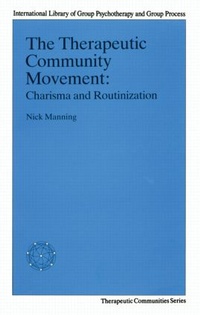
The Therapeutic Community Movement
Charisma and Routinisation
1st Edition
Published on 16. February 1989
Book
Paperback/Softback
256 pages
978-0-415-03057-1 (ISBN)
Description
There are now more than 1000 therapeutic communites world wide. Yet the fervour which heralded the approach has cooled. Nick Manning tells the story of the therapeutic community movement. Against this background he provides a new analysis of the leading British community, the Henderson Hospital, and examines the development of community based therapeutic communities in Australia by the Richmond fellowship. A statistical evaluation of the effectiveness of the latter is provided. Considerable attention is paid to recent sociology, psychology and critical theory as a basis for reinvigorating therapeutic community work in the changing context of the 1990s is provided.
Reviews / Votes
`Nick Manning has produced an excellent book which puts the therapeutic community movement into a much clearer perspective. He charts the origins and subsequent developent of the movement, using modern social theories.' - Nursing TimesMore details
Language
English
Place of publication
London
United Kingdom
Publishing group
Taylor & Francis Ltd
Target group
College/higher education
Dimensions
Height: 216 mm
Width: 138 mm
Weight
470 gr
ISBN-13
978-0-415-03057-1 (9780415030571)
Copyright in bibliographic data and cover images is held by Nielsen Book Services Limited or by the publishers or by their respective licensors: all rights reserved.
Schweitzer Classification
Other editions
Additional editions
E-Book
11/2013
1st Edition
Routledge
€36.99
Available for download
E-Book
11/2013
1st Edition
Routledge
€36.99
Available for download
Book
02/1989
1st Edition
Routledge
€133.69
Article not available at the moment
Person
Manning, Nick
Content
Chapter 1 The origins of the therapeutic community; Chapter 2 The growth and spread of therapeutic communities; Chapter 3 Social theory and the therapeutic community; Chapter 4 The therapeutic community at Belmont; Chapter 5 The therapeutic community in Australia; Chapter 6 Towards a sociology of the therapeutic community;