

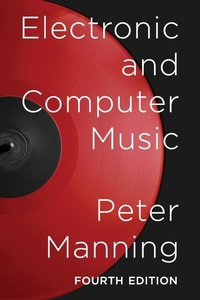
Electronic and Computer Music
4th Edition
Published on 25. April 2013
Book
Paperback/Softback
576 pages
978-0-19-974639-2 (ISBN)
Description
In this new edition of the classic text on the history and evolution of electronic music, Peter Manning extends the definitive account of the medium from its birth to include key developments from the dawn of the 21st century to the present day.
After explaining the antecedents of electronic music from the turn of the 20th century to the Second World War, Manning discusses the emergence of the early 'classical' studios of the 1950s, and the subsequent evolution of more advanced analogue technologies during the 1960s and '70s, leading in turn to the birth and development of the MIDI synthesizer. Attention then turns to the characteristics of the digital revolution, from the pioneering work of Max Mathews at Bell Telephone Laboratories in the 1950s to the wealth of resources available today, facilitated by the development of the personal computer and allied digital technologies. The scope and extent of the technical and creative developments that have taken place since the late 1990s are considered in an extended series of new and updated chapters. These include topics such as the development of the digital audio workstation, laptop music, the Internet, and the emergence of new performance interfaces.
Manning offers a critical perspective of the medium in terms of the philosophical and technical features that have shaped its growth. Emphasizing the functional characteristics of emerging technologies and their influence on the creative development of the medium, Manning covers key developments in both commercial and the non-commercial sectors to provide readers with the most comprehensive resource available on the evolution of this ever-expanding area of creativity.
After explaining the antecedents of electronic music from the turn of the 20th century to the Second World War, Manning discusses the emergence of the early 'classical' studios of the 1950s, and the subsequent evolution of more advanced analogue technologies during the 1960s and '70s, leading in turn to the birth and development of the MIDI synthesizer. Attention then turns to the characteristics of the digital revolution, from the pioneering work of Max Mathews at Bell Telephone Laboratories in the 1950s to the wealth of resources available today, facilitated by the development of the personal computer and allied digital technologies. The scope and extent of the technical and creative developments that have taken place since the late 1990s are considered in an extended series of new and updated chapters. These include topics such as the development of the digital audio workstation, laptop music, the Internet, and the emergence of new performance interfaces.
Manning offers a critical perspective of the medium in terms of the philosophical and technical features that have shaped its growth. Emphasizing the functional characteristics of emerging technologies and their influence on the creative development of the medium, Manning covers key developments in both commercial and the non-commercial sectors to provide readers with the most comprehensive resource available on the evolution of this ever-expanding area of creativity.
Reviews / Votes
Manning ... presents an in-depth history of electronic and computer music by tracing the technological developments that gave birth to it and governed its evolution ... he provides a remarkable breadth of scientifically oriented information for advanced students and practitioners in the field who need to understand how the current technological landscape came about. This new edition, along with the earlier editions, belongs in academic music research libraries as well as relevant science collections. * D. Arnold, Choice *More details
Edition
4th Revised edition
Language
English
Place of publication
New York
United States
Target group
College/higher education
Professional and scholarly
Edition type
Revised edition
Illustrations
20 halftones, 21 music examples, 24 line illus.
Dimensions
Height: 234 mm
Width: 156 mm
Thickness: 30 mm
Weight
854 gr
ISBN-13
978-0-19-974639-2 (9780199746392)
Copyright in bibliographic data and cover images is held by Nielsen Book Services Limited or by the publishers or by their respective licensors: all rights reserved.
Schweitzer Classification
Other editions
Additional editions
Peter Manning
Electronic and Computer Music
E-Book
02/2013
4th Edition
OUP eBook
€38.49
Available for download
Peter Manning
Electronic and Computer Music
E-Book
02/2013
1st Edition
Oxford University Press, USA
€11.89
Available for download
Person
Peter Manning completed a doctorate in electronic and computer music at the University of Durham in 1977, and has been director of the Electronic Music Studio since 1980. In addition to writing books and articles on the history and development of the medium he has directed several research programs into new technologies for computer music and composed a number of electroacoustic works that have been widely performed in Europe, the Far East, and America.
Content
Contents ; List of Illustrations ; Preface ; About the Companion Website ; 1 The Background, to 1945 ; I. Developments from 1945 to 1960 ; 2 Paris and Musique Concrete ; 3 Cologne and Electronische Musik ; 4 Milan and Elsewhere in Europe ; 5 America ; II. New Horizons in Electronic Design ; 6 The Voltage-Controlled Synthesizer ; III. The Electronic Repertory from 1960 ; 7 Works for Tape ; 8 Live Electronic Music ; 9 Rock and Pop Electronic Music ; IV. The Digital Revolution to 1980 ; 10 The Foundations of Computer Music ; 11 From Computer Technology to Musical Creativity ; 12 The Microprocessor Revolution ; V. Digital Audio ; 13 The Characteristics of Digital Audio ; VI. MIDI ; 14 The Development of the MIDI Communications Protocol ; From Analog to Digital: The Evolution of MIDI Hardware ; 16 From Microcomputer to Music Computer: The MIDI Perspective ; 17 Further Advances in Hardware Design ; 18 The Changing Fortunes of the MIDI Manufacturing Sector ; VII. Desktop Synthesis and Signal Processing ; 19 From Minicomputer to Advanced Computer Workstation ; 20 The Personal Computer ; 21 The Digital Audio Workstation ; 22 Laptop Music and Related Activities ; 23 Synthesis, Signal Processing, and Spatialization ; 24 Performance Controllers: Evolution and Change ; VIII. Global Networking ; 25 The Internet ; 26 Conclusion ; Notes ; Bibliography ; Index