

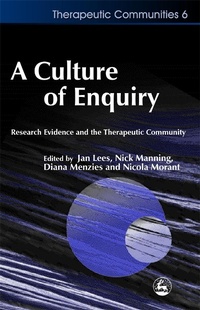
A Culture of Enquiry
Research Evidence and the Therapeutic Community
Will be published approx. on 15. September 2003
Book
Paperback/Softback
336 pages
978-1-85302-857-1 (ISBN)
Description
Research is an increasing priority for workers throughout the mental health sector, and therapeutic communities are no exception. Those working in TCs increasingly have to justify the success and efficiency of their methods to outside bodies, and the prime means of doing so is through research. This volume collects a wide range of papers by experienced contributors discussing all aspects of TC research. They consider questions of which methods are most appropriate in the unique environment of TCs, how research studies affect the TC environment, as well as practical and ethical questions. The book also includes accounts of several research studies undertaken at, among other places, the Cassel Hospital. Taken as a whole, the book will be an invaluable resource for anyone involved in researching therapeutic communities - whether undertaking a study, attempting to anticipate its clinical impact, or seeking to understand the kinds of results which TC research produces.
Reviews / Votes
a great source book to researchers and clinicians working in therapeutic communities, it will also be of great interest to any practitioner who wishes to understand more about the various ways in which research in therapeutic communities can be approached. -- The Journal of Critical Psychology, counselling & Psychotherapy The comprehensive book 'A Culture of Enquiry' aims at disseminating research findings on therapeutic communities. -- Therapeutic Community Journal Due to the topic's nature, the book is written in the first place for researchers and therapeutic community practitioners who are planning to undertake research. -- Therapeutic Community Journal The different research methods and designs, such as RCTs, meta-analysis, outcome research designs, qualitative methods (such as focus groups) are explained and illustrated with research examples both executed by the authors as well as by other (well-known) researches. Therefore, and also from our own teaching experiences with both Master-and Bachelor level students in Orthopedagogy (Special Education), we consider the book suitable for students as well. Finally, because the book elaborates on research findings, we thing the book will certainly appeal as well to clinicians and other practitioners both in therapeutic communities and other treatment services. -- Therapeutic Community Journal This edited book is - by our knowledge - one of the first attempts to group a wide diversity of studies, research methodologies and related findings within the specific context of therapeutic communities. It is interesting that the editors have brought together a comprehensive range of different research paradigms (e.g. both quantitative and qualitative studies have been described) applied to questions, which address 'individuals, groups and collective systems'. Furthermore, we can only support the editors' initiative to incorporate research within both 'democratic' and 'hierarchical or concept-based' therapeutic communities, as the totality of the TC-world is grasped this way. -- Therapeutic Community Journal The book supplies an evidence base for TCs that is growing rapidly in both volume and sophistication. With relevantly systematic literature reviews on TC research this book offers a very good opportunity to read current research progress and findings. -- Paul Shelley, Associate Editor, International Journal of Psychiatric Nursing ResearchMore details
Series
Language
English
Place of publication
London
United Kingdom
Target group
College/higher education
Professional and scholarly
Product notice
Paperback (UK-trade)
Dimensions
Height: 230 mm
Width: 162 mm
Thickness: 20 mm
Weight
522 gr
ISBN-13
978-1-85302-857-1 (9781853028571)
Copyright in bibliographic data and cover images is held by Nielsen Book Services Limited or by the publishers or by their respective licensors: all rights reserved.
Schweitzer Classification
Other editions
Additional editions
Nick Manning | Diana Menzies | Jan Lees
A Culture of Enquiry
Research Evidence and the Therapeutic Community
E-Book
09/2003
1st Edition
Jessica Kingsley Publishers
€44.69
Available for download
Persons
Jan Lees is a part-time research associate at Francis Dixon Lodge Therapeutic Community in Leicester: she is also joint series editor, with Rex Haigh, of Jessica Kingsley's Therapeutic Communities series. She has worked in, taught about and researched therapeutic communities for over 20 years. Nick Manning is Professor of Social Policy and Sociology at the University of Nottingham. Since his graduate fieldwork at Henderson Hospital in 1972 he has undertaken a variety of research on therapeutic communities. Diana Menzies is Consultant Psychotherapist with the Henderson Outreach Services Team, concerned with the development of out-patient group-based treatments for people with personality disorders. Nicola Morant is a lecturer in Social Psychology at Anglia Polytechnic University. After completing doctoral work at the LSE she worked as a research psychologist at Henderson Hospital.
Content
Acknowledgements. Introduction. Section 1: Overview. 1. Principles and Practices in Therapeutic Community Research. Nick Manning and Nicola Morant. 2. Therapeutic Community Research: An Overview and Meta-Analysis. Jan Lees, Barbara Rawlings and Nick Manning. Section II: Context and Methodologies. 3. The Research Context in the National Health Service. Frank Margison. 4. Practice Evaluation of Therapeutic Communities. Jan Lees. 5. The Research Context for Therapeutic Communities in the USA. George DeLeon. 6. The Gold Standard: What are RCTs and Where Did They Come From? Nick Manning . 7. Characteristics of Effective Treatment Environments: A Process-Outcome Model for Research on Therapeutic Communities. Rudolph H. Moos. 8. Using Qualitative Research Methods in Therapeutic Communities. Barbara Rawlings. 9. Outsiders on the Inside: Researchers in Therapeutic Communities. Nicola Morant and Fiona Warren. 10. The Psychodynamics of Being a Researcher in a Therapeutic Community: Living the Borderline Experience. Diana Menzies and Jan Lees. Section III: Research Findings. 11. What makes a Therapeutic Community? A Comparative Study of Ideal Values. Fiona Dunstan and Sarah Birch. 12. Researching Concept-Based Therapeutic Communities. Susan Eley, Rowdy Yates and Jane Wilson. 13. An Experimental Study of Treatment Outcome: The Cassel-North Devon Personality Disorder Project. Marco Chiesa, Peter Fonagy and Jeremy Holmes. 14. Assessing Outcome at Henderson Hospital: Challenges and Achievements. Kingsley Norton and Fiona Warren. 15. Research on the Norwegian Therapeutic Community Network. Sigmund Karterud, Geir Pedersen and Oyvind Urnes. 16. Economic Evaluations in Therapeutic Community Research. Steffan Davies and Diana Menzies. 17. Grendon: A Therapeutic Community in Prison. Elaine Genders and Elaine Player. 18. Leaving the Therapeutic Community. Nicola Morant. Appendix 1: Stages Used in a CRD Systematic Review. Appendix 2: The 29 Studies Included in the Meta-analysis. Apendix 3: Additional Sources of Information on Research Governance. Notes. Editor and Contributor Biographies. References. Index.