

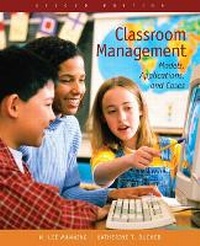
Classroom Management
Models, Applications, and Cases
2nd Edition
Published on 5. May 2006
Book
Paperback/Softback
336 pages
978-0-13-170750-4 (ISBN)
Description
Written by two respected authors, this classroom management text has three parts and fifteen chapters. Unique features include the examination of traditional and contemporary models, readers being encouraged to develop or identify their own philosophical beliefs, and readers being encouraged to develop their own personalized classroom management plan that reflects their philosophical beliefs. Also unique is the book is written for both elementary and secondary school educators who are seeking management techniques in an increasingly diverse world.
Differences in this second edition include: the Management Tips have been greatly expanded and provide specific information for both elementary and secondary educators, an increased amount on diversity (e.g. social class), important terms bolded in the chapters (and defined in the glossary-which is new), the Quick Reference Guide located on the front cover, updated websites, and a companion website.
The book is readable, interesting, and full of practical examples that are written for both elementary and secondary educators. Plus, it has a clear organization, e.g., introduction to classroom management, traditional and contemporary models, safe schools, and developing a personalized classroom philosophy and model.
Differences in this second edition include: the Management Tips have been greatly expanded and provide specific information for both elementary and secondary educators, an increased amount on diversity (e.g. social class), important terms bolded in the chapters (and defined in the glossary-which is new), the Quick Reference Guide located on the front cover, updated websites, and a companion website.
The book is readable, interesting, and full of practical examples that are written for both elementary and secondary educators. Plus, it has a clear organization, e.g., introduction to classroom management, traditional and contemporary models, safe schools, and developing a personalized classroom philosophy and model.
More details
Edition
2nd edition
Language
English
Place of publication
United States
Publishing group
Pearson Education (US)
Target group
Professional and scholarly
Dimensions
Height: 204 mm
Width: 253 mm
Thickness: 18 mm
Weight
655 gr
ISBN-13
978-0-13-170750-4 (9780131707504)
Copyright in bibliographic data and cover images is held by Nielsen Book Services Limited or by the publishers or by their respective licensors: all rights reserved.
Schweitzer Classification
Other editions
New editions
Book
01/2012
3rd Edition
Pearson
€101.67
Article is exhausted; no reprint
Content
PART I Understanding the Need for Classroom Management
Chapter 1 Introducing the Concept of Classroom Management
PART II Understanding Classroom Management Theories
Chapter 2 Building the Foundation
Chapter 3 Exploring the Theories of Lee Canter and Marlene Canter-Assertive Discipline
Chapter 4 Exploring the Theories of Rudolf Driekurs-Democratic Teaching
Chapter 5 Exploring the Theories of Haim Ginott-Congruent Communication
Chapter 6 Exploring the Theories of Jacob Kounin-Instructional Management
Chapter 7 Exploring the Theories of Richard Curwin and Allen Mendler-Discipline with Dignity
Chapter 8 Exploring the Theories of Frederic Jones-Positive Classroom Management
Chapter 9 Exploring the Theories of Barbara Coloroso-Inner Discipline
Chapter 10 Exploring the Theories of Jerome Freiberg-Consistency Management
Chapter 11 Exploring the Theories of Forrest Gathercoal-Judicious Discipline
Chapter 12 Introducing Additional Theorists
PART III Building a Personal Classroom Management Plan
Chapter 13 Creating Safe Classrooms and Safe Schools
Chapter 14 Developing Your Personal Classroom Management Philosophy
Chapter 15 Applying a Management Philosophy in Your Classroom
Chapter 1 Introducing the Concept of Classroom Management
PART II Understanding Classroom Management Theories
Chapter 2 Building the Foundation
Chapter 3 Exploring the Theories of Lee Canter and Marlene Canter-Assertive Discipline
Chapter 4 Exploring the Theories of Rudolf Driekurs-Democratic Teaching
Chapter 5 Exploring the Theories of Haim Ginott-Congruent Communication
Chapter 6 Exploring the Theories of Jacob Kounin-Instructional Management
Chapter 7 Exploring the Theories of Richard Curwin and Allen Mendler-Discipline with Dignity
Chapter 8 Exploring the Theories of Frederic Jones-Positive Classroom Management
Chapter 9 Exploring the Theories of Barbara Coloroso-Inner Discipline
Chapter 10 Exploring the Theories of Jerome Freiberg-Consistency Management
Chapter 11 Exploring the Theories of Forrest Gathercoal-Judicious Discipline
Chapter 12 Introducing Additional Theorists
PART III Building a Personal Classroom Management Plan
Chapter 13 Creating Safe Classrooms and Safe Schools
Chapter 14 Developing Your Personal Classroom Management Philosophy
Chapter 15 Applying a Management Philosophy in Your Classroom