

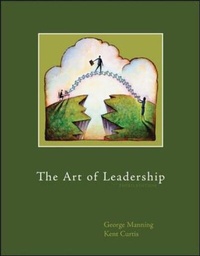
The Art of Leadership
3rd Edition
Published on 16. November 2008
Book
Paperback/Softback
432 pages
978-0-07-338135-0 (ISBN)
Description
The Art of Leadership uses a highly interactive approach to explore Leadership Development. By blending behavior theory, practical application, and personalized learning, students are encouraged to develop their full potential as a leader and to become the kind of leader they always wanted to have. The book can be described as more than just a textbook. Rather, it is a "learning" book which actively involves the reader in the learning process. The text's applied approach combines behavior theory with business practice, as each chapter focuses on central concepts and skills in an important area of leadership development. The book is made more valuable and the impact is made greater by the self-evaluation questionnaires and practical exercises that are used for personal development and class involvement. In this way, readers are equipped to engage with all that the text offers.The Art of Leadership retains the most popular topics and exercises of the previous edition and adds timely subjects and new activities to make the book fresh, alive, and interesting for leaders in today's workplace. It teaches concepts, principles, and skills of leadership in a way that is appropriate for both new and experienced leaders, as well as for the everyday person who must influence others to get things done.
More details
Edition
3rd edition
Language
English
Place of publication
United States
Publishing group
McGraw-Hill Education - Europe
Target group
Professional and scholarly
Dimensions
Height: 274 mm
Width: 216 mm
Thickness: 20 mm
Weight
941 gr
ISBN-13
978-0-07-338135-0 (9780073381350)
Copyright in bibliographic data and cover images is held by Nielsen Book Services Limited or by the publishers or by their respective licensors: all rights reserved.
Schweitzer Classification
Other editions
Previous edition
George Manning | Kent Curtis
The Art of Leadership
Book
11/2005
2nd Edition
McGraw Hill Higher Education
€136.39
Article exhausted; check for reprint
Persons
George Manning is professor emeritus of psychology at Northern Kentucky University. He is a consultant to business, industry, and government, serving such clients as the AMA, AT&T, General Electric, IBM, Duke Energy, the United Auto Works, Young Presidents' Organization, the U/S. Navy, and the National Institutes of Health. He lectures on economic and social issues, including quality of work life, workforce values, and business ethics. He maintains as active program of research and writing in organizational psychology. His current studies and interests include the changing meaning of work, leadership ethics, and coping skills for personal and social change.
Kent Curtis is professor emeritus of organizational leadership at Northern Kentucky University. He has examined the collegiate tutorial system as a visiting Fellow at the University of Durham in England and has designed numerous employee and management development programs serving such clients as Texas Medical Center, Junior Achievement, Wendys International, Procter & Gamble, and American Electric Power. He developed the Northern Kentucky University online organizational leadership degree. His current research includes leading teams, the leader as coach and developer of people, and teaching leadership via distance learning.
Kent Curtis is professor emeritus of organizational leadership at Northern Kentucky University. He has examined the collegiate tutorial system as a visiting Fellow at the University of Durham in England and has designed numerous employee and management development programs serving such clients as Texas Medical Center, Junior Achievement, Wendys International, Procter & Gamble, and American Electric Power. He developed the Northern Kentucky University online organizational leadership degree. His current research includes leading teams, the leader as coach and developer of people, and teaching leadership via distance learning.
Content
1.The Importance of Leadership: Setting the StagePart 1Leadership Variables2.The Leadership Equation3.Leadership Qualities4.Characteristics of Followers5.Situational FactorsPart 2The Power of Vision6.The Importance of Vision7.The Motive to Lead8.Organizational ClimatePart 3The Importance of Ethics9.Leadership Ethics10.The Role of Values11.Ethics at WorkPart 4The Empowerment of People12.Leadership Authority13.Empowerment in the Workplace14.The Quality ImperativePart 5 Leadership Principles15.Effective Leadership16.Human Relations17.The Team ConceptPart 6 Understanding People18.Human Behavior19.The Art of Persuasion20.The Diversity ChallengePart 7Multiplying Effectiveness21.Effective Delegation22.How to Assign Work23.The Role of PersonalityPart 8Developing Others24.The Leader as Teacher25.Helping People Through Change26.Burnout PreventionPart 9Performance Management27.Managing Performance28.Professional Performance29.Sustaining Discipline30.The Road Ahead: Challenge and Charge