

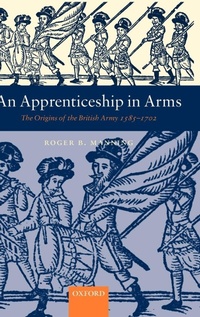
An Apprenticeship in Arms
The Origins of the British Army 1585-1702
Published on 25. May 2006
Book
Hardback
496 pages
978-0-19-926149-9 (ISBN)
Description
Based upon a wide range of historical and literary sources, An Apprenticeship in Arms is a scholarly study of the military experiences of peers and gentlemen from the British Isles who volunteered to fight in the religious and dynastic wars of mainland Europe, as well as the ordinary men who were impressed to serve in the ranks from the time of the English intervention in the Dutch war of independence in 1585 to the death of the soldier-king William III in 1702. This apprenticeship in arms exposed these men to the technological innovations of the military revolution, laid the foundations for a fledgling professional officer class based upon merit and established a fund of military expertise. This remilitarization of aristocratic culture and society was completed by 1640, and provided numerous experienced military officers for the various armies of the civil wars and, subsequently, for the embryonic British army after William III invaded and conquered the British Isles and committed the Three Kingdoms to the armed struggle against Louis XIV during the Nine Years War.
Conflicts between amateur aristocrats and so-called 'soldiers of fortune' led to continuing debates about the relative merits of standing armies and a select militia; the individual pursuit of honour and glory by such amateurs also obscured the more rational military and political objectives of the modern state, subverted military discipline, and delayed the process of the professionalization of the officer corps of the British army.
Conflicts between amateur aristocrats and so-called 'soldiers of fortune' led to continuing debates about the relative merits of standing armies and a select militia; the individual pursuit of honour and glory by such amateurs also obscured the more rational military and political objectives of the modern state, subverted military discipline, and delayed the process of the professionalization of the officer corps of the British army.
Reviews / Votes
A lengthy and detailed narrative * Ian Roy, English Historical Review * Manning brings together a wealth of material ... and by adopting a broad framework offers a useful synthesis of a literature that has developed considerably during the past thirty years. * John Childs, TLS * A valuable study of the days of the formation of a Standing Army. * The Bulletin of the Military Historical Society, Volume 57, Number 225 *More details
Language
English
Place of publication
Oxford
United Kingdom
Target group
Professional and scholarly
Scholars and students of early modern British history, military historians.
Illustrations
7 maps, 3 tables
Dimensions
Height: 240 mm
Width: 161 mm
Thickness: 31 mm
Weight
892 gr
ISBN-13
978-0-19-926149-9 (9780199261499)
Copyright in bibliographic data and cover images is held by Nielsen Book Services Limited or by the publishers or by their respective licensors: all rights reserved.
Schweitzer Classification
Person
Content
I. A MILITARY APPRENTICESHIP 1585-1640 ; 1. The Irish Wars ; 2. The Low Countries Wars ; 3. British Manpower and the States' Army ; 4. Recruiting in the British Isles for Mainland European Armies ; 5. Military and Naval Expeditions of the 1620s ; 6. The campus martius: The Domestic School of War ; II. THE EXPERIENCE OF CIVIL WAR 1640-1660 ; 7. Mercenaries and Gentlemen ; 8. Raising and Organizing Standing Armies ; 9. Atrocity, Plunder, and Discipline ; 10. The Civil Wars in Ireland and Scotland ; III. THE DECAY OF A MILITARY TRADITION 1660-1688 ; 11. Standing Armies in the Three Kingdoms ; 12. The Decay of the Militia ; 13. English, Irish, and Scots in Mainland European Armies ; IV. THE RECOVERY OF A MILITARY TRADITION 1688-1702 ; 14. The Descent on England ; 15. The Williamite Conquest of Scotland and Ireland ; 16. The Nine Years War ; 17. Conclusion: Military Professionalism ; Select Bibliography ; Index