

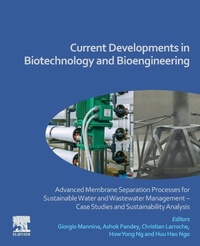
Current Developments in Biotechnology and Bioengineering
Advanced Membrane Separation Processes for Sustainable Water and Wastewater Management Case Studies and Sustainability Analysis
Published on 30. January 2020
Book
Paperback/Softback
434 pages
978-0-12-819854-4 (ISBN)
Description
Current Developments in Biotechnology and Bioengineering: Advanced Membrane Separation Processes for Sustainable Water and Wastewater Management - Case Studies and Sustainability Analysis gives an up-to-date review and research developments of MBR systems (including hybrid systems) in wastewater treatment in terms of pollutant removal, nutrient recovery, and energy production as well as the achievement of energy efficiency of the process itself. The current challenges that hinder the application and industrialization of MBR technology as well as knowledge gaps and future research perspectives are also discussed, including possible strategies to solve the various problems involved.
This work is an excellent reference for education and understanding of biotechnology, microbiology, environmental science and technology, environmental engineering, chemical engineering, biotechnology and bioengineering research and development. It is also an invaluable resource to postgraduate and doctoral students, educators, professional course students, researchers, and wastewater treatment professionals.
This work is an excellent reference for education and understanding of biotechnology, microbiology, environmental science and technology, environmental engineering, chemical engineering, biotechnology and bioengineering research and development. It is also an invaluable resource to postgraduate and doctoral students, educators, professional course students, researchers, and wastewater treatment professionals.
More details
Language
English
Place of publication
United States
Target group
Professional and scholarly
College/higher education
Post graduate and doctoral students and educators, professional course students, researchers and wastewater treatment professionals, policy makers, regulators, water management practitioners
Product notice
Paperback (trade)
Dimensions
Height: 235 mm
Width: 191 mm
Thickness: 22 mm
Weight
743 gr
ISBN-13
978-0-12-819854-4 (9780128198544)
Copyright in bibliographic data and cover images is held by Nielsen Book Services Limited or by the publishers or by their respective licensors: all rights reserved.
Schweitzer Classification
Other editions
Additional editions
Giorgio Mannina | Ashok Pandey | Christian Larroche
Current Developments in Biotechnology and Bioengineering
Advanced Membrane Separation Processes for Sustainable Water and Wastewater Management - Case Studies and Sustainability Analysis
E-Book
01/2020
Elsevier
€200.00
Available for download
Persons
Dr. Giorgio Mannina is Professor of Sanitary and Environmental Engineering at the Engineering Department of Palermo University, Italy. His research interest and focus is on resource recovery from wastewater, advanced wastewater treatments (MBR, MBBR, hybrid processes, IFAS, granular systems, etc.), BNR processes, mathematical modeling, and water quality issues related to integrated urban drainage systems. Prof. Ashok Pandey is currently Executive Director, Centre for Energy and Environmental Sustainability-India, Lucknow. His major research and technological development interests are industrial and environmental biotechnology and energy biosciences, focusing on biomass to biofuels and chemicals, waste to wealth and energy, etc.
Prof. Christian Larroche is Director of Polytech Clermont-Ferrand, a graduate school of engineering of University Clermont-Auvergne, France. He is also member of the research laboratory Institut Pascal and of the laboratory of excellence ImobS3 at the same university. He has strong research skills and expertise in the area of applied microbiology and biochemical engineering. He is author of 220 documents, including 114 articles, three patents, 15 book chapters and 24 co-editions of books or journal special issues. He is member of French Society for Process Engineering (SFGP), French Society of Biotechnology and European Federation of Chemical Engineering. He is administrator of IBA-IFIBiop and editor of Bioresource Technology. Prof. How Yong Ng is a Provost Chair's Professor of the Department of Civil and Environmental Engineering at the National University of Singapore (NUS). He also currently serves as the Director of the NUS Environmental Research Institute and the Director of the Sembcorp-NUS Corporate Laboratory. His research focuses on biological treatment processes including modelling, membrane bioreactor and microbial fuel cell for water reuse and energy recovery. He had contributed to more than 350 publications in referred international journals and conference papers. Dr. Ng is an Associate Editor of Water Research and an Editor of the Journal of Water Reuse and Desalination. He is a Fellow of the International Water Association (IWA) and is currently the Vice-Chair of the IWA Membrane Technology Specialist Group (MTSG) and the President of the Environmental Engineering Society of Singapore (EESS). Prof. Ngo is currently a Professor of Environmental Engineering and serving as Deputy Director of Centre for Technology in Water and Wastewater, Co-Director of Joint Research Centre for Protective Infrastructure Technology and Environmental Green Bioprocess, School of Civil and Environmental Engineering, Faculty of Engineering and Information Technology, University of Technology Sydney. He has been duly elected as Fellow of International Water Association (FIWA) and Fellow and Lead Researcher of the International Bioprocessing Association (FIBA and LRIBA) while serving as IBA Council Member.
Prof. Ngo is internationally well-known for his activities in the areas of advanced biological waste treatment technologies (e.g. membrane bioreactor, specific attached and/or suspended growth bioreactors, anaerobic digesters, wetland and bio-sorption) and membrane technologies. His expertise and practical experience also covers the areas of alternative resources, management and impacts assessment, and solid waste management. Currently, he is very active to work on the development of specific green bioprocessing technologies: resource recovery, water-waste- bioenergy nexus and greenhouse gas emission control.
Prof. Ngo has been listed as Highly Cited Researcher 2019 in Cross Field Category, Clarivate Analytics, Web of Science; Elsevier - World Top 3 ranking researcher 2019 in Environmental Engineering; Lead Researcher in the field of Biotechnology in Australia. He ranks #2 in the world for number of scholarly outputs in the SciVal topic 'membrane fouling; bioreactors; membrane bioreactors (SciVal, Feb 2020). He ranks #1 in Australia for number of scholarly outputs in the SciVal topic 'biosorption; aqueous solution; bisorption capacity; 'antibiotics; oxytetracycline; veterinary antibiotics', (SciVal, Feb 2020).
Prof. Ngo has published more than 500 SCI/ISI journal papers (citations >20,000), 7 books and 35 book chapters, a number of patents while receiving several highly recognized honours/awards. He has been invited to give numerous plenary/keynotes and invited talks, seminars and lecturers in the international conferences as well as the universities/research institutions.
Prof. Ngo has appointed as Editor of Bioresource Technology, Elsevier, Associate Editor of Science of the Total Environment, Elsevier, Associate Editor of Water Process Engineering and Associate Editor of Heliyon Journal, Elsevier. He is also an editorial board member/guest editor of numerous international journals such as Bioresource Technology Reports, Elsevier; Environmental Nanotechnology, Monitoring and Management, Elsevier; Journal of Energy and Environmental Sustainability, IJSEES, Environmental Science and Ecotechnology, EHIT, Journal of Bioengineered, Taylor & Francis.
Prof. Christian Larroche is Director of Polytech Clermont-Ferrand, a graduate school of engineering of University Clermont-Auvergne, France. He is also member of the research laboratory Institut Pascal and of the laboratory of excellence ImobS3 at the same university. He has strong research skills and expertise in the area of applied microbiology and biochemical engineering. He is author of 220 documents, including 114 articles, three patents, 15 book chapters and 24 co-editions of books or journal special issues. He is member of French Society for Process Engineering (SFGP), French Society of Biotechnology and European Federation of Chemical Engineering. He is administrator of IBA-IFIBiop and editor of Bioresource Technology. Prof. How Yong Ng is a Provost Chair's Professor of the Department of Civil and Environmental Engineering at the National University of Singapore (NUS). He also currently serves as the Director of the NUS Environmental Research Institute and the Director of the Sembcorp-NUS Corporate Laboratory. His research focuses on biological treatment processes including modelling, membrane bioreactor and microbial fuel cell for water reuse and energy recovery. He had contributed to more than 350 publications in referred international journals and conference papers. Dr. Ng is an Associate Editor of Water Research and an Editor of the Journal of Water Reuse and Desalination. He is a Fellow of the International Water Association (IWA) and is currently the Vice-Chair of the IWA Membrane Technology Specialist Group (MTSG) and the President of the Environmental Engineering Society of Singapore (EESS). Prof. Ngo is currently a Professor of Environmental Engineering and serving as Deputy Director of Centre for Technology in Water and Wastewater, Co-Director of Joint Research Centre for Protective Infrastructure Technology and Environmental Green Bioprocess, School of Civil and Environmental Engineering, Faculty of Engineering and Information Technology, University of Technology Sydney. He has been duly elected as Fellow of International Water Association (FIWA) and Fellow and Lead Researcher of the International Bioprocessing Association (FIBA and LRIBA) while serving as IBA Council Member.
Prof. Ngo is internationally well-known for his activities in the areas of advanced biological waste treatment technologies (e.g. membrane bioreactor, specific attached and/or suspended growth bioreactors, anaerobic digesters, wetland and bio-sorption) and membrane technologies. His expertise and practical experience also covers the areas of alternative resources, management and impacts assessment, and solid waste management. Currently, he is very active to work on the development of specific green bioprocessing technologies: resource recovery, water-waste- bioenergy nexus and greenhouse gas emission control.
Prof. Ngo has been listed as Highly Cited Researcher 2019 in Cross Field Category, Clarivate Analytics, Web of Science; Elsevier - World Top 3 ranking researcher 2019 in Environmental Engineering; Lead Researcher in the field of Biotechnology in Australia. He ranks #2 in the world for number of scholarly outputs in the SciVal topic 'membrane fouling; bioreactors; membrane bioreactors (SciVal, Feb 2020). He ranks #1 in Australia for number of scholarly outputs in the SciVal topic 'biosorption; aqueous solution; bisorption capacity; 'antibiotics; oxytetracycline; veterinary antibiotics', (SciVal, Feb 2020).
Prof. Ngo has published more than 500 SCI/ISI journal papers (citations >20,000), 7 books and 35 book chapters, a number of patents while receiving several highly recognized honours/awards. He has been invited to give numerous plenary/keynotes and invited talks, seminars and lecturers in the international conferences as well as the universities/research institutions.
Prof. Ngo has appointed as Editor of Bioresource Technology, Elsevier, Associate Editor of Science of the Total Environment, Elsevier, Associate Editor of Water Process Engineering and Associate Editor of Heliyon Journal, Elsevier. He is also an editorial board member/guest editor of numerous international journals such as Bioresource Technology Reports, Elsevier; Environmental Nanotechnology, Monitoring and Management, Elsevier; Journal of Energy and Environmental Sustainability, IJSEES, Environmental Science and Ecotechnology, EHIT, Journal of Bioengineered, Taylor & Francis.
Editor
Director of WRRF'lab at Palermo University
Executive Director, Centre for Energy and Environmental Sustainability-India, Lucknow, India
Chemical and Biochemical Engineering Laboratory, Institute Pascal, University Clermont Auvergne, Clermont Ferrand, France
Professor and Provost Chair, Department of Civil and Environmental Engineering, National University of Singapore, Singapore
Professor, University of Technology Sydney, Australia
Content
1. Sustainability analysis of large scale membrane bioreactor plant
2. Fouling Control in MBR in a Sustainable Perspective
3. Baffled Membrane Bioreactor: efficient nutrient removal, operational energy reduction and modeling
4. Sludge reduction and microbial structures in MBRs: features influencing the sustainable adoption of MBRs
5. Greenhouse gas from MBR: new perspectives on monitoring and mathematical modelling
6. Advanced Membrane Bioreactors for Emerging Contaminant Removal and Quorum Sensing Control
7. Membrane Bio Reactors treating tannery wastewaters, limits and potentials for an optimized full scale application
8. High Salinity Wastewater Treatment by Membrane bioreactors
9. Sustainable Adoption and Future Perspectives for MBR Applications
10. Self-Forming Dynamic Membrane Bioreactors (SFD MBR) for wastewater treatment: principles and applications
11. Environmental profile of decentralized wastewater treatment strategies based on membrane technologies
12. Energy and environmental impact of an AnMBR demonstration plant treating urban wastewater
13. MBR for wastewater reclamation: cost analysis
14. MBR sludge: from production to disposal
15. New applications in Integrated Fixed film Activated Sludge - Membrane Bioreactor (IFAS-MBR) Systems
16. Influence of bio(de)flocculation on activated sludge separation processes in membrane bioreactors
2. Fouling Control in MBR in a Sustainable Perspective
3. Baffled Membrane Bioreactor: efficient nutrient removal, operational energy reduction and modeling
4. Sludge reduction and microbial structures in MBRs: features influencing the sustainable adoption of MBRs
5. Greenhouse gas from MBR: new perspectives on monitoring and mathematical modelling
6. Advanced Membrane Bioreactors for Emerging Contaminant Removal and Quorum Sensing Control
7. Membrane Bio Reactors treating tannery wastewaters, limits and potentials for an optimized full scale application
8. High Salinity Wastewater Treatment by Membrane bioreactors
9. Sustainable Adoption and Future Perspectives for MBR Applications
10. Self-Forming Dynamic Membrane Bioreactors (SFD MBR) for wastewater treatment: principles and applications
11. Environmental profile of decentralized wastewater treatment strategies based on membrane technologies
12. Energy and environmental impact of an AnMBR demonstration plant treating urban wastewater
13. MBR for wastewater reclamation: cost analysis
14. MBR sludge: from production to disposal
15. New applications in Integrated Fixed film Activated Sludge - Membrane Bioreactor (IFAS-MBR) Systems
16. Influence of bio(de)flocculation on activated sludge separation processes in membrane bioreactors