

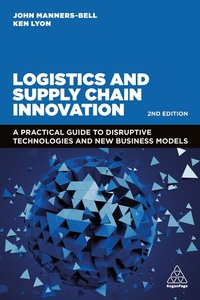
Logistics and Supply Chain Innovation
A Practical Guide to Disruptive Technologies and New Business Models
2nd Edition
Published on 3. November 2022
Book
Paperback/Softback
416 pages
978-1-3986-0748-4 (ISBN)
Description
Global disruption, new technologies and changing consumer habits are causing turmoil in the supply chain industry. This book shows businesses how to remain resilient in this dynamic new environment.
The supply chain crisis of 2021 exposed the necessity of a sustainable supply chain. The Fourth Industrial Revolution has transformed our society and economy. The logistics and supply chain industry continues to be innovated by automation, blockchain and sustainability. Amid all this volatility, it is vital for businesses to not only protect their operations from disruption, but to rise to the challenge that these innovations pose to become game-changers in their sectors.
Now in its second edition,
Logistics and Supply Chain Innovation
provides vital insight into the major trends transforming the supply chain and logistics industry. Featuring a new section on the role of technologies in reducing carbon emissions, case studies from companies such as Amazon, Alibaba, Maersk, UPS and DHL, as well as a full update of all existing content on crowd sourcing and shipping, on-demand delivery, autonomous vehicles and more,
Logistics and Supply Chain Innovation
is the essential guide to thriving in a rapidly developing logistics landscape. Online supporting resources include PowerPoints and sample case studies.
Reviews / Votes
"The need for innovation in logistics was never an option and should be in the DNA of every supply chain professional. The second edition of Logistics and Supply Chain Innovation is an easy-to-read, substantial reference book. It is the opportunity to add new imperatives that already and will continue to disrupt the world of logistics and supply chain such as global pandemics and the decarbonization urgency, calling for a next normal."More details
Language
English
Place of publication
London
United Kingdom
Target group
College/higher education
Professional and scholarly
Edition type
Revised edition
Product notice
Paperback (trade)
Dimensions
Height: 234 mm
Width: 156 mm
Thickness: 22 mm
Weight
629 gr
ISBN-13
978-1-3986-0748-4 (9781398607484)
Schweitzer Classification
Other editions
Additional editions
John Manners-Bell | Ken Lyon
Logistics and Supply Chain Innovation
A Practical Guide to Disruptive Technologies and New Business Models
E-Book
11/2022
2nd Edition
Kogan Page Ltd
€48.99
Available for download
John Manners-Bell | Ken Lyon
Logistics and Supply Chain Innovation
A Practical Guide to Disruptive Technologies and New Business Models
Book
11/2022
2nd Edition
Kogan Page Ltd
€177.20
Shipment within 10-20 days
Previous edition
John Manners-Bell | Ken Lyon
The Logistics and Supply Chain Innovation Handbook
Disruptive Technologies and New Business Models
Book
07/2019
1st Edition
Kogan Page Ltd
€71.98
Article exhausted; check for reprint
Persons
Author
John Manners-Bell is the CEO of Transport Intelligence, a leading supplier of market solutions to the global logistics industry. He is also Visiting Professor at the London Guildhall Faculty of Business and Law, London Metropolitan University.
John Manners-Bell started his working life as an operations manager in a freight forwarding and road haulage company based in the UK. Prior to establishing Transport Intelligence, he worked as an analyst in consultancies specialising in international trade, transport and logistics. He also spent a number of years as European marketing manager for UPS Supply Chain Solutions working at locations across Europe, including France, Netherlands and Germany.
He holds an MSc in Transport Planning and Management from the University of Westminster, a BA (Hons) in Classics from King's College London where he was also awarded an Associateship (AKC). John Manners-Bell is a Fellow of the UK Chartered Institute of Logistics and Transport and former Chair of the Supply Chain, Logistics Global Advisory Council of the World Economic Forum, and a Freeman of the City of London.
ISNI:
ISNI:
Ken Lyon has over 30 years of experience in the transportation industry. Ken specialises in the use of advanced information systems to manage the operations of 3PL (Third Party Logistics), 4PL and Lead Logistics Providers and their trading partner networks. Over the past few years he has helped start-ups concerned with supply chain technologies and before that, he spent 10 years as a Director and VP of information services at UPS, helping to establish its Logistics and supply chain services Group. Ken was recently appointed Chairman of the Board for an international logistics software group and also sits on the board of Ti.
ISNI:
ISNI:
Content
-
- Chapter - 00: Introduction;
- Section - ONE: The impact of innovation and disruption on the supply chain;
-
- Chapter - 01: The Fourth Industrial Revolution and the anatomy of innovation;
- Chapter - 02: Breaking the paradigm;
- Chapter - 03: Lessons from the past;
- Chapter - 04: Disruption to the post-Covid-19 supply chain and logistics industry;
- Section - TWO: Transforming supply chain models;
-
- Chapter - 05: The direct-to-consumer model and its implications for logistics;
- Chapter - 06: Alternative downstream retail distribution models;
- Chapter - 07: On-demand delivery and crowd-shipping;
- Chapter - 08: Innovating to meet the challenge of urban distribution;
- Chapter - 09: The disruptive power of e-retailing;
- Chapter - 10: Amazon - The ultimate disruptor;
- Chapter - 11: 3D printing and the transformation of upstream supply chains;
- Section - THREE: New technology development and adoption;
-
- Chapter - 12: The Internet of Things, Big Data and artificial intelligence;
- Chapter - 13: Control towers and supply chain visibility;
- Chapter - 14: Blockchain in supply chains;
- Chapter - 15: The disruptive potential of robots and automation in the warehouse;
- Chapter - 16: Autonomous vehicles and delivery robots;
- Section - FOUR: Digitalization of logistics markets;
-
- Chapter - 17: Digital road freight and warehousing platforms;
- Chapter - 18: The digitalization of international freight forwarding;
- Chapter - 19: Disrupting trade finance;
- Section - FIVE: Innovating for sustainability;
-
- Chapter - 20: The role of new technologies in mitigating climate change;
- Chapter - 21: A guide to alternative propulsion systems;
- Chapter - 22: Designing smart and circular supply chains;
- Chapter - 23: 'Shifting to Green' survey;
- Section - SIX: Future directions for global supply chains;
-
- Chapter - 24: The 'Great Reset';
- Chapter - 25: Conclusion