

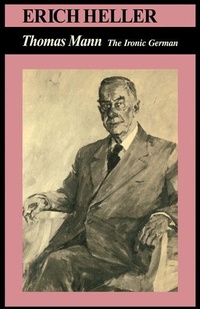
Thomas Mann
The Ironic German
Published on 12. March 1981
Book
Paperback/Softback
316 pages
978-0-521-28022-8 (ISBN)
Description
In this book, which was first published in 1958 and reissued in 1981, Professor Heller sees Mann as the late heir of the central tradition of modern German literature and also as one of the most ironic writers within that tradition. He offers a detailed study of the major works of fiction, Buddenbrooks, Tonio Kroeher, Death in Venice, The Magic Mountain, Joseph and His Brothers, Doctor Faustus and Felix Krull, as well as a discussion of Mann's most significant political essay, 'Meditations of a Non-Political Man'. Beyond this, Heller's book is a profound commentary on Mann by a mind attuned to (and mouded by) precisely the intellectual and cultural traditions which are so much part of Mann's creative make-up.
More details
Language
English
Place of publication
Cambridge
United Kingdom
Target group
College/higher education
Product notice
Paperback (trade)
Illustrations
Worked examples or Exercises
Dimensions
Height: 216 mm
Width: 140 mm
Thickness: 19 mm
Weight
448 gr
ISBN-13
978-0-521-28022-8 (9780521280228)
Copyright in bibliographic data and cover images is held by Nielsen Book Services Limited or by the publishers or by their respective licensors: all rights reserved.
Schweitzer Classification
Other editions
Additional editions

Book
03/1981
Cambridge University Press
€37.14
Article exhausted; check for reprint
Previous edition
Book
03/1981
Cambridge University Press
€37.14
Article exhausted; check for reprint
Persons
German novelist, short story author, social commentator, philanthropist, essayist, and 1929 Nobel Prize in Literature winner Paul Thomas Mann lived from 6 June 1875 to 12 August 1955. His sardonic and highly symbolic epic novels and novellas are renowned for their understanding of the minds of artists and intellectuals. He incorporated modernized versions of German and Biblical tales, as well as concepts from Friedrich Nietzsche, Arthur Schopenhauer, and Johann Wolfgang von Goethe, in his analysis and critique of the European and German spirit. In his first book, Buddenbrooks, Mann-a member of the Hanseatic Mann family-depicted his clan and social status. Three of Heinrich Mann's six children, Erika Mann, Klaus Mann, and Golo Mann, all went on to become well-known German writers, as did his older brother Heinrich Mann, a radical writer. Mann escaped to Switzerland in 1933, the year Adolf Hitler took office. He relocated to the United States in 1939 when World War II began, then went back to Switzerland in 1952. One of the most well-known authors of the so-called Exilliteratur, German writing produced in exile by individuals opposed to the Hitler government, is Mann.
Content
Preface; 1. Introduction: a tribute; 2. Pessimism and sensibility; 3. The embarrassed muse; 4. The conservative imagination; 5. Conservation on the magic mountain; 6. The theology of irony; 7. Parody, tragic and comic; Bibliography; References.