

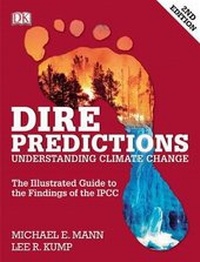
Dire Predictions
Understanding Climate Change
2nd Edition
Published on 16. July 2015
Book
Paperback/Softback
208 pages
978-0-13-390977-7 (ISBN)
Description
Periodic reports from the Intergovernmental Panel on Climate Change (IPCC) evaluate the risk of climate change brought on by humans. But the sheer volume of scientific data remains inscrutable to the general public, particularly to those who may still question the validity of climate change. In just over 200 pages, this practical text presents and expands upon the essential findings in a visually stunning and undeniably powerful way to the lay reader. Scientific findings that provide validity to the implications of climate change are presented in clear-cut graphic elements, striking images, and understandable analogies.
KEY TOPICS: IPCC Report. Climate Change Basics. Projections of Future Climate Change. The Impacts of Climate Change. Vulnerability and Adaptation to Climate Change.
MARKET: For all readers interested in learning more, and making informed decisions, regarding climate change
KEY TOPICS: IPCC Report. Climate Change Basics. Projections of Future Climate Change. The Impacts of Climate Change. Vulnerability and Adaptation to Climate Change.
MARKET: For all readers interested in learning more, and making informed decisions, regarding climate change
Reviews / Votes
MEDIA REVIEWSA'ndrea Elyse Messer, Research Penn State:
"A key element is accurate information debunking the most commonly held myths about climate change, including the ideas that carbon dioxide is causing the holes in the ozone, that the increase in carbon dioxide is the result of natural cycles, and that our atmosphere is not warming at all. The authors consider each myth or misunderstanding and explain any kernel of truth within it before providing its refutation."
Dan Vergano, USA Today:
"[Michael] Mann and his colleague Lee Kump have written a terrific illustrated guide to global warming...with graphics that make even the most complex climate questions easily understandable. Our graphics department will be plundering the book for the next few years."
Bud Ward, Yale Climate Forum:
"Practically every page spread...is studded with stunning and informative graphics and illustrations. Hear that? Repeat: Stunning AND informative."
Gerry Karey, Platt's The Barrel:
" 'Dire Predictions - Understanding Global Warming,' ... is likely to infuriate climate skeptics because it is so user friendly that it could become a popular default source for information on global warming."
Janet Raloff, ScienceNews:
"[T]he authors have tackled a tough job and given lay readers a nice primer to begin wading into the complexities of Earth's climate.
Margot Roosevelt, Greenspace, Los Angeles Times:
"[A] handy guide for every harried individual daunted by the complexities of greenhouse effects, carbon-cycle feedbacks, ocean conveyor belts and climate modeling."
Jay Gulledge, Nature Reports:
"The main tool of communication and by far the best feature of the book is its high-quality data graphics showing the key observations and projections from which the IPCC developed its conclusions." See also Olive Heffernan's synopsis on Nature's Climate Feedback blog.
Nola Theiss, Sanibel-Captiva Islander:
"[I]t almost reads like a travel guide that helps the reader traverse the difficult terrain of climate change facts and figures through the use of photos, charts, and maps. It doesn't downplay the science behind the articles, but it really is all about presentation and the implications of that science."
Marcus Schneck, The Harr
More details
Other editions
Previous edition
Book
04/2012
Pearson
€30.98
Article exhausted; check for reprint
Persons
Dr. Michael E. Mann is Distinguished Professor of Meteorology at Penn State University, with joint appointments in the Department of Geosciences and the Earth and Environmental Systems Institute (EESI). He is also director of the Penn State Earth System Science Center (ESSC).
Dr. Mann received his undergraduate degrees in Physics and Applied Math from the University of California at Berkeley, an M.S. degree in Physics from Yale University, and a Ph.D. in Geology & Geophysics from Yale University. His research involves the use of theoretical models and observational data to better understand Earth's climate system.
Dr. Mann was a Lead Author on the Observed Climate Variability and Change chapter of the Intergovernmental Panel on Climate Change (IPCC) Third Scientific Assessment Report in 2001 and was organizing committee chair for the National Academy of Sciences Frontiers of Science in 2003. He has received a number of honors and awards including NOAA's outstanding publication award in 2002 and selection by Scientific American as one of the fifty leading visionaries in science and technology in 2002. He contributed, with other IPCC authors, to the award of the 2007 Nobel Peace Prize. He was awarded the Hans Oeschger Medal of the European Geosciences Union in 2012 and was awarded the National Conservation Achievement Award for science by the National Wildlife Federation in 2013. He made Bloomberg News' list of fifty most influential people in 2013. He is a Fellow of both the American Geophysical Union and the American Meteorological Society.
Lee R. Kump is a Professor in the Department of Geosciences, and an associate of the Earth System Science Center and Astrobiology Research Center at the Pennsylvania State University. A native of Minnesota, he received his bachelor's degree in geophysical sciences from the University of Chicago in 1981, and his Ph.D. in marine sciences from the University of South Florida in 1986. While in Florida he spent two summers as a geologist with the United States Geological Survey's Fisher Island Station. In August of 1986 he joined the faculty at Penn State.
Dr. Kump is a Fellow of the Geological Societies of America and London, and a member of the American Geophysical Union, the Geochemical Society, and the Geochemistry Division of the American Chemical Society. His research has been funded by the Environmental Protection Agency, the National Science Foundation, NASA, the Gas Research Institute, the Petroleum Research Fund of the American Chemical Society, and Texaco. Dr. Kump became Associate Director of the CIAR Earth System Evolution Program in 2004. Dr. Kump's primary research effort is in the development of numerical models of global biogeochemical cycles. His early work focussed on the carbon and sulfur cycles, and on the feedbacks that regulate atmospheric oxygen levels. More recently his emphasis has shifted to the study of the dynamic coupling between global climate and biogeochemical cycles. He studies the long-term evolution of the oceans and atmosphere, using a combination of field work, laboratory analysis, and numerical modeling.
Dr. Mann received his undergraduate degrees in Physics and Applied Math from the University of California at Berkeley, an M.S. degree in Physics from Yale University, and a Ph.D. in Geology & Geophysics from Yale University. His research involves the use of theoretical models and observational data to better understand Earth's climate system.
Dr. Mann was a Lead Author on the Observed Climate Variability and Change chapter of the Intergovernmental Panel on Climate Change (IPCC) Third Scientific Assessment Report in 2001 and was organizing committee chair for the National Academy of Sciences Frontiers of Science in 2003. He has received a number of honors and awards including NOAA's outstanding publication award in 2002 and selection by Scientific American as one of the fifty leading visionaries in science and technology in 2002. He contributed, with other IPCC authors, to the award of the 2007 Nobel Peace Prize. He was awarded the Hans Oeschger Medal of the European Geosciences Union in 2012 and was awarded the National Conservation Achievement Award for science by the National Wildlife Federation in 2013. He made Bloomberg News' list of fifty most influential people in 2013. He is a Fellow of both the American Geophysical Union and the American Meteorological Society.
Lee R. Kump is a Professor in the Department of Geosciences, and an associate of the Earth System Science Center and Astrobiology Research Center at the Pennsylvania State University. A native of Minnesota, he received his bachelor's degree in geophysical sciences from the University of Chicago in 1981, and his Ph.D. in marine sciences from the University of South Florida in 1986. While in Florida he spent two summers as a geologist with the United States Geological Survey's Fisher Island Station. In August of 1986 he joined the faculty at Penn State.
Dr. Kump is a Fellow of the Geological Societies of America and London, and a member of the American Geophysical Union, the Geochemical Society, and the Geochemistry Division of the American Chemical Society. His research has been funded by the Environmental Protection Agency, the National Science Foundation, NASA, the Gas Research Institute, the Petroleum Research Fund of the American Chemical Society, and Texaco. Dr. Kump became Associate Director of the CIAR Earth System Evolution Program in 2004. Dr. Kump's primary research effort is in the development of numerical models of global biogeochemical cycles. His early work focussed on the carbon and sulfur cycles, and on the feedbacks that regulate atmospheric oxygen levels. More recently his emphasis has shifted to the study of the dynamic coupling between global climate and biogeochemical cycles. He studies the long-term evolution of the oceans and atmosphere, using a combination of field work, laboratory analysis, and numerical modeling.
Content
Part 1 Climate Change Basics
The relative impacts of humans and nature on climate
Taking action in the face of uncertainty
Why is it called the greenhouse effect?
Feedback loops compound the greenhouse effect of carbon dioxide
What are the important greenhouse gases, and where do they come from?
Greenhouse gases on the rise
Could the increase in atmospheric CO2 be the result of natural cycles?
It's getting hotter down here!
Where is all that heat going?
Is our atmosphere really warming?
Back to the future
Suffocating the ocean
Weren't scientists warning us of a coming ice age only decades ago?
How does modern warming differ from past warming trends?
Welcome to the Anthropocene
What can a decade of western North American drought tell us about the future?
Signs of things to come? The 2012 North American heat wave
* The 2003 European heat wave
* Does a cold snap in Peoria invalidate global warming?
* A tempest in a greenhouse
* The vanishing snows of Kilimanjaro
* The last interglacial
* How to build a climate model
Profiles: James Hansen, Warren Washington, Stephen Schneider, and Susan Solomon
Comparing climate model predictions with observations
Regional vs global trends
Some climates disappear as others emerge
"Fingerprints" distinguish human and natural impacts on climate
Part 2 Climate Change Projections
How sensitive is the climate?
Fossil-fuel emissions scenarios
The Faux Pause
Past IPCC projections-how did they do?
The next century
The geographical pattern of future warming
Tipping points, irreversibility, and abrupt climate change
Carbon-cycle feedbacks
Melting ice and rising sea level
Future changes in extreme weather
Stabilizing atmospheric CO2
Part 3 The Impacts of Climate Change
The rising impact of global warming
Is it time to sell that beach house?
Ecosystems
Coral reefs
The highway to extinction?
Too much and too little
Is warming from carbon dioxide leading to more air pollution?
War
Famine
Pestilence and death
Earth, wind, and fire
Too wet and too hot
The polar meltdown
Part 4 Vulnerability and Adaptation to Climate Change
Is global warming the last straw for vulnerable ecosystems?
What is the best course for the coming century?
It's the economy, stupid!
A finger in the dike
Keeping the water flowing
A hard row to hoe
Part 5 Solving Climate Change
Solving global warming
Where do all those emissions come from?
Keeping the power turned on
On the road again
Building green
Reducing industrial CO2 pollution
The water-energy nexus
Greener acres
Forests
Waste not, want watts?
Geoengineering
But what can I do about it?
Sustainability success stories
What's your carbon footprint?
Global problems require international cooperation
Can we achieve sustainable development?
The ethics of climate change
The known unknowns and the unknown unknowns
The urgency of climate change
The relative impacts of humans and nature on climate
Taking action in the face of uncertainty
Why is it called the greenhouse effect?
Feedback loops compound the greenhouse effect of carbon dioxide
What are the important greenhouse gases, and where do they come from?
Greenhouse gases on the rise
Could the increase in atmospheric CO2 be the result of natural cycles?
It's getting hotter down here!
Where is all that heat going?
Is our atmosphere really warming?
Back to the future
Suffocating the ocean
Weren't scientists warning us of a coming ice age only decades ago?
How does modern warming differ from past warming trends?
Welcome to the Anthropocene
What can a decade of western North American drought tell us about the future?
Signs of things to come? The 2012 North American heat wave
* The 2003 European heat wave
* Does a cold snap in Peoria invalidate global warming?
* A tempest in a greenhouse
* The vanishing snows of Kilimanjaro
* The last interglacial
* How to build a climate model
Profiles: James Hansen, Warren Washington, Stephen Schneider, and Susan Solomon
Comparing climate model predictions with observations
Regional vs global trends
Some climates disappear as others emerge
"Fingerprints" distinguish human and natural impacts on climate
Part 2 Climate Change Projections
How sensitive is the climate?
Fossil-fuel emissions scenarios
The Faux Pause
Past IPCC projections-how did they do?
The next century
The geographical pattern of future warming
Tipping points, irreversibility, and abrupt climate change
Carbon-cycle feedbacks
Melting ice and rising sea level
Future changes in extreme weather
Stabilizing atmospheric CO2
Part 3 The Impacts of Climate Change
The rising impact of global warming
Is it time to sell that beach house?
Ecosystems
Coral reefs
The highway to extinction?
Too much and too little
Is warming from carbon dioxide leading to more air pollution?
War
Famine
Pestilence and death
Earth, wind, and fire
Too wet and too hot
The polar meltdown
Part 4 Vulnerability and Adaptation to Climate Change
Is global warming the last straw for vulnerable ecosystems?
What is the best course for the coming century?
It's the economy, stupid!
A finger in the dike
Keeping the water flowing
A hard row to hoe
Part 5 Solving Climate Change
Solving global warming
Where do all those emissions come from?
Keeping the power turned on
On the road again
Building green
Reducing industrial CO2 pollution
The water-energy nexus
Greener acres
Forests
Waste not, want watts?
Geoengineering
But what can I do about it?
Sustainability success stories
What's your carbon footprint?
Global problems require international cooperation
Can we achieve sustainable development?
The ethics of climate change
The known unknowns and the unknown unknowns
The urgency of climate change