

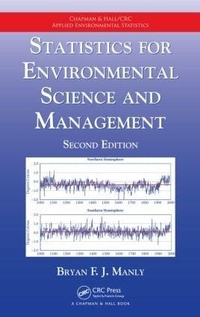
Statistics for Environmental Science and Management
2nd Edition
Published on 21. October 2008
Book
Hardback
310 pages
978-1-4200-6147-5 (ISBN)
Description
Revised, expanded, and updated, this second edition of Statistics for Environmental Science and Management is that rare animal, a resource that works well as a text for graduate courses and a reference for appropriate statistical approaches to specific environmental problems. It is uncommon to find so many important environmental topics covered in one book. Its strength is author Bryan Manly's ability to take a non-mathematical approach while keeping essential mathematical concepts intact. He clearly explains statistics without dwelling on heavy mathematical development.
The book begins by describing the important role statistics play in environmental science. It focuses on how to collect data, highlighting the importance of sampling and experimental design in conducting rigorous science. It presents a variety of key topics specifically related to environmental science such as monitoring, impact assessment, risk assessment, correlated and censored data analysis, to name just a few.
Revised, updated or expanded material on:
Data Quality Objectives
Generalized Linear Models
Spatial Data Analysis
Censored Data
Monte Carlo Risk Assessment
There are numerous books on environmental statistics; however, while some focus on multivariate methods and others on the basic components of probability distributions and how they can be used for modeling phenomenon, most do not include the material on sampling and experimental design that this one does. It is the variety of coverage, not sacrificing too much depth for breadth, that sets this book apart.
The book begins by describing the important role statistics play in environmental science. It focuses on how to collect data, highlighting the importance of sampling and experimental design in conducting rigorous science. It presents a variety of key topics specifically related to environmental science such as monitoring, impact assessment, risk assessment, correlated and censored data analysis, to name just a few.
Revised, updated or expanded material on:
Data Quality Objectives
Generalized Linear Models
Spatial Data Analysis
Censored Data
Monte Carlo Risk Assessment
There are numerous books on environmental statistics; however, while some focus on multivariate methods and others on the basic components of probability distributions and how they can be used for modeling phenomenon, most do not include the material on sampling and experimental design that this one does. It is the variety of coverage, not sacrificing too much depth for breadth, that sets this book apart.
More details
Series
Edition
2nd edition
Language
English
Place of publication
Oxford
United Kingdom
Publishing group
Taylor & Francis Ltd
Target group
College/higher education
Professional
Product notice
Paper over boards
Illustrations
81 s/w Abbildungen, 70 s/w Tabellen
70 Tables, black and white; 81 Illustrations, black and white
Dimensions
Height: 142 mm
Width: 224 mm
Thickness: 22 mm
Weight
618 gr
ISBN-13
978-1-4200-6147-5 (9781420061475)
Copyright in bibliographic data and cover images is held by Nielsen Book Services Limited or by the publishers or by their respective licensors: all rights reserved.
Schweitzer Classification
Other editions
Additional editions
Bryan F.J. Manly
Statistics for Environmental Science and Management
E-Book
10/2008
2nd Edition
Chapman & Hall/CRC
€125.99
Available for download
Bryan F.J. Manly
Statistics for Environmental Science and Management
E-Book
10/2008
2nd Edition
Chapman and Hall
€125.99
Available for download
Previous edition
Bryan F.J. Manly
Statistics for Environmental Science and Management
Book
09/2000
1st Edition
Chapman & Hall/CRC
€78.17
Article exhausted; check for reprint
Person
Western EcoSystem Technology, Inc., Laramie, Wyoming, USA University of North Carolina, Chapel Hill, USA
Content
The Role of Statistics in Environmental Science. Environmental Sampling. Models for Data. Drawing Conclusions from Data. Environmental Monitoring. Impact Assessment. Assessing Site Reclamation. Time Series Analysis. Spatial Data Analysis. Censored Data. Monte Carlo Risk Assessment.