

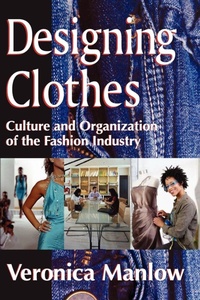
Designing Clothes
Culture and Organization of the Fashion Industry
1st Edition
Published on 15. February 2009
Book
Paperback/Softback
328 pages
978-1-4128-1055-5 (ISBN)
Description
Fashion is all around us: we see it, we buy it, we read about it, but most people know little about fashion as a business. Veronica Manlow considers the broader signifi cance of fashion in society, the creative process of fashion design, and how fashion unfolds in an organizational context where design is conceived and executed. To get a true insider's perspective, she became an intern at fashion giant Tommy Hilfi ger. Th ere, she observed and recorded how a business's culture is built on a brand that is linked to the charisma and style of its leader.
Fashion firms are not just in the business of selling clothing along with a variety of sidelines. Th ese companies must also sell a larger concept around which people can identify and distinguish themselves from others. Manlow defi nes the four main tasks of a fashion fi rm as creation of an image, translation of that image into a product, presentation of the product, and selling the product. Each of these processes is interrelated and each requires the eff orts of a variety of specialists, who are often in distant locations. Manlow shows how the design and presentation of fashion is infl uenced by changes in society, both cultural and economic. Information about past sales and reception of items, as well as projective research informs design, manufacturing, sales, distribution, and marketing decisions.
Manlow offers a comprehensive view of the ways in which creative decisions are made, leading up to the creation of actual styles. She helps to defi ne the contribution fashion fi rms make in upholding, challenging, or redefi ning the social order. Readers will fi nd this a fascinating examination of an industry that is quite visible, but little understood.
Fashion firms are not just in the business of selling clothing along with a variety of sidelines. Th ese companies must also sell a larger concept around which people can identify and distinguish themselves from others. Manlow defi nes the four main tasks of a fashion fi rm as creation of an image, translation of that image into a product, presentation of the product, and selling the product. Each of these processes is interrelated and each requires the eff orts of a variety of specialists, who are often in distant locations. Manlow shows how the design and presentation of fashion is infl uenced by changes in society, both cultural and economic. Information about past sales and reception of items, as well as projective research informs design, manufacturing, sales, distribution, and marketing decisions.
Manlow offers a comprehensive view of the ways in which creative decisions are made, leading up to the creation of actual styles. She helps to defi ne the contribution fashion fi rms make in upholding, challenging, or redefi ning the social order. Readers will fi nd this a fascinating examination of an industry that is quite visible, but little understood.
More details
Language
English
Place of publication
New York
United States
Publishing group
Taylor & Francis Inc
Dimensions
Height: 229 mm
Width: 152 mm
Thickness: 19 mm
Weight
534 gr
ISBN-13
978-1-4128-1055-5 (9781412810555)
Copyright in bibliographic data and cover images is held by Nielsen Book Services Limited or by the publishers or by their respective licensors: all rights reserved.
Schweitzer Classification
Other editions
Additional editions
E-Book
05/2018
1st Edition
Routledge
€67.49
Available for download
E-Book
05/2018
1st Edition
Routledge
€67.49
Available for download

Book
07/2007
1st Edition
Transaction Publishers
€215.41
Article not available at the moment
Person
Veronica Manlow is assistant professor in the Department of Economics at Brooklyn College.
Content
I: The Fashion Industry; 1: Clothing, Fashion, and Society; 2: The Emergence of the Fashion Industry; 3: The Fashion Designer; 4: Leadership in the Fashion Industry; 5: Organizational Culture in the Fashion Industry; II: Tommy Hilfiger USA, Inc.: A Case Study; 6: Charisma, Culture, and Representation at Tommy Hilfiger; 7: Epilogue