

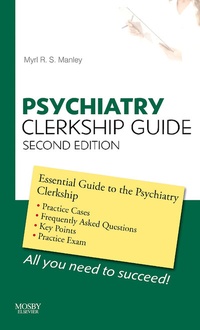
Psychiatry Clerkship Guide
2nd Edition
Published on 1. June 2007
Book
Paperback/Softback
544 pages
978-1-4160-3132-1 (ISBN)
Description
This guide equips you with the practical core knowledge you need to manage the patients you're most likely to see during your psychiatry clerkship. Brief enough to read from cover to cover, yet thorough enough to address virtually all the challenges you might face, "Psychiatry Clerkship Guide" is just the tool you need to succeed. Broken into three sections, the book first introduces you to basic skills and concepts, including ethics, history, physical examination, and developmental assessment. It then goes on to describe specific psychiatric health conditions, organized by presentation (symptom, sign, abnormal lab value) and by diagnosis-allowing you to approach a problem from either direction.
More details
Series
Edition
2nd Revised edition
Language
English
Place of publication
St Louis
United States
Publishing group
Elsevier - Health Sciences Division
Target group
College/higher education
Medical Students
Edition type
Revised edition
Illustrations
Illustrated
Dimensions
Height: 210 mm
Width: 127 mm
ISBN-13
978-1-4160-3132-1 (9781416031321)
Copyright in bibliographic data and cover images is held by Nielsen Book Services Limited or by the publishers or by their respective licensors: all rights reserved.
Schweitzer Classification
Other editions
Previous edition

Myrl R. S. Manley
Psychiatry Clerkship Guide
Book
01/2003
Mosby
€30.99
Article exhausted; check for reprint
Content
I-A. Orientation to the Psychiatry Clerkship 1. The patient's day on the inpatient unit 2. The medical student's role on the inpatient service 3. The medical student in the outpatient clinic 4. The medical student on the consultation/liaison service 5. The medical student in the psychiatric emergency room I-B. Evaluating the patient 6. Using DSM-IV 7. The history and mental status examination 8. The medical evaluation of psychiatric patients 9. Psychological testing II. Symptoms, signs, and abnormal laboratory values 10. Hallucinations 11. Delusions 12. Disorganized thinking and speech 13. Mood disturbances 14. Anxiety 15. Memory loss 16. Suicidality 17. Violence 18. Sleep disturbance 19. Sexual symptoms 20. Changes in appetite and eating disturbances III. Patients with a known condition 21. Schizophrenia and other psychotic disorders 22. Major depression 23 Bipolar disorder 24. Anxiety disorders 25. Substance-related disorders 26. Delirium and dementia 27. Personality disorders 28. Eating disorders 29. Sleep disorders 30. Sexual dysfunctions 31. Somatoform disorders, factitious disorders and malingering 32. Disorders of childhood and adolescence 33. Medication-induced movement disorders