

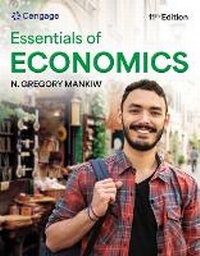
Essentials of Economics
11th Edition
Published on 1. January 2026
Book
Hardback
576 pages
979-8-214-05541-1 (ISBN)
Description
Gain a strong understanding of the essential principles of economics with Mankiw's "Essentials of Economics," 11th Edition -- part of the popular economic series that's trusted worldwide. Using a concise, inviting writing style, this edition focuses exclusively on content to help you better understand the world and economy in which you live. Become an astute participant in today's economy as you learn the potential and limits of essential economic policy. Examples and learning features clarify and bring key economic principles to life as Mankiw puts himself in the position of someone seeing economics for the first time. Dr. Mankiw's goal is to emphasize the material you will find most relevant and interesting as you study economics. MindTap digital resources, Aplia digital homework solution and author videos are also available to help you further master essential economic principles.
More details
Edition
11th edition
Language
English
Place of publication
Florence
United States
Publishing group
Cengage Learning, Inc
Target group
College/higher education
Product notice
sewn/stitched
Cloth over boards
Dimensions
Height: 244 mm
Width: 213 mm
Thickness: 28 mm
Weight
1338 gr
ISBN-13
979-8-214-05541-1 (9798214055411)
Copyright in bibliographic data and cover images is held by Nielsen Book Services Limited or by the publishers or by their respective licensors: all rights reserved.
Schweitzer Classification
Person
N. Gregory Mankiw is the Robert M. Beren Professor of Economics at Harvard University. As a student, he studied economics at Princeton University and the Massachusetts Institute of Technology. As a teacher, he has taught macroeconomics, microeconomics, statistics and principles of economics. Professor Mankiw is a prolific writer and a regular participant in academic and policy debates. In addition to his teaching, research and writing, Professor Mankiw has been a research associate of the National Bureau of Economic Research and an advisor to the Federal Reserve Banks of Boston and New York and the Congressional Budget Office. From 2003 to 2005, he served as chairman of the US President's Council of Economic Advisors and was an advisor to presidential candidate Mitt Romney during the 2012 US presidential election.
Content
About the Author.
Brief Contents.
Table of Contents.
Preface.
Part I: INTRODUCTION.
1. Ten Principles of Economics.
2. Thinking Like an Economist.
3. Interdependence and the Gains from Trade.
Part II: HOW MARKETS WORK.
4. The Market Forces of Supply and Demand.
5. Elasticity and Its Application.
6. Supply, Demand, and Government Policies.
Part III: MARKETS AND WELFARE.
7. Consumers, Producers, and the Efficiency of Markets.
8. Application: The Costs of Taxation.
9. Application: International Trade.
Part IV: THE ECONOMICS OF THE PUBLIC SECTOR.
10. Externalities.
11. Public Goods and Common Resources.
Part V: Firm Behavior and the Organization of Industry.
12. The Costs of Production.
13. Firms in Competitive Markets.
14. Monopoly.
Part VI: THE DATA OF MACROECONOMICS.
15. Measuring a Nation's Income.
16. Measuring the Cost of Living.
Part VII: THE REAL ECONOMY IN THE LONG RUN.
17. Production and Growth.
18. Saving, Investment, and the Financial System.
19. The Basic Tools of Finance.
20. Unemployment.
Part VIII: MONEY AND PRICES IN THE LONG RUN.
21. The Monetary System.
22. Money Growth and Inflation.
Part IX: SHORT-RUN ECONOMIC FLUCTUATIONS.
23. Aggregate Demand and Aggregate Supply.
24. The Influence of Monetary and Fiscal Policy on Aggregate Demand.
Glossary.
Index.
Brief Contents.
Table of Contents.
Preface.
Part I: INTRODUCTION.
1. Ten Principles of Economics.
2. Thinking Like an Economist.
3. Interdependence and the Gains from Trade.
Part II: HOW MARKETS WORK.
4. The Market Forces of Supply and Demand.
5. Elasticity and Its Application.
6. Supply, Demand, and Government Policies.
Part III: MARKETS AND WELFARE.
7. Consumers, Producers, and the Efficiency of Markets.
8. Application: The Costs of Taxation.
9. Application: International Trade.
Part IV: THE ECONOMICS OF THE PUBLIC SECTOR.
10. Externalities.
11. Public Goods and Common Resources.
Part V: Firm Behavior and the Organization of Industry.
12. The Costs of Production.
13. Firms in Competitive Markets.
14. Monopoly.
Part VI: THE DATA OF MACROECONOMICS.
15. Measuring a Nation's Income.
16. Measuring the Cost of Living.
Part VII: THE REAL ECONOMY IN THE LONG RUN.
17. Production and Growth.
18. Saving, Investment, and the Financial System.
19. The Basic Tools of Finance.
20. Unemployment.
Part VIII: MONEY AND PRICES IN THE LONG RUN.
21. The Monetary System.
22. Money Growth and Inflation.
Part IX: SHORT-RUN ECONOMIC FLUCTUATIONS.
23. Aggregate Demand and Aggregate Supply.
24. The Influence of Monetary and Fiscal Policy on Aggregate Demand.
Glossary.
Index.