

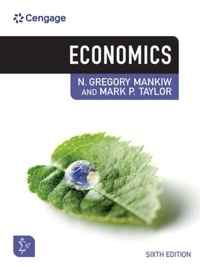
Economics
6th Edition
Published on 10. February 2023
Book
Paperback/Softback
832 pages
978-1-4737-8698-1 (ISBN)
Description
Now firmly established as one of the leading economics principles texts in the UK and Europe, the sixth edition of Economics has been fully updated. Much revered for its friendly and accessible approach, emphasis on active learning and unrivalled support resources, this edition features a brand-new chapter on sustainability economics as well as exciting coverage on modern monetary theory, digitization, Industry 4.0 and the costs and benefits of globalization.
This title is available with MindTap, a flexible online learning solution that provides students with all the tools they need to succeed including an interactive eReader, engaging multimedia, practice questions, assessment materials, revision aids, and analytics to help you track their progress.
This title is available with MindTap, a flexible online learning solution that provides students with all the tools they need to succeed including an interactive eReader, engaging multimedia, practice questions, assessment materials, revision aids, and analytics to help you track their progress.
More details
Edition
6th edition
Language
English
Place of publication
London
United Kingdom
Target group
College/higher education
Dimensions
Height: 259 mm
Width: 194 mm
Thickness: 34 mm
Weight
1520 gr
ISBN-13
978-1-4737-8698-1 (9781473786981)
Copyright in bibliographic data and cover images is held by Nielsen Book Services Limited or by the publishers or by their respective licensors: all rights reserved.
Schweitzer Classification
Other editions
New editions
N. Mankiw | Mark Taylor
Economics
Book
02/2026
7th Edition
Cengage Learning EMEA
€78.00
Available immediately
Additional editions
Loose-leaf edition
01/2023
10th Edition
CENGAGE Learning Custom Publishing
€189.91
Article not available for order
Persons
N. Gregory Mankiw is the Robert M. Beren Professor of Economics at Harvard University. As a student, he studied economics at Princeton University and the Massachusetts Institute of Technology. As a teacher, he has taught macroeconomics, microeconomics, statistics and principles of economics. Professor Mankiw is a prolific writer and a regular participant in academic and policy debates. In addition to his teaching, research and writing, Professor Mankiw has been a research associate of the National Bureau of Economic Research and an advisor to the Federal Reserve Banks of Boston and New York and the Congressional Budget Office. From 2003 to 2005, he served as chairman of the US President's Council of Economic Advisors and was an advisor to presidential candidate Mitt Romney during the 2012 US presidential election. Mark P. Taylor is the Donald Danforth, Jr Distinguished Professor of Finance at the Olin Business School at Washington University in St Louis, USA. He was previously Dean of the Olin Business School and, before that, Dean and Professor of Finance and Economics at of Warwick Business School at the University of Warwick, UK. He obtained his first degree in philosophy, politics and economics from Oxford University and a Master's and Doctoral degrees in economics and finance from London University.. Professor Taylor has taught economics at various universities (including Warwick, Oxford, Marseille and New York), at various levels (from principles courses to advanced graduate and MBA courses) and in various fields (including macroeconomics, microeconomics and econometrics). He has also worked as a senior economist at the International Monetary Fund and at the Bank of England and as a managing director at BlackRock, the world's largest financial asset manager, where he ran a global investment fund based on macroeconomic analysis. His work has been extensively published in scholarly journals, such as the Journal of Political Economy and the Economic Journal, and he is today one of the most highly cited economists in the world in economic research. In addition, Professor Taylor has acted as an advisor to the International Monetary Fund, the World Bank, the Bank of England, the European Commission and to senior members of the UK government. He is a research fellow of the Centre for Economic Policy Research, a member of council of the Royal Economic Society and a fellow of both the Royal Statistical Society and the Royal Society of Arts.
Content
Part I. Introduction to Economics
1. What is Economics?
2. Thinking Like an Economist
Part II. The Theory of Competitive Markets
3. The Market Forces of Supply and Demand
4. Background to Demand: Consumer Choices
5. Background to Supply: The Costs of Production of Firms
6. Background to Supply: Firms in Competitive Markets
7. Consumers, Producers and The Efficiency of Markets
Part III. Interventions in Markets
8. Supply, Demand and Government Policies
9. Public Goods, Common Resources and Merit Goods
10. Market Failure and Externalities
Part IV. Firm Behaviour and Market Structures
11. Market Structures I: Monopoly
12. Market Structures II: Monopolistic Competition
13. Market Structures III: Oligopoly
14. Market Structures IV: Contestable Markets
Part V. Factor Markets
15. The Economics of Factor Markets
Part VI. Inequality
16. Income Inequality and Poverty
Part VII. Trade
17. Interdependence and the Gains From Trade
Part VIII. Heterodox Economics
18. Information and Behavioural Economics
19. Heterodox Theories in Economics
Part IX. The Data of Macroeconomics
20. Measuring a Nation's Wellbeing and the Price Level
Part X. The Real Economy in the Long Run
21. Production and Growth
22. Unemployment and the Labour Market
Part XI. Long-Run Macroeconomics
23. Saving, Investment and the Financial System
24. The Monetary System
25. Open-Economy Macroeconomics
Part XII. Short-Run Economic Fluctuations
26. Business Cycles
27. Keynesian Economics and IS-LM Analysis
28. Aggregate Demand and Aggregate Supply
29. The Influence of Monetary and Fiscal Policy on Aggregate Demand
30. The Short-Run Trade-Off Between Inflation and Unemployment
31. Supply-Side Policies
Part XIII. International Macroeconomics
32. Economic Shocks
33. The European Union
34. Sustainability Economics
1. What is Economics?
2. Thinking Like an Economist
Part II. The Theory of Competitive Markets
3. The Market Forces of Supply and Demand
4. Background to Demand: Consumer Choices
5. Background to Supply: The Costs of Production of Firms
6. Background to Supply: Firms in Competitive Markets
7. Consumers, Producers and The Efficiency of Markets
Part III. Interventions in Markets
8. Supply, Demand and Government Policies
9. Public Goods, Common Resources and Merit Goods
10. Market Failure and Externalities
Part IV. Firm Behaviour and Market Structures
11. Market Structures I: Monopoly
12. Market Structures II: Monopolistic Competition
13. Market Structures III: Oligopoly
14. Market Structures IV: Contestable Markets
Part V. Factor Markets
15. The Economics of Factor Markets
Part VI. Inequality
16. Income Inequality and Poverty
Part VII. Trade
17. Interdependence and the Gains From Trade
Part VIII. Heterodox Economics
18. Information and Behavioural Economics
19. Heterodox Theories in Economics
Part IX. The Data of Macroeconomics
20. Measuring a Nation's Wellbeing and the Price Level
Part X. The Real Economy in the Long Run
21. Production and Growth
22. Unemployment and the Labour Market
Part XI. Long-Run Macroeconomics
23. Saving, Investment and the Financial System
24. The Monetary System
25. Open-Economy Macroeconomics
Part XII. Short-Run Economic Fluctuations
26. Business Cycles
27. Keynesian Economics and IS-LM Analysis
28. Aggregate Demand and Aggregate Supply
29. The Influence of Monetary and Fiscal Policy on Aggregate Demand
30. The Short-Run Trade-Off Between Inflation and Unemployment
31. Supply-Side Policies
Part XIII. International Macroeconomics
32. Economic Shocks
33. The European Union
34. Sustainability Economics