

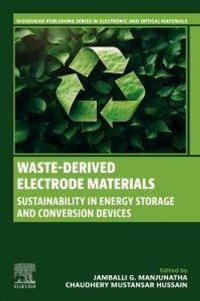
Waste-Derived Electrode Materials
Sustainability in Energy Storage and Conversion Devices
Will be published approx. on 1. March 2027
Book
Paperback/Softback
550 pages
978-0-443-33467-2 (ISBN)
Description
Waste-Derived Electrode Materials: Sustainability in Energy Storage and Conversion Devices addresses the pressing need for sustainable solutions in the field of energy storage and conversion. The world is facing significant challenges related to waste management and the depletion of natural resources. At the same time, there is a growing demand for advanced electrode materials to meet the requirements of emerging technologies such as batteries, fuel cells, and solar cells. This book bridges the gap between these two areas by exploring the potential of waste-derived materials for use in electrode fabrication. The book provides a comprehensive and authoritative resource on the topic of waste-derived electrode materials, focusing on their synthesis, characterization, and application in energy storage and conversion devices. It explores the various types of waste materials that can be used as precursors, such as carbon-based waste (biomass, agricultural residues, and waste plastics) and metal-containing waste (spent batteries, electronic waste). It also covers the methods and processes for transforming these waste materials into high-performance electrode materials through innovative techniques such as pyrolysis, hydrothermal treatment, and chemical modification. The environmental and economic aspects of utilizing waste-derived electrode materials are considered, including factors such as resource efficiency, waste reduction, carbon footprint, and cost-effectiveness. The book also discusses the potential impact of these materials on sustainability, circular economy principles, and the reduction of environmental pollution.
More details
Series
Language
English
Place of publication
United States
Publishing group
Elsevier - Health Sciences Division
Target group
Professional and scholarly
Product notice
Paperback (trade)
Unsewn / adhesive bound
Dimensions
Height: 229 mm
Width: 152 mm
ISBN-13
978-0-443-33467-2 (9780443334672)
Copyright in bibliographic data and cover images is held by Nielsen Book Services Limited or by the publishers or by their respective licensors: all rights reserved.
Schweitzer Classification
Persons
J G Manjunatha is an Assistant Professor in Chemistry at FMKMC College, A Constituent College of Mangalore University, India. He received his Ph.D. degree in Chemistry from Kuvempu University and Postdoc from the University of Kebangsaan Malaysia. His research interests focus on the fabrication of electrochemical sensors for the detection of biologically active molecules and the fabrication of binderless supercapacitors. He has received various awards and published more than 190 research articles in reputed International Journals. An editor for around 21 books books (RSC, ACS, IOP, Elsevier and Bentham science publishers), and special issues (IOP Science Publisher, Frontiers in Sensors, MDPI). He is also an editorial board member for many reputed journals and Editor -Chief Sensing technology journal (Taylor and Francis).
Chaudhery Mustansar Hussain is an adjunct professor and lab director in the Department of Chemistry & Environmental Sciences at the New Jersey Institute of Technology (NJIT), United States. His research is focused on sustainability, nanotechnology & advanced materials, environmental management, analytical chemistry, and other various industries. Dr. Hussain is the author of numerous papers in peer-reviewed journals as well as a prolific author and editor of several books, including scientific monographs and handbooks in his research areas. He has published with ELSEVIER, American Chemical Society, Royal Society of Chemistry, John Wiley & Sons, CRC Press, and Springer.
Chaudhery Mustansar Hussain is an adjunct professor and lab director in the Department of Chemistry & Environmental Sciences at the New Jersey Institute of Technology (NJIT), United States. His research is focused on sustainability, nanotechnology & advanced materials, environmental management, analytical chemistry, and other various industries. Dr. Hussain is the author of numerous papers in peer-reviewed journals as well as a prolific author and editor of several books, including scientific monographs and handbooks in his research areas. He has published with ELSEVIER, American Chemical Society, Royal Society of Chemistry, John Wiley & Sons, CRC Press, and Springer.
Content
Part 1: INTRODUCTION AND FUNDAMENTALS
1. Introduction to Waste-derived Electrode Materials
2. Preparation of Electrode materials
3. Sustainable Energy Storage materials and Circular Economy
Part 2: VARIOUS WASTE SOURCES AND CHARACTERIZATION
4. Municipal Solid Waste (MSW)-based Electrode Materials
5. Industrial Waste-based Electrode Materials
6. Agricultural and Biomass Waste-based Electrode Materials
7. Electronic Waste-based Electrode Materials
8. Construction and Demolition Waste-based Electrode Materials
9. Mining and Metallurgical Waste-based Electrode Materials
Part 3: TREATMENT TECHNOLOGIES FOR SYNTHESIS OF ELECTRODE MATERIALS
10. Pyrolysis and Gasification of Waste for Electrode Materials
11. Chemical and Electrochemical Modification of Waste-derived Materials
12. Nanostructuring and Surface Engineering of Waste-derived Electrode Materials
13. Additive Manufacturing and Waste-derived Electrode Materials
PART 4: APPLICATIONS OF WASTE-DERIVED ELECTRODE MATERIALS
14. Waste-derived Electrode Materials for Lithium-ion Batteries
15. Waste-derived Electrode Materials for Sodium-ion Batteries
16. Waste-derived Electrode Materials for Potassium-ion Batteries
17. Waste-derived Electrode Materials for Supercapacitors
18. Waste-derived Electrode Materials for Fuel Cells
19. Waste-derived Electrode Materials for Photovoltaics
20. Chapter 20: Waste-derived Electrode Materials for Emerging Energy Storage Technologies
Part 5: CASE STUDIES
21. Case Studies I
22. Case Studies II
23. Case Studies III
24. Case Studies IV
Part 6: OTHER IMPORTANT ASPECTS
25. Scale-up, Economics Analysis and Commercialization Challenges
26. Environmental Impacts, Social and Ethical Aspects
27. Waste regulation and Policy Issues
28. Conclusion
1. Introduction to Waste-derived Electrode Materials
2. Preparation of Electrode materials
3. Sustainable Energy Storage materials and Circular Economy
Part 2: VARIOUS WASTE SOURCES AND CHARACTERIZATION
4. Municipal Solid Waste (MSW)-based Electrode Materials
5. Industrial Waste-based Electrode Materials
6. Agricultural and Biomass Waste-based Electrode Materials
7. Electronic Waste-based Electrode Materials
8. Construction and Demolition Waste-based Electrode Materials
9. Mining and Metallurgical Waste-based Electrode Materials
Part 3: TREATMENT TECHNOLOGIES FOR SYNTHESIS OF ELECTRODE MATERIALS
10. Pyrolysis and Gasification of Waste for Electrode Materials
11. Chemical and Electrochemical Modification of Waste-derived Materials
12. Nanostructuring and Surface Engineering of Waste-derived Electrode Materials
13. Additive Manufacturing and Waste-derived Electrode Materials
PART 4: APPLICATIONS OF WASTE-DERIVED ELECTRODE MATERIALS
14. Waste-derived Electrode Materials for Lithium-ion Batteries
15. Waste-derived Electrode Materials for Sodium-ion Batteries
16. Waste-derived Electrode Materials for Potassium-ion Batteries
17. Waste-derived Electrode Materials for Supercapacitors
18. Waste-derived Electrode Materials for Fuel Cells
19. Waste-derived Electrode Materials for Photovoltaics
20. Chapter 20: Waste-derived Electrode Materials for Emerging Energy Storage Technologies
Part 5: CASE STUDIES
21. Case Studies I
22. Case Studies II
23. Case Studies III
24. Case Studies IV
Part 6: OTHER IMPORTANT ASPECTS
25. Scale-up, Economics Analysis and Commercialization Challenges
26. Environmental Impacts, Social and Ethical Aspects
27. Waste regulation and Policy Issues
28. Conclusion