

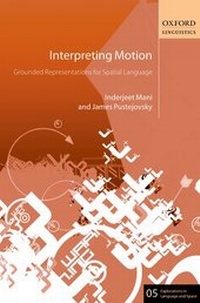
Interpreting Motion
Grounded Representations for Spatial Language
1st Edition
Published on 16. February 2012
Book
Hardback
182 pages
978-0-19-960124-0 (ISBN)
Description
Interpreting Motion presents an integrated perspective on how language structures constrain concepts of motion and how the world shapes the way motion is linguistically expressed. Natural language allows for efficient communication of elaborate descriptions of movement without requiring a precise specification of the motion. Interpreting Motion is the first book to analyze the semantics of motion expressions in terms of the formalisms of qualitative spatial reasoning. It shows how motion descriptions in language are mapped to trajectories of moving entities based on qualitative spatio-temporal relationships. The authors provide an extensive discussion of prior research on spatial prepositions and motion verbs, devoting chapters to the compositional semantics of motion sentences, the formal representations needed for computers to reason qualitatively about time, space, and motion, and the methodology for annotating corpora with linguistic information in order to train computer programs to reproduce the annotation. The applications they illustrate include route navigation, the mapping of travel narratives, question-answering, image and video tagging, and graphical rendering of scenes from textual descriptions.
The book is written accessibly for a broad scientific audience of linguists, cognitive scientists, computer scientists, and those working in fields such as artificial intelligence and geographic information systems.
The book is written accessibly for a broad scientific audience of linguists, cognitive scientists, computer scientists, and those working in fields such as artificial intelligence and geographic information systems.
Reviews / Votes
a high-quality volume that deserves the attention of any computational linguist or cognitive scientist with an interest in qualitative spatial reasoning models, computer reasoning about motion and corpus annotation. * Giovanna Marotta, Language Resources and Evaluation *More details
Series
Language
English
Place of publication
Oxford
United Kingdom
Target group
Professional and scholarly
College/higher education
Researchers in fields such as linguistics, computer science, artificial intelligence, and geography, as well as specialists in formal semantics, computational linguistics, and qualitative spatial reasoning. Also aimed at graduate-level courses in semantics, computational linguistics, information extraction, text mining, geographic information systems, artificial intelligence, qualitative spatial reasoning, and cognitive systems.
Illustrations
Figures, Line Drawings
Figures, Line Drawings
Dimensions
Height: 240 mm
Width: 163 mm
Thickness: 17 mm
Weight
428 gr
ISBN-13
978-0-19-960124-0 (9780199601240)
Copyright in bibliographic data and cover images is held by Nielsen Book Services Limited or by the publishers or by their respective licensors: all rights reserved.
Schweitzer Classification
Other editions
Additional editions
James Pustejovsky Inderjeet Mani
Interpreting Motion Grounded Representations for Spatial Language
Grounded Representations for Spatial Language
E-Book
02/2012
1st Edition
Oxford University Press
€110.49
Available for download
Persons
Inderjeet Mani has been a Senior Principal Scientist at The MITRE Corporation, a Visiting Fellow at Cambridge University, and an Associate Professor at Georgetown University. He is the author of Automatic Summarization (John Benjamins 2001), The Imagined Moment: Time, Narrative, and Computation (Nebraska 2010), and Narrative Modeling (Morgan and Claypool forthcoming), and co-editor of Advances in Automatic Text Summarization (MIT 1999) and The Language of Time (OUP 2005).
James Pustejovsky is the TJX/Feldberg Chair in Computer Science at Brandeis University. His topics of research are natural language processing, lexical semantics, temporal reasoning, event semantics, and language annotation. His books include The Generative Lexicon (MIT 1995); with Bran Boguraev, Lexical Semantics: The Problem of Polysemy (OUP 1997); with Carol Tenny, Events as Grammatical Objects (CSLI 2001); with Amber Stubbs, Natural Language Annotation for Machine Learning (O'Reilly 2012); with Elizabetta Jezek Generative Lexicon Theory: A Guide (OUP forthcoming); and Coercion and Compositionality (MIT Press forthcoming).
James Pustejovsky is the TJX/Feldberg Chair in Computer Science at Brandeis University. His topics of research are natural language processing, lexical semantics, temporal reasoning, event semantics, and language annotation. His books include The Generative Lexicon (MIT 1995); with Bran Boguraev, Lexical Semantics: The Problem of Polysemy (OUP 1997); with Carol Tenny, Events as Grammatical Objects (CSLI 2001); with Amber Stubbs, Natural Language Annotation for Machine Learning (O'Reilly 2012); with Elizabetta Jezek Generative Lexicon Theory: A Guide (OUP forthcoming); and Coercion and Compositionality (MIT Press forthcoming).
Content
1. Introduction ; 2. Concepts of Motion in Language ; 3. Spatial and Temporal Ontology ; 4. The Representation of Motion ; 5. Semantic Annotation ; 6. Applications and Prospects ; References ; Index