

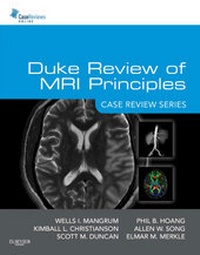
Duke Review of MRI Principles: Case Review Series
Case Review Series
Published on 2. April 2012
Book
Paperback/Softback
304 pages
978-1-4557-0084-4 (ISBN)
Description
The newest title in the popular Case Review Series, Duke Review of MRI Principles, by Wells Mangrum, MD; Kimball Christianson, MD; Scott Duncan, MD; Phil Hoang, MD; Allen W. Song, PhD; and Elmar Merkle, MD, uses a case-based approach to provide you with a concise overview of the physics behind magnetic resonance imaging (MRI). Written by radiology residents, practicing radiologists, and radiology physicists, this multidisciplinary text introduces you to the basic physics of MRI and how they apply to successful and accurate imaging, interpretation, and diagnosis. Clinically relevant cases with associated questions and images reinforce your understanding of essential principles needed to confidently interpret a wide range of MRI images for all organ systems.
Review the basic physics of MRI in a concise, high-yield manner and learn how to apply them for successful and accurate imaging, interpretation, and diagnosis.
Master 17 essential MRI principles you need to know through clinically relevant cases accompanied by associated questions and 600 images that reinforce your understanding and help you confidently interpret a wide range of MRI images.
Effectively diagnose disease in all organ systems. Authors are fellowship-trained in each body system - neuro, breast, body, vascular and MSK, providing you with practical guidance in every area
Focus on the information that's most relevant to your needs from a multidisciplinary author team comprised of radiology residents, practicing radiologists and radiology physicists.
See the underlying simplicity behind MRI physics. Despite employing the same MRI principles, similar imaging systems use slightly different names. A simplified explanation of these principles and how they are applied to each body system deepens your understanding and helps avoid any confusion.
All the MRI physics that the resident needs to understand to comfortably interpret MRI
Review the basic physics of MRI in a concise, high-yield manner and learn how to apply them for successful and accurate imaging, interpretation, and diagnosis.
Master 17 essential MRI principles you need to know through clinically relevant cases accompanied by associated questions and 600 images that reinforce your understanding and help you confidently interpret a wide range of MRI images.
Effectively diagnose disease in all organ systems. Authors are fellowship-trained in each body system - neuro, breast, body, vascular and MSK, providing you with practical guidance in every area
Focus on the information that's most relevant to your needs from a multidisciplinary author team comprised of radiology residents, practicing radiologists and radiology physicists.
See the underlying simplicity behind MRI physics. Despite employing the same MRI principles, similar imaging systems use slightly different names. A simplified explanation of these principles and how they are applied to each body system deepens your understanding and helps avoid any confusion.
All the MRI physics that the resident needs to understand to comfortably interpret MRI
More details
Series
Language
English
Place of publication
Philadelphia
United States
Publishing group
Elsevier - Health Sciences Division
Target group
Professional and scholarly
Illustrations
Approx. 619 illustrations
Dimensions
Height: 276 mm
Width: 216 mm
ISBN-13
978-1-4557-0084-4 (9781455700844)
Copyright in bibliographic data and cover images is held by Nielsen Book Services Limited or by the publishers or by their respective licensors: all rights reserved.
Schweitzer Classification
Other editions
New editions
Wells Mangrum | Quoc Bao Hoang | Tim J. Amrhein
Duke Review of MRI Physics: Case Review Series
Book
06/2018
2nd Edition
Elsevier
€76.00
Shipment within 10-15 days
Persons
Content
Chapter 1
T1 Contrast
Chapter 2
T2 Contrast
Chapter 3
Proton Density
Chapter 4
Gadolinium-Based Contrast Agents
Chapter 5
Preparatory Pulses
Chapter 6
Inversion Recovery
Chapter 7
Chemical Shift Type II Artifact
Chapter 8
Susceptibility Artifact
Chapter 9
Motion, Pulsation and Other Artifacts
Chapter 10
Flow Related Contrast
Chapter 11
Time of Flight Imaging
Chapter 12
Time-Resolved Contrast-Enhanced Magnetic Resonance Angiography
Chapter 13
Phase Contrast
Chapter 14
Diffusion MRI
Chapter 15
Perfusion Magnetic Resonance Imaging
Chapter 16
Magnetic Resonance Spectroscopy
Chapter 17
Functional Magnetic Resonance Imaging
T1 Contrast
Chapter 2
T2 Contrast
Chapter 3
Proton Density
Chapter 4
Gadolinium-Based Contrast Agents
Chapter 5
Preparatory Pulses
Chapter 6
Inversion Recovery
Chapter 7
Chemical Shift Type II Artifact
Chapter 8
Susceptibility Artifact
Chapter 9
Motion, Pulsation and Other Artifacts
Chapter 10
Flow Related Contrast
Chapter 11
Time of Flight Imaging
Chapter 12
Time-Resolved Contrast-Enhanced Magnetic Resonance Angiography
Chapter 13
Phase Contrast
Chapter 14
Diffusion MRI
Chapter 15
Perfusion Magnetic Resonance Imaging
Chapter 16
Magnetic Resonance Spectroscopy
Chapter 17
Functional Magnetic Resonance Imaging