

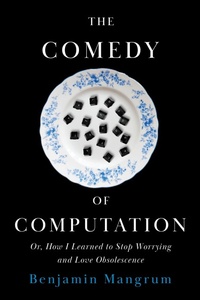
The Comedy of Computation
Or, How I Learned to Stop Worrying and Love Obsolescence
Published on 29. July 2025
Book
Hardback
276 pages
978-1-5036-4262-1 (ISBN)
Description
In this cultural history of the computer, Benjamin Mangrum shows that comedy has been central to how we've made sense of the technology's sweeping effects on public life and private experience. From the first Broadway play to include a computer in the 1950s to popular films like You've Got Mail and joke-telling digital assistants, Mangrum assembles an extensive archive of work by writers, filmmakers, programmers, engineers, and other technologists who have coupled comedy with computation. Many have used comedy to make the computer seem ordinary. Others have tried to stage the assimilation of computers within corporate life as a kind of comic drama. Mangrum describes these and many other ways in which comedy and computation have come together as a new genre of experience: the comedy of computation.
The modern world exalts advances in technology, but we are constantly haunted by the specter of falling behind and becoming obsolete. Mangrum examines how comedy serves as a stage for working out these conflicted modes of experience in writing by Dave Eggers, Curtis Sittenfeld, Ishmael Reed, and Kurt Vonnegut Jr., among others, arguing that when we look at the comic forms that shape the cultures of computing, we come to better understand the tensions and contradictions internal to the social world we inhabit.
The modern world exalts advances in technology, but we are constantly haunted by the specter of falling behind and becoming obsolete. Mangrum examines how comedy serves as a stage for working out these conflicted modes of experience in writing by Dave Eggers, Curtis Sittenfeld, Ishmael Reed, and Kurt Vonnegut Jr., among others, arguing that when we look at the comic forms that shape the cultures of computing, we come to better understand the tensions and contradictions internal to the social world we inhabit.
Reviews / Votes
"Essential for understanding the technological world in its complexity, absurdity, and vibrancy. Never satisfied with cheap laughs, Mangrum reads across culture in the widest sense, and knows exactly when to take his subjects seriously-for their sake and our own."-Mark Goble, University of California, Berkeley "Mangrum helps readers understand that anxieties about automation are old, not new, and that arts and culture play an essential role in the conversation around computation. An important and illuminating work for scholars of American literature and cultural studies."
-Aarthi Vadde, Duke University
More details
Edition
New edition
Language
English
Place of publication
Palo Alto
United States
Target group
Professional and scholarly
College/higher education
Edition type
New edition
Product notice
Cloth
Illustrations
22 halftones
Dimensions
Height: 232 mm
Width: 160 mm
Thickness: 22 mm
Weight
534 gr
ISBN-13
978-1-5036-4262-1 (9781503642621)
Copyright in bibliographic data and cover images is held by Nielsen Book Services Limited or by the publishers or by their respective licensors: all rights reserved.
Schweitzer Classification
Person
Benjamin Mangrum is Associate Professor of Literature at MIT and author of Land of Tomorrow: Postwar Fiction and the Crisis of American Liberalism (2019), winner of the Louis I. Bredvold Prize in 2019, awarded by the University of Michigan.