

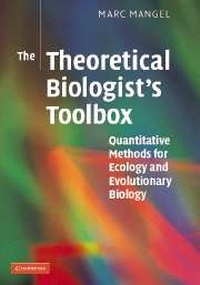
The Theoretical Biologist's Toolbox
Quantitative Methods for Ecology and Evolutionary Biology
Published on 27. July 2006
Book
Hardback
390 pages
978-0-521-83045-4 (ISBN)
Description
Mathematical modelling is widely used in ecology and evolutionary biology and it is a topic that many biologists find difficult to grasp. In this new textbook Marc Mangel provides a no-nonsense introduction to the skills needed to understand the principles of theoretical and mathematical biology. Fundamental theories and applications are introduced using numerous examples from current biological research, complete with illustrations to highlight key points. Exercises are also included throughout the text to show how theory can be applied and to test knowledge gained so far. Suitable for advanced undergraduate courses in theoretical and mathematical biology, this book forms an essential resource for anyone wanting to gain an understanding of theoretical ecology and evolution.
Reviews / Votes
'...this is a hugely engaging and interesting book. It's written with many asides and snippets of information about the topic, and particularly about the key figures in the history of theoretical biology ... I do recommend this book as an excellent read and insight into the methodology of the theoretical biologist at work ...' Biologist '[the author] goes to considerable lengths to generate the necessary thirst through metaphor, humour, and through the clarity with which he writes about the subject. At the same time he is realistic about the need ultimately to get out a pencil and paper, and to work through the exercises, as the key to making real progress in understanding. ... The blend of deterministic and stochastic modelling nicely captures the pulse of current thinking in theoretical ecology, and is a real strength of this book ... For me, part of the charm of the book is its quirkiness, and I will be recommending it to my graduate students.' Fish and Fisheries '... offers a refreshing approach ... providing aspiring (and even established) theoreticians with a user-friendly and thorough introduction to a wide variety of techniques. ... It is an accessible introduction to different models and analyses in theoretical population biology. ... it is replete with exercises. These are not confined to the end of each chapter but appear after the introduction of associated material. This approach is a huge asset that underscores the book's pedagogic approach to mathematical biology, allowing easy reference to particular topics.' BioScience '... very entertaining ... a real desire to encourage enthusiastic participation, and a general sense of excitement about the use of theory in biology, helped along by the many references to classic studies in ecology and evolutionary biology.' EvolutionMore details
Language
English
Place of publication
Cambridge
United Kingdom
Target group
Professional and scholarly
Illustrations
29 Halftones, unspecified; 57 Line drawings, unspecified
Dimensions
Height: 254 mm
Width: 180 mm
Thickness: 23 mm
Weight
932 gr
ISBN-13
978-0-521-83045-4 (9780521830454)
Copyright in bibliographic data and cover images is held by Nielsen Book Services Limited or by the publishers or by their respective licensors: all rights reserved.
Schweitzer Classification
Other editions
New editions
Marc Mangel
The Theoretical Biologist's Toolbox
Quantitative Methods for Ecology and Evolutionary Biology
Book
07/2006
Cambridge University Press
€75.30
Shipment within 15-20 days
Additional editions
Marc Mangel
The Theoretical Biologist's Toolbox
Quantitative Methods for Ecology and Evolutionary Biology
E-Book
11/2006
1st Edition
Cambridge University Press
€54.99
Available for download
Marc Mangel
The Theoretical Biologist's Toolbox
Quantitative Methods for Ecology and Evolutionary Biology
Book
07/2006
Cambridge University Press
€75.30
Shipment within 15-20 days
Person
Marc Mangel is Professor of Mathematical Biology and Fellow of Stevenson College at the University of California, Santa Cruz campus.
Content
Preface; 1. Four examples and a metaphor; 2. Topics from ordinary and partial differential equations; 3. Probability and some statistics; 4. The evolutionary ecology of parasitoids; 5. The population biology of disease; 6. An introduction to some of the problems of sustainable fisheries; 7. The basics of stochastic population dynamics; 8. Applications of stochastic population dynamics to ecology, evolution and biodemography.