

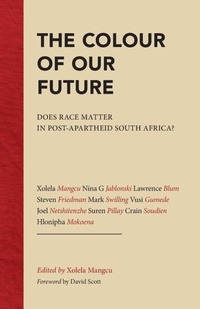
The Colour of Our Future
Does Race Matter in Post-apartheid South Africa?
Published on 1. July 2015
Book
Paperback/Softback
272 pages
978-1-86814-569-0 (ISBN)
Description
South Africa is ready for a new vocabulary than can form the basis for a national consciousness which recognises racialised identities while affirming that, as human beings, we are much more than our racial, sexual, class, religious or national identities.
The Colour of Our Future makes a bold and ambitious contribution to the discourse on race. It addresses the tension between the promise of a post-racial society and the persistence of racialised identities in South Africa, which has historically played itself out in debates between the 'I don't see race' of non-racialism and the 'I'm proud to be black' of black consciousness.
The chapters in this volume highlight the need for a race-transcendent vision that moves beyond 'the festival of negatives' embodied in concepts such as non-racialism, non-sexism, anti-colonialism and anti-apartheid. Steve Biko's notion of a 'joint culture' is the scaffold on which this vision rests; it recognises that a race-transcendent society can only be built by acknowledging the constituent elements of South Africa's EuroAfricanAsian heritage.
The distinguished authors in this volume have, over the past two decades, used the democratic space to insert into the public domain new conversations around the intersections of race and the economy, race and the state, race and the environment, race and ethnic difference, and race and higher education. Presented here is some of their most trenchant and yet still evolving thinking.
The Colour of Our Future makes a bold and ambitious contribution to the discourse on race. It addresses the tension between the promise of a post-racial society and the persistence of racialised identities in South Africa, which has historically played itself out in debates between the 'I don't see race' of non-racialism and the 'I'm proud to be black' of black consciousness.
The chapters in this volume highlight the need for a race-transcendent vision that moves beyond 'the festival of negatives' embodied in concepts such as non-racialism, non-sexism, anti-colonialism and anti-apartheid. Steve Biko's notion of a 'joint culture' is the scaffold on which this vision rests; it recognises that a race-transcendent society can only be built by acknowledging the constituent elements of South Africa's EuroAfricanAsian heritage.
The distinguished authors in this volume have, over the past two decades, used the democratic space to insert into the public domain new conversations around the intersections of race and the economy, race and the state, race and the environment, race and ethnic difference, and race and higher education. Presented here is some of their most trenchant and yet still evolving thinking.
Reviews / Votes
The colour of our future is a timely book. The individual chapters clearly show that questions of race have not withered away with the installation of a progressive constitution intended to create a nonracial society. That there might be good reason for understanding and accepting racial identities that are not only imposed or accepted for the purpose of resistance, but can, properly understood, be part of a positive future, is to be welcomed - Paul Graham, former executive director of IDASA.More details
Language
English
Place of publication
Johannesburg
South Africa
Target group
Professional and scholarly
Product notice
Paperback (trade)
Dimensions
Height: 211 mm
Width: 132 mm
Thickness: 20 mm
Weight
272 gr
ISBN-13
978-1-86814-569-0 (9781868145690)
Copyright in bibliographic data and cover images is held by Nielsen Book Services Limited or by the publishers or by their respective licensors: all rights reserved.
Schweitzer Classification
Other editions
Additional editions
E-Book
07/2015
Abingdon Press
€29.49
Available for download
Persons
Xolela Mangcu is now based at the Department of Sociology at the University of Cape Town. He is Non-resident Senior Fellow at the Brookings Institution, Washington D.C.
Xolela Mangcu is now based at the Department of Sociology at the University of Cape Town. He is Non-resident Senior Fellow at the Brookings Institution, Washington D.C.
Nina G. Jablonski is the Evan Pugh Professor in the Department of Sociology at the University of Cape Town.
Dennis L. Krebs is Chair and Professor of Psychology at Simon Fraser University. Lawrence A. Blum is Professor of Philosophy and Women's studies at the University of Massachusetts at Boston. M Zuzanna Smolenska is Assistant Professor, Polish Academy of Science.
Steven Friedman is Research Professor associated with the Department of Politics in the Humanities Faculty, University of Johannesburg. He is a political scientist who specialises in the study of democracy; a public commentator; newspaper columnist and a former trade unionist.
Xolela Mangcu is now based at the Department of Sociology at the University of Cape Town. He is Non-resident Senior Fellow at the Brookings Institution, Washington D.C.
Nina G. Jablonski is the Evan Pugh Professor in the Department of Sociology at the University of Cape Town.
Dennis L. Krebs is Chair and Professor of Psychology at Simon Fraser University. Lawrence A. Blum is Professor of Philosophy and Women's studies at the University of Massachusetts at Boston. M Zuzanna Smolenska is Assistant Professor, Polish Academy of Science.
Steven Friedman is Research Professor associated with the Department of Politics in the Humanities Faculty, University of Johannesburg. He is a political scientist who specialises in the study of democracy; a public commentator; newspaper columnist and a former trade unionist.
Content
Foreword by David Scott; Acknowledgements and preface; What moving beyond race can actually mean: Towards a joint culture Xolela Mangcu; The colour of our past and present: The evolution of human skin pigmentation Nina G. Jablonski; Races, racialised groups and racial identity: Perspectives from South Africa and the United States Larry Blum; The Janus face of the past: Preserving and resisting South African path dependence Steven Friedman; How black is the future of green in South Africa's urban future? Mark Swilling; Inequality in democratic South Africa Vusi Gumede; Interrogating the concept and dynamics of race in public policy Joel Netshitenzhe; Why I am no longer a non-racialist: Identity, and difference Suren Pillay; Interrogating transformation in South African higher education Crain Soudien; The black interpreters and the arch of history Hlonipha Mokoena; Acronyms and abbreviations; Index.