

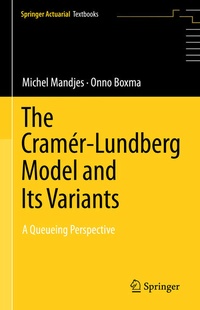
The Cramér-Lundberg Model and Its Variants
A Queueing Perspective
Published on 28. November 2023
Book
Hardback
XI, 246 pages
978-3-031-39104-0 (ISBN)
Description
This book offers a comprehensive examination of the Cramér-Lundberg model, which is the most extensively researched model in ruin theory. It covers the fundamental dynamics of an insurance company's surplus level in great detail, presenting a thorough analysis of the ruin probability and related measures for both the standard model and its variants.
Providing a systematic and self-contained approach to evaluate the crucial quantities found in the Cramér-Lundberg model, the book makes use of connections with related queueing models when appropriate, and its emphasis on clean transform-based techniques sets it apart from other works. In addition to consolidating a wealth of existing results, the book also derives several new outcomes using the same methodology.
This material is complemented by a thoughtfully chosen collection of exercises. The book's primary target audience is master's and starting PhD students in applied mathematics, operations research, and actuarial science, although it also serves as a useful methodological resource for more advanced researchers. The material is self-contained, requiring only a basic grounding in probability theory and some knowledge of transform techniques.
Providing a systematic and self-contained approach to evaluate the crucial quantities found in the Cramér-Lundberg model, the book makes use of connections with related queueing models when appropriate, and its emphasis on clean transform-based techniques sets it apart from other works. In addition to consolidating a wealth of existing results, the book also derives several new outcomes using the same methodology.
This material is complemented by a thoughtfully chosen collection of exercises. The book's primary target audience is master's and starting PhD students in applied mathematics, operations research, and actuarial science, although it also serves as a useful methodological resource for more advanced researchers. The material is self-contained, requiring only a basic grounding in probability theory and some knowledge of transform techniques.
More details
Series
Edition
2023 ed.
Language
English
Place of publication
Cham
Switzerland
Publishing group
Springer International Publishing
Target group
Primary & secondary/elementary & high school
Illustrations
31 s/w Abbildungen
XI, 246 p. 31 illus.
Dimensions
Height: 241 mm
Width: 160 mm
Thickness: 20 mm
Weight
559 gr
ISBN-13
978-3-031-39104-0 (9783031391040)
DOI
10.1007/978-3-031-39105-7
Schweitzer Classification
Other editions
Additional editions
Book
11/2024
Springer
€58.84
Shipment within 15-20 days
E-Book
11/2023
Springer
€58.84
Available for download
Persons
Michel Mandjes
is a full professor at the Mathematical Institute of Leiden University, with a part-time appointment at the Korteweg-de Vries Institute for Mathematics of the University of Amsterdam. His previous employers include KPN Research, Bell Laboratories, the University of Twente, and CWI. His research focuses on stochastic processes and their applications in actuarial sciences and operations research.
Onno Boxma is Professor of Stochastic Operations Research in the Department of Mathematics and Computer Science of Eindhoven University of Technology. His main research interests are in queueing theory and its applications to the performance analysis of computer-, communication-, production- and traffic systems, and in insurance risk.
Onno Boxma is Professor of Stochastic Operations Research in the Department of Mathematics and Computer Science of Eindhoven University of Technology. His main research interests are in queueing theory and its applications to the performance analysis of computer-, communication-, production- and traffic systems, and in insurance risk.
Content
- 1. Cramér-Lundberg Model. - 2. Asymptotics. - 3. Regime Switching. - 4. Interest and Two-Sided Jumps. - 5. Threshold-Based Net Cumulative Claim Process. - 6. Level-Dependent Dynamics. - 7. Multivariate Ruin. - 8. Arrival Processes with Clustering. - 9. Dependence Between Claim Sizes and Interarrival Times. - 10. Advanced Bankruptcy Concepts.