

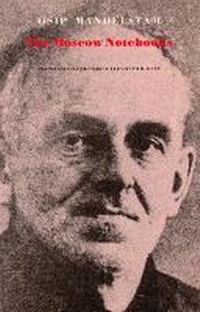
The Moscow Notebooks
Poems 1930-1934
Published on 21. February 1991
Book
Paperback/Softback
96 pages
978-1-85224-126-1 (ISBN)
Description
Mandelstam was one of the great Russian poets of the twentieth century, with a prophetic understanding of its suffering. This contains the poems of his years of persecution, from his journey to Armenia in 1930 until 1934, when he was arrested and exiled to the Urals for writing an unflattering poem about Stalin. Written and preserved by a miracle, his poems have become in Peter Levi's description "all gems and ingots" in the McKanes' translations. This edition is now out of print but the whole book is reprinted as part of The Moscow and Voronezh Notebooks.
More details
Language
English
Place of publication
Tyne and Wear
United Kingdom
Dimensions
Height: 216 mm
Width: 138 mm
Weight
160 gr
ISBN-13
978-1-85224-126-1 (9781852241261)
Copyright in bibliographic data and cover images is held by Nielsen Book Services Limited or by the publishers or by their respective licensors: all rights reserved.
Schweitzer Classification
Persons
Osip Mandelstam was one of the great Russian poets of the 20th century, with a prophetic understanding of its suffering, which he transformed into luminous poetry. Born in 1891, he grew up in St Petersburg. With Akhmatova and Gumilyov he formed the Acmeist movement. Childish and wise, joyous and angry, at once complex and simple, he was sustained for 20 years by his wife and memoirist Nadezhda Mandelstam, who became, with Anna Akhmatova, the saviour of his poetry. His last poems, preserved in his notebooks, were translated by Richard and Elizabeth McKane as The Moscow & Voronezh Notebooks (Bloodaxe Books, 2003). In 1934, Mandlestam was arrested for writing an unflattering poem about Stalin, and subjected to gruelling interrogations and torture before being exiled to Voronezh. Nadezhda's Mandlestam's memoir Hope Against Hope includes a moving account of their time in Voronezh, and Anna Akhmatova's poem 'Voronezh' describes her visit there. In 1938 he was re-arrested and sentenced to five years' hard labour for 'counter-revolutionary activities', and died that winter, of 'heart failure', in a freezing transit camp in Siberia.