

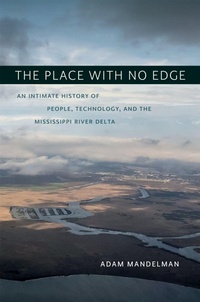
The Place with No Edge
An Intimate History of People, Technology, and the Mississippi River Delta
Published on 30. April 2020
Book
Hardback
296 pages
978-0-8071-7283-4 (ISBN)
Description
In The Place with No Edge, Adam Mandelman follows three centuries of human efforts to inhabit and control the lower Mississippi River delta, the vast watery flatlands spreading across much of southern Louisiana. He finds that people's use of technology to tame unruly nature in the region has produced interdependence with, rather than independence from, the environment.
Created over millennia by deposits of silt and sand, the Mississippi River delta is one of the most dynamic landscapes in North America. From the eighteenth-century establishment of the first French fort below New Orleans to the creation of Louisiana's Coastal Master Plan in the 2000s, people have attempted to harness and master the landscape through technology. Mandelman examines six specific interventions employed in the delta over time: levees, rice flumes, pullboats, geophysical surveys, dredgers, and petroleum cracking. He demonstrates that even as people seemed to gain control over the environment, they grew more deeply intertwined with, and vulnerable to, it.
The greatest folly, Mandelman argues, is to believe that technology affords mastery. Environmental catastrophes of coastal land loss and petrochemical pollution may appear to be disconnected, but both emerged from the same fantasy of harnessing nature to technology. Similarly, the levee system's failures and the subsequent deluge after Hurricane Katrina owe as much to centuries of human entanglement with the delta as to global warming's rising seas and strengthening storms.
The Place with No Edge advocates for a deeper understanding of humans' relationship with nature. It provides compelling evidence that altering the environment, whether to make it habitable, profitable, or navigable, inevitably brings a response, sometimes with unanticipated consequences. Mandelman encourages a mindfulness of the ways that our inventions engage with nature and a willingness to intervene in responsible, respectful ways.
Created over millennia by deposits of silt and sand, the Mississippi River delta is one of the most dynamic landscapes in North America. From the eighteenth-century establishment of the first French fort below New Orleans to the creation of Louisiana's Coastal Master Plan in the 2000s, people have attempted to harness and master the landscape through technology. Mandelman examines six specific interventions employed in the delta over time: levees, rice flumes, pullboats, geophysical surveys, dredgers, and petroleum cracking. He demonstrates that even as people seemed to gain control over the environment, they grew more deeply intertwined with, and vulnerable to, it.
The greatest folly, Mandelman argues, is to believe that technology affords mastery. Environmental catastrophes of coastal land loss and petrochemical pollution may appear to be disconnected, but both emerged from the same fantasy of harnessing nature to technology. Similarly, the levee system's failures and the subsequent deluge after Hurricane Katrina owe as much to centuries of human entanglement with the delta as to global warming's rising seas and strengthening storms.
The Place with No Edge advocates for a deeper understanding of humans' relationship with nature. It provides compelling evidence that altering the environment, whether to make it habitable, profitable, or navigable, inevitably brings a response, sometimes with unanticipated consequences. Mandelman encourages a mindfulness of the ways that our inventions engage with nature and a willingness to intervene in responsible, respectful ways.
Reviews / Votes
The Place with No Edge documents and interprets the environmental history of the Mississippi Delta in a way that also sheds light on the broader topic of human/environment interaction over time. Mandelman lays out the story of people reorganizing their environment, and in the process succumbing to the erroneous conclusion that they had managed to conquer and control nature in a more or less permanent way.More details
Series
Language
English
Place of publication
Baton Rouge
United States
Target group
Professional and scholarly
Product notice
sewn/stitched
Cloth over boards
Illustrations
26 halftones, 5 line illustrations, 6 maps
Dimensions
Height: 234 mm
Width: 163 mm
Thickness: 28 mm
Weight
544 gr
ISBN-13
978-0-8071-7283-4 (9780807172834)
Copyright in bibliographic data and cover images is held by Nielsen Book Services Limited or by the publishers or by their respective licensors: all rights reserved.
Schweitzer Classification
Other editions
Additional editions
Adam Mandelman
The Place with No Edge
An Intimate History of People, Technology, and the Mississippi River Delta
E-Book
04/2020
Zando - Hillman Grad Books
€19.49
Available for download