

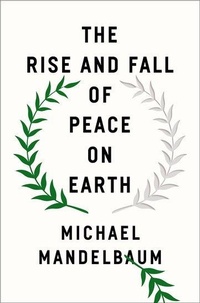
The Rise and Fall of Peace on Earth
Published on 9. May 2019
Book
Hardback
232 pages
978-0-19-093593-1 (ISBN)
Description
In the twenty-five years after 1989 the world enjoyed the deepest peace in its history. The Rise and Fall of Peace on Earth examines that singular quarter century, describing how and why peace was established and then fell apart. Mandelbaum argues that peace ended because three important countries - Vladimir Putin's Russia in Europe, Xi Jinping's China in East Asia, and the Shia clerics' Iran in the Middle East - put an end to it with aggressive nationalist policies aimed at overturning the prevailing political arrangements in their respective regions. The three had a common motive: a dictatorial regime's need to survive in a democratic age with their prospects for economic growth uncertain. Mandelbaum further argues that the key to a return of peace lies in the advent of genuine democracy, including free elections and the protection of religious, economic, and political liberty. Since democracy cannot be imposed from the outside, The Rise and Fall of Peace on Earth has a dual message: the world has a formula for peace, but there is no way to ensure that all countries embrace it.
Reviews / Votes
This book addresses the most critical foreign relations question of our times: is the post-Cold War era of peace over and confict resurfacing? Mandelbaum expertly probes the threats and prospects. * Azar Gat, Univeristy of Tel Aviv, and author of War in Human Civilization * In this fascinating study, Mandelbaum takes dead aim at the Wilsonian foreign policy optimism of the pre-Trump era. He argues that the post-Cold War quarter-century was indeed unusually peaceful, due to US predominance combined with the spread of market democracies, but that this liberal democratic peace has now broken down with the rise of revisionist authoritarian powers in each major region. His conclusion is thought-provoking and distinct: the democratic peace is real yet cannot be imposed. * Colin Dueck, George Mason University, and author of The Obama Doctrine and Hard Line * Mandelbaum has never shied away from tackling the big questions in international politics, and he never fails to offer lucid, compelling answers. In The Rise and Fall of Peace on Earth, he asks why peace reigned for twenty-five years after the end of the Cold War in 1989 and why it has now begun to fray in three critical regions: Europe, East Asia, and the Middle East. His incisive explanation is presented, as always, in elegant prose. * Rajan Menon, City University of New York, and author of The Conceit of Humanitarian Intervention * Exceptionally wise, erudite and compelling, Mandelbaum has produced the definitive record of the rise and fall of the 'deep peace.' Masterful in its historical command and judicious in the strategic lessons to be drawn, he offers cause for hope and dismay to advocates of liberal democratic capitalism everywhere. The formula for peace that works best is one the US cannot install where it is needed most. A must-read volume.' * Robert Singh, Professor of Politics, University of London, Birkbeck *More details
Language
English
Place of publication
New York
United States
Product notice
sewn/stitched
Cloth over boards
Dimensions
Height: 243 mm
Width: 164 mm
Thickness: 30 mm
Weight
446 gr
ISBN-13
978-0-19-093593-1 (9780190935931)
Copyright in bibliographic data and cover images is held by Nielsen Book Services Limited or by the publishers or by their respective licensors: all rights reserved.
Schweitzer Classification
Other editions
Additional editions
Michael Mandelbaum
The Rise and Fall of Peace on Earth
E-Book
02/2019
1st Edition
OUP eBook
€9.99
Available for download
Michael Mandelbaum
The Rise and Fall of Peace on Earth
E-Book
02/2019
1st Edition
OUP eBook
€9.99
Available for download
Person
Michael Mandelbaum is the Christian A. Herter Professor Emeritus of American Foreign Policy at The Johns Hopkins School of Advanced International Studies and the author of sixteen books, including Mission Failure (Oxford), The Ideas That Conquered the World, The Meaning of Sports, The Frugal Superpower, and That Used To Be Us (with Thomas L. Friedman).
Content
Acknowledgements
Introduction
Chapter One: Europe: The Lost Peace
The Blunder
From Yeltsin to Putin
The End of Peace
The New/Old Europe
Chapter Two: East Asia: The Commercial Peace
Chinese Singularity
Chinese Revisionism
The Korean Conundrum
The New/Old East Asia
Chapter Three: The Middle East: The Hegemonic Truce
Iran
The Bomb
The Arab Spring
The New/Old Middle East
Chapter Four: Peace Regained?
Accident or Precedent?
Perpetual Peace?
Universal Democracy?
Introduction
Chapter One: Europe: The Lost Peace
The Blunder
From Yeltsin to Putin
The End of Peace
The New/Old Europe
Chapter Two: East Asia: The Commercial Peace
Chinese Singularity
Chinese Revisionism
The Korean Conundrum
The New/Old East Asia
Chapter Three: The Middle East: The Hegemonic Truce
Iran
The Bomb
The Arab Spring
The New/Old Middle East
Chapter Four: Peace Regained?
Accident or Precedent?
Perpetual Peace?
Universal Democracy?