

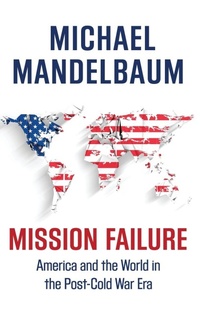
Mission Failure
America and the World in the Post-Cold War Era
Published on 23. June 2016
Book
Hardback
498 pages
978-0-19-046947-4 (ISBN)
Description
Unbeknownst to just about all observers of international affairs, America's decision in 1991 to provide air defense to oppressed Kurds in Iraq after the Gulf War had ended ushered in an entirely new era in American foreign policy. Until that moment, the United States used military power to defend against threats (real and perceived) that its leaders thought would either weaken America's position in the world order or--in the worst case--threaten the homeland. For the first time ever, the United States militarily was now actively involved in states that represented no threat, and with missions that were largely humanitarian and socio-political. After establishing the Kurdish no-fly zone, the US in quick succession intervened in Somalia, Haiti, and Kosovo. Even after 9/11, it decided that it had a duty to not just invade Iraq, but reconstruct Iraqi society along Western lines.
In Mission Failure, the eminent international relations scholar Michael Mandelbaum provides a sweeping interpretive history of American foreign policy in the post-Cold War era to show why this new approach was doomed to failure. America had always adhered to a mission-based foreign policy, but in the post-Cold War era it swung away from security concerns to a near-exclusive emphasis on implanting Western institutions wherever it could. Many good things happened in this era, including a broad expansion of democracy and strong growth in the global economy. But the U.S. never had either the capacity or the will to change societies that were dramatically different from our own. Over two decades later, we can see the wreckage: a broken Iraq a teetering Afghanistan, a China that laughs at our demands that they adopt a human rights regime, and a still-impoverished Haiti. Mandelbaum does not deny that American foreign policy has always had a strong ideological component. Instead, he argues that emphasizing that particular feature generally leads to mission failure. We are able to defend ourselves well and effectively project power, but we have very little capacity to change other societies. If nothing else, that is what the last quarter century has taught us.
In Mission Failure, the eminent international relations scholar Michael Mandelbaum provides a sweeping interpretive history of American foreign policy in the post-Cold War era to show why this new approach was doomed to failure. America had always adhered to a mission-based foreign policy, but in the post-Cold War era it swung away from security concerns to a near-exclusive emphasis on implanting Western institutions wherever it could. Many good things happened in this era, including a broad expansion of democracy and strong growth in the global economy. But the U.S. never had either the capacity or the will to change societies that were dramatically different from our own. Over two decades later, we can see the wreckage: a broken Iraq a teetering Afghanistan, a China that laughs at our demands that they adopt a human rights regime, and a still-impoverished Haiti. Mandelbaum does not deny that American foreign policy has always had a strong ideological component. Instead, he argues that emphasizing that particular feature generally leads to mission failure. We are able to defend ourselves well and effectively project power, but we have very little capacity to change other societies. If nothing else, that is what the last quarter century has taught us.
Reviews / Votes
The story is fascinating. Also, since one knows the conclusion, one has to ask whether that conclusion is fair and then what it means for future policy over the next few decades. Consequently, being able to critique a well-written analysis such as this is constantly fun and interesting for anyone interested in contemplating foreign policy decision making. Even though one may not agree with Mandelbaum every step of the way, he is objective in his overview and offers outstanding analysis in every chapter. * John M. Bublic, Barton College *More details
Language
English
Place of publication
New York
United States
Target group
College/higher education
Dimensions
Height: 240 mm
Width: 161 mm
Thickness: 31 mm
Weight
907 gr
ISBN-13
978-0-19-046947-4 (9780190469474)
Copyright in bibliographic data and cover images is held by Nielsen Book Services Limited or by the publishers or by their respective licensors: all rights reserved.
Schweitzer Classification
Other editions
Additional editions
E-Book
03/2016
1st Edition
OUP eBook
€9.99
Available for download
E-Book
03/2016
1st Edition
OUP USA
€9.99
Available for download
Person
Professor of Political Science, Johns Hopkins-SAIS
Content
Table of Contents ; Chapter 1: Introduction ; Chapter 2: China, the Global Economy, and Russia ; A New Administration in a New World ; China and Human Rights ; Economics as Foreign Policy ; Russia: The Good Deed ; Russia: The Bad Deed ; Chapter 3: Humanitarian Intervention ; The Innovation ; Somalia, Haiti, Rwanda ; Bosnia ; Kosovo ; Famous Victories ; Chapter 4: The War on Terror and Afghanistan ; To the World Trade Center ; The War on Terror ; Afghanistan: Success ; Afghanistan: Failure ; Afghanistan: The Long Goodbye ; Chapter 5: Iraq ; From War to War ; From Success to Failure ; The Wars After the War ; The Home Front ; Exit and Reentry ; Chapter 6: The Middle East ; The Center of the World ; The Peace Process ; Land for War ; The Democracy Agenda ; The Arab Spring ; Chapter 7: The Restoration ; The End of the Post-Cold War Era ; The Bubbles Burst ; The Rogues ; The Rise of China ; The Revenge of Russia ; Chapter 8: Conclusion