

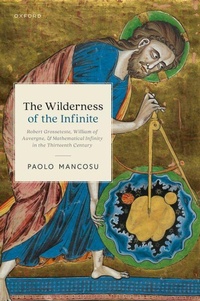
The Wilderness of the Infinite
Robert Grosseteste, William of Auvergne, and Mathematical Infinity in the Thirteenth Century
Published on 5. February 2026
Book
Hardback
368 pages
978-0-19-892688-7 (ISBN)
Description
The Wilderness of the Infinite explores the emergence in the Latinate thirteenth century of original approaches to mathematical infinity and to unequal infinities. Within the span of twenty years (1220-1240), Robert Grosseteste and William of Auvergne countenanced the actual infinite and presented very original views on the possibility of comparing infinities. Robert Grosseteste postulated the existence of infinite numbers that measure the number of points in finite line segments. Until his proposal, no one in Western culture had operated with infinite numbers.
Grosseteste's proposal led to debates on what criteria one should use when assigning 'sizes' to infinite collections with one-to-one correspondence being proposed as a challenge to the part-whole intuition defended by Grosseteste. But the book is not only about Robert Grosseteste, William of Auvergne, and their impact on medieval philosophy in the period up to 1275. Rather, the historical investigation is instrumental in showing that some of the daring ideas proposed by Grosseteste and William of Auvergne although criticized as naive, or even incoherent, by twentieth century investigators can be given a perfectly coherent development using some recent mathematical theories, namely non-standard analysis and the theory of numerosities. The book thus offers a methodological proposal on how to engage with the history and the philosophy of mathematical infinity.
Grosseteste's proposal led to debates on what criteria one should use when assigning 'sizes' to infinite collections with one-to-one correspondence being proposed as a challenge to the part-whole intuition defended by Grosseteste. But the book is not only about Robert Grosseteste, William of Auvergne, and their impact on medieval philosophy in the period up to 1275. Rather, the historical investigation is instrumental in showing that some of the daring ideas proposed by Grosseteste and William of Auvergne although criticized as naive, or even incoherent, by twentieth century investigators can be given a perfectly coherent development using some recent mathematical theories, namely non-standard analysis and the theory of numerosities. The book thus offers a methodological proposal on how to engage with the history and the philosophy of mathematical infinity.
More details
Language
English
Place of publication
Oxford
United Kingdom
Target group
College/higher education
Product notice
sewn/stitched
Cloth over boards
Illustrations
22 diagrams
Dimensions
Height: 240 mm
Width: 162 mm
Thickness: 28 mm
Weight
694 gr
ISBN-13
978-0-19-892688-7 (9780198926887)
Copyright in bibliographic data and cover images is held by Nielsen Book Services Limited or by the publishers or by their respective licensors: all rights reserved.
Schweitzer Classification
Person
Paolo Mancosu is Willis S. and Marion Slusser Professor of Philosophy at the University of California at Berkeley. He is the author of numerous articles and books in logic and philosophy of mathematics. During his career he has taught at Stanford, Oxford, and Yale. He has been a fellow of the Humboldt Stiftung, of the Wissenschaftskolleg zu Berlin, of the Institute for Advanced Study in Princeton, and of the Institut d'Etudes Avancees in Paris. He has received grants from the Guggenheim Foundation, the NSF, and the CNRS. In 2021-2022 he was a visiting professor at the Universite de Paris 1 Pantheon-Sorbonne as Chaire d'excellence internationale Blaise Pascal.
Content
1: Greek, Roman, Islamic, and Jewish Sources on Unequal Infinities 2: Grosseteste on Unequal Infinities 3: William of Auvergne and the "Wilderness of the Infinite" 4: Grosseteste's and William of Auvergne's Legacies in the Third Quarter of the Thirteenth Century 5: Methodological Reflections and Logical Explorations Appendix