

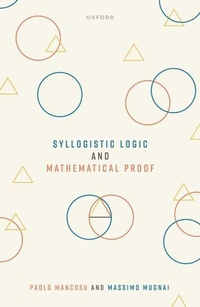
Syllogistic Logic and Mathematical Proof
Published on 18. May 2023
Book
Hardback
240 pages
978-0-19-887692-2 (ISBN)
Description
Does syllogistic logic have the resources to capture mathematical proof? This volume provides the first unified account of the history of attempts to answer this question, the reasoning behind the different positions taken, and their far-reaching implications. Aristotle had claimed that scientific knowledge, which includes mathematics, is provided by syllogisms of a special sort: 'scientific' ('demonstrative') syllogisms. In ancient Greece and in the Middle Ages, the claim that Euclid's theorems could be recast syllogistically was accepted without further scrutiny. Nevertheless, as early as Galen, the importance of relational reasoning for mathematics had already been recognized. Further critical voices emerged in the Renaissance and the question of whether mathematical proofs could be recast syllogistically attracted more sustained attention over the following three centuries. Supported by more detailed analyses of Euclidean theorems, this led to attempts to extend logical theory to include relational reasoning, and to arguments purporting to reduce relational reasoning to a syllogistic form. Philosophical proposals to the effect that mathematical reasoning is heterogenous with respect to logical proofs were famously defended by Kant, and the implications of the debate about the adequacy of syllogistic logic for mathematics are at the very core of Kant's account of synthetic a priori judgments. While it is now widely accepted that syllogistic logic is not sufficient to account for the logic of mathematical proof, the history and the analysis of this debate, running from Aristotle to de Morgan and beyond, is a fascinating and crucial insight into the relationship between philosophy and mathematics.
Reviews / Votes
This book holds significant interest for specialists in formal logic, particularly those with a penchant for historical analysis, as well as for scholars in philosophy with a focus on the methodology of sciences, epistemology, and the philosophy of mathematics. * Piotr Cholda, Computing Reviews * This is an excellent book. It tackles a question that is of clear interest to anybody curious about the history of logic or mathematics, and does so in a way that is focused, persuasive, and rich with philosophical insights. It is remarkable that Mancosu and Mugnai have managed to answer such a broad question, in a comprehensive and accessible way, in a volume of this size. I thoroughlyrecommend it. * Wesley Wrigley, The Mathematical Gazette *More details
Language
English
Place of publication
Oxford
United Kingdom
Target group
Professional and scholarly
Product notice
sewn/stitched
Cloth over boards
Dimensions
Height: 237 mm
Width: 160 mm
Thickness: 20 mm
Weight
496 gr
ISBN-13
978-0-19-887692-2 (9780198876922)
Copyright in bibliographic data and cover images is held by Nielsen Book Services Limited or by the publishers or by their respective licensors: all rights reserved.
Schweitzer Classification
Other editions
Additional editions
Paolo Mancosu | Massimo Mugnai
Syllogistic Logic and Mathematical Proof
E-Book
04/2023
1st Edition
OUP eBook
€59.49
Available for download
Paolo Mancosu | Massimo Mugnai
Syllogistic Logic and Mathematical Proof
E-Book
04/2023
1st Edition
OUP eBook
€59.49
Available for download
Persons
Paolo Mancosu is Willis S. and Marion Slusser Professor of Philosophy at the University of California at Berkeley. He is the author of numerous articles and books in logic and philosophy of mathematics, and three books on the publishing history of Pasternak's Doctor Zhivago in the context of the cultural Cold War. He has held teaching positions at Stanford, Oxford, and Yale, and was visiting professor at the Universite de Paris 1 Pantheon-Sorbonne as Chaire d'excellence internationale Blaise Pascal for 2021-2022.
Massimo Mugnai is Professor Emeritus at the Scuola Normale Superiore at Pisa. His research focuses on the philosophy Leibniz and the history of logic. He has previously held positions at the University of Florence and the Institute for Advanced Studies in Jerusalem.
Massimo Mugnai is Professor Emeritus at the Scuola Normale Superiore at Pisa. His research focuses on the philosophy Leibniz and the history of logic. He has previously held positions at the University of Florence and the Institute for Advanced Studies in Jerusalem.
Content
Introduction
1: Aristotelian Syllogism and Mathematics in Antiquity and the Medieval Period
2: Extensions of the Syllogism in Medieval Logic
3: Syllogistic and Mathematics: The Case of Piccolomini
4: Obliquities and Mathematics in the 17th and 18th Centuries: From Jungius to Wolff
5: The Extent of Syllogistic Reasoning: From Ruediger to Wolff
6: Lambert and Kant
7: Bernard Bolzano on Non-Syllogistic Reasoning
8: Thomas Reid, William Hamilton and Augustus De Morgan
Conclusion
1: Aristotelian Syllogism and Mathematics in Antiquity and the Medieval Period
2: Extensions of the Syllogism in Medieval Logic
3: Syllogistic and Mathematics: The Case of Piccolomini
4: Obliquities and Mathematics in the 17th and 18th Centuries: From Jungius to Wolff
5: The Extent of Syllogistic Reasoning: From Ruediger to Wolff
6: Lambert and Kant
7: Bernard Bolzano on Non-Syllogistic Reasoning
8: Thomas Reid, William Hamilton and Augustus De Morgan
Conclusion