

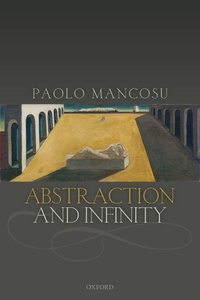
Abstraction and Infinity
Published on 14. May 2019
Book
Paperback/Softback
240 pages
978-0-19-882268-4 (ISBN)
Description
Paolo Mancosu provides an original investigation of historical and systematic aspects of the notions of abstraction and infinity and their interaction. A familiar way of introducing concepts in mathematics rests on so-called definitions by abstraction. An example of this is Hume's Principle, which introduces the concept of number by stating that two concepts have the same number if and only if the objects falling under each one of them can be put in one-one correspondence. This principle is at the core of neo-logicism.
In the first two chapters of the book, Mancosu provides a historical analysis of the mathematical uses and foundational discussion of definitions by abstraction up to Frege, Peano, and Russell. Chapter one shows that abstraction principles were quite widespread in the mathematical practice that preceded Frege's discussion of them and the second chapter provides the first contextual analysis of Frege's discussion of abstraction principles in section 64 of the Grundlagen. In the second part of the book, Mancosu discusses a novel approach to measuring the size of infinite sets known as the theory of numerosities and shows how this new development leads to deep mathematical, historical, and philosophical problems. The final chapter of the book explore how this theory of numerosities can be exploited to provide surprisingly novel perspectives on neo-logicism.
In the first two chapters of the book, Mancosu provides a historical analysis of the mathematical uses and foundational discussion of definitions by abstraction up to Frege, Peano, and Russell. Chapter one shows that abstraction principles were quite widespread in the mathematical practice that preceded Frege's discussion of them and the second chapter provides the first contextual analysis of Frege's discussion of abstraction principles in section 64 of the Grundlagen. In the second part of the book, Mancosu discusses a novel approach to measuring the size of infinite sets known as the theory of numerosities and shows how this new development leads to deep mathematical, historical, and philosophical problems. The final chapter of the book explore how this theory of numerosities can be exploited to provide surprisingly novel perspectives on neo-logicism.
Reviews / Votes
Mancosu's book is packed with new ideas, novel perspectives, and important insights, offering the reader a thorough and exciting examination.... The book should be required reading for anyone interested in the history and foundations of mathematics. * Ray T. Cook and Michael Calasso, Philosophia Mathematica * 'I highly recommend Mancosu's book to philosophers and mathematicians interested in the philosophy or the history of mathematics and logic. It is rich in historical commentary and philosophical ideas. Mancosu not only proves to be one of the great detectives of the history of mathematical practice, but shows us how an historical approach to mathematical practice can, and in this case, does successfully move forward our current debates in the philosophy of mathematics.' * Philip A. Ebert, Notre Dame Philosophical Reviews * 'It is an absolutely first-rate piece of work, both of scholarship and philosophy, which no one seriously interested in definition by abstraction, in Frege's work on the foundations of arithmetic, or in the neo-Fregean project, can afford not to study.' * Bob Hale, Journal of Philosophy * 'Mancosu's book is packed with new ideas, novel perspectives, and important insights, offering the reader a thorough and exciting examination of abstraction as a methodology that is not limited to a contemporary position in the philosophy of mathematics, but instead has been, and continues to be, a central component of mathematical methodology.' * Roy Cook & Michael Calasso, Philosophia Mathematica * 'The book is a pleasure to read.' * Roman Kossak, Mathematical Intelligencer *More details
Language
English
Place of publication
Oxford
United Kingdom
Target group
Professional and scholarly
Dimensions
Height: 234 mm
Width: 156 mm
Thickness: 13 mm
Weight
360 gr
ISBN-13
978-0-19-882268-4 (9780198822684)
Copyright in bibliographic data and cover images is held by Nielsen Book Services Limited or by the publishers or by their respective licensors: all rights reserved.
Schweitzer Classification
Other editions
Additional editions
Paolo Mancosu
Abstraction and Infinity
Book
12/2016
Oxford University Press
€106.50
Shipment within 15-20 days
Person
Paolo Mancosu is Willis S. and Marion Slusser Professor of Philosophy at the University of California at Berkeley. He is the author of numerous articles and books in logic and philosophy of mathematics. He is also the author of Inside the Zhivago Storm: The editorial adventures of Pasternak's masterpiece (Feltrinelli, Milan, 2013). During his career he has taught at Stanford, Oxford, and Yale. He has been a fellow of the Humboldt Stiftung, the Wissenschaftskolleg zu Berlin, the Institute for Advanced Study in Princeton, and the Institut d'Etudes Avancees in Paris. He has received grants from the Guggenheim Foundation, the NSF, and the CNRS.
Content
Introduction
1: The mathematical practice of definitions by abstraction from Euclid to Frege (and beyond)
2: The logical and philosophical reflection on definitions by abstraction: From Frege to the Peano school and Russell
3: Measuring the size of infnite collections of natural numbers: Was Cantor's theory of infinite number inevitable?
4: In good company? On Hume's Principle and the assignment of numbers to infinite concepts
1: The mathematical practice of definitions by abstraction from Euclid to Frege (and beyond)
2: The logical and philosophical reflection on definitions by abstraction: From Frege to the Peano school and Russell
3: Measuring the size of infnite collections of natural numbers: Was Cantor's theory of infinite number inevitable?
4: In good company? On Hume's Principle and the assignment of numbers to infinite concepts