

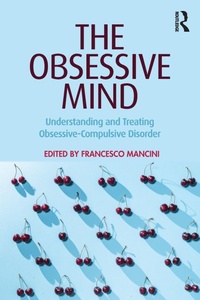
The Obsessive Mind
Understanding and Treating Obsessive-Compulsive Disorder
1st Edition
Published on 15. November 2018
Book
Paperback/Softback
422 pages
978-1-138-32107-6 (ISBN)
Description
The Obsessive Mind offers a well-defined and comprehensive understanding of obsessive-compulsive disorder and its treatment model. Based on the results of current research, the book offers a psychological perspective on the disorder, a complete presentation of useful strategies and techniques that can be implemented in therapy, and work that can be done with family members of OCD patients, all proposed coherently with the theoretical model of the disorder. It also illustrates the pivotal role of moral goals as proximal psychological determinants of the obsessive symptomatology. The Obsessive Mind can be used by new clinicians to become acquainted with the theory and treatment of OCD, as well as more advanced clinicians to improve their OCD treatment skills and learn new interventions and ways to get out of deadlock in treatment and thereby increase efficacy.
Reviews / Votes
"The Obsessive Mind provides a comprehensive guide to understanding important perspectives on the nature and treatment of obsessions and compulsions. Grounded in the latest clinical psychological science, the chapters in this book serve as highly instructive for clinicians, scientists, and students. It occupies a prominent place on my bookshelf!"Jonathan S. Abramowitz, professor of psychology, University of North Carolina at Chapel Hill; editor, Journal of Obsessive-Compulsive and Related Disorders
"In this impressive volume, Mancini and his colleagues integrate rich clinical observations and ingenious empirical research to support the idea that the major driving force of obsessive-compulsive symptoms is fear of guilt. This powerful unifying theory makes an invaluable contribution to understanding and treating OCD, as I can testify from my own teaching and clinical work. I highly recommend this book to all scholars and practitioners who wish to expand their knowledge of OCD and its treatment."
Reuven Dar, PhD, professor and head of Clinical Track, School of Psychological Sciences, Tel Aviv University
"This is a fascinating book on obsessive-compulsive disorder. Thoughtful and well informed, the authors argue that crucial to this disorder is the fear of moral misconduct. The arguments provided are convincing and thought provoking, both clinically and scientifically. The book is a rich, fresh and inspiring source for therapists and researchers alike. A must read for professionals interested in obsessive-compulsive disorder."
Marcel van den Hout, PhD, professor of clinical psychology and experimental psychopathology, Utrecht University, The Netherlands
More details
Language
English
Place of publication
London
United Kingdom
Publishing group
Taylor & Francis Ltd
Target group
Professional and scholarly
Professional and Professional Practice & Development
Illustrations
6 s/w Zeichnungen, 22 s/w Tabellen, 4 s/w Photographien bzw. Rasterbilder, 10 s/w Abbildungen
22 Tables, black and white; 6 Line drawings, black and white; 4 Halftones, black and white; 10 Illustrations, black and white
Dimensions
Height: 229 mm
Width: 152 mm
Thickness: 23 mm
Weight
630 gr
ISBN-13
978-1-138-32107-6 (9781138321076)
Copyright in bibliographic data and cover images is held by Nielsen Book Services Limited or by the publishers or by their respective licensors: all rights reserved.
Schweitzer Classification
Other editions
Additional editions
Book
11/2018
1st Edition
Routledge
€207.80
Shipment within 10-20 days
E-Book
10/2018
1st Edition
Routledge
€65.99
Available for download
E-Book
10/2018
1st Edition
Routledge
€65.99
Available for download
Person
Francesco Mancini is director of the Quadrennial Postgraduate Specialisation Schools in Cognitive-Behaviour Psychotherapy Associazione di Psicologia Cognitiva APC and Scuola di Psicoterapia Cognitiva srl SPC, and full professor of clinical psychology at Guglielmo Marconi University, Rome. He is the past-president of the Italian Society of Behavioural and Cognitive Therapy (SITCC).
Content
List of Contributors Foreword Acknowledgements Introduction Part 1 Psychological Explanation of Obsessive-Compulsive Disorder 1. The Characteristics of Obsessive-Compulsive Disorder and the Questions it Raises 2. Goals and Beliefs, Proximate Determinants of Obsessive-Compulsive Symptoms 3. Cognitive Processes in Obsessive-Compulsive Disorder 4. Answers to the Questions Raised by Obsessive-Compulsive Disorder 5. Cognitive Deficits and Obsessive-Comulsive Disorder 6. Vulnerability in Obsessive-Comulsive Disorder Part 2 Psychological Therapy for Obsessive-Compulsive Disorder 7. Introduction to the Therapy: The Rationale of the Intervention 8. Constructing a Diagrammatic Model for Understanding the Disorder: Objectives, Procedure, Difficulties 9. Techniques of Cognitive Restructuring 10. Disgust and Contamination: Cognitive Anti-Disgust Interventions 11. Accepting Risk: Cognitive Techniques 12. Exposure with Response Prevention as a Practice of Acceptance 13. Mindfulness for the Treatment of Obsessive-Compulsive Disorder 14. Intervention to Reduce Current Vulnerability to Obsessive-Compulsive Disorder 15. Interventions on Historical Vulnerability 16. Preventing Relapses and Concluding Therapy 17. The Role of Family Members in the Maintenance of Obsessive-Compulsive Disorder: Psychoeducation and Psychotherapy 18. Treatment Traps: Underlying Beliefs and Goals and Solutions References Index