

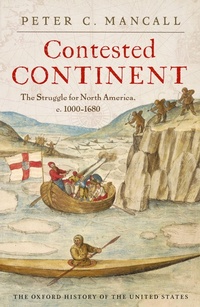
Contested Continent
The Struggle for North America, c. 1000-1680
Will be published approx. on 4. September 2026
Book
Hardback
752 pages
978-0-19-537278-6 (ISBN)
Description
The newest volume in the acclaimed Oxford History of the United States series, Contested Continent recounts the origins of "America" and how it came to birth the United States.
The Oxford History of the United States is by far the most respected multi-volume history of our nation. The series includes three Pulitzer Prize winners, two New York Times bestsellers, and winners of the Bancroft and Parkman Prizes. In the newest volume in the series, Peter C. Mancall recounts how North America was forged from the experiences of millions of Indigenous women and men as well as Europeans and Africans.
The first volume of the Oxford History of the United States series, Contested Continent is also the most ambitiously far-ranging history of North America concentrating on the period from c. 1000 to 1680, from the arrival of Norse explorers to an explosion of revolts that underlined the stubborn struggle to master the continent some two centuries after Columbus's landfall. This history spans the continent from the North Atlantic to the West Indies and includes the entire Atlantic basin. Mancall emphasizes the experiences of diverse peoples while, at the same time, telling a new story about the origins of major aspects of American culture. He illuminates the rise of a booming trans-Atlantic economy based on the extraction of abundant American natural resources; the central role that European migrants and their descendants played in the enslavement of Africans and the displacement of Indigenous peoples; and the spread of self-governing polities where many enjoyed religious freedom. None of these developments was inevitable. Conflicts broke out frequently as different peoples battled over precious resources. Europeans' appetites for material gain and expanding Christendom brought horrific consequences for those brutalized, enslaved, and vulnerable to infectious diseases.
This is a sweeping history of developments crucial to the eventual founding of the United States. Contested Continent underscores the titanic struggles between the peoples who had populated the Americas for centuries and the migrants from the Old World who initiated changes that created a New World that offered boundless opportunities for some and crushed the aspirations of others.
The Oxford History of the United States is by far the most respected multi-volume history of our nation. The series includes three Pulitzer Prize winners, two New York Times bestsellers, and winners of the Bancroft and Parkman Prizes. In the newest volume in the series, Peter C. Mancall recounts how North America was forged from the experiences of millions of Indigenous women and men as well as Europeans and Africans.
The first volume of the Oxford History of the United States series, Contested Continent is also the most ambitiously far-ranging history of North America concentrating on the period from c. 1000 to 1680, from the arrival of Norse explorers to an explosion of revolts that underlined the stubborn struggle to master the continent some two centuries after Columbus's landfall. This history spans the continent from the North Atlantic to the West Indies and includes the entire Atlantic basin. Mancall emphasizes the experiences of diverse peoples while, at the same time, telling a new story about the origins of major aspects of American culture. He illuminates the rise of a booming trans-Atlantic economy based on the extraction of abundant American natural resources; the central role that European migrants and their descendants played in the enslavement of Africans and the displacement of Indigenous peoples; and the spread of self-governing polities where many enjoyed religious freedom. None of these developments was inevitable. Conflicts broke out frequently as different peoples battled over precious resources. Europeans' appetites for material gain and expanding Christendom brought horrific consequences for those brutalized, enslaved, and vulnerable to infectious diseases.
This is a sweeping history of developments crucial to the eventual founding of the United States. Contested Continent underscores the titanic struggles between the peoples who had populated the Americas for centuries and the migrants from the Old World who initiated changes that created a New World that offered boundless opportunities for some and crushed the aspirations of others.
Reviews / Votes
Contested Continent is magisterial. Mancall's smoothly written and prodigiously researched work opens the door to the America of the pre-Columbian age in which the foundation for the America we know was laid.This book is destined to become indispensable. * Annette Gordon-Reed, author of The Hemingses of Monticello: An American Family * Wide-ranging and authoritative, Contested Continent tells a complex story with remarkable clarity. Enslaved Africans, enduring Natives, and contentious colonizers interacted in kaleidoscopic patterns to reshape North America. A leading historian of American origins, Peter Mancall offers a sure guide into a deeply contested terrain. * Alan Taylor, author of American Colonies: The Settlement of North America * In this expansive and authoritative book, Peter Mancall masterfully weaves Europe and the Americas together and follows multiple narratives to create a compelling picture of a changing world. It will surely become the go-to work for understanding how European colonization of an Indigenous continent shaped what we know as early America * Colin G. Calloway, Dartmouth College * How did 'America' begin? Peter Mancall's brilliant, necessarily and inventively capacious opening volume for the Oxford History of the United States shines powerful interpretive and narrative light on its origins. Drawing on an exceptional depth of material, including decades of expert scholarship, Mancall shows a world made new through contest among diverse and powerful Indigenous peoples who defined the continent for the whole of the long period under study, the scattered Europeans who came to claim it, and the Africans they enslaved. * Karin Wulf, Director and Librarian, John Carter Brown Library * Nearly 500 pages describing 17th century North America deliver far more details than school history texts-and in far superior prose... Excellent survey of North America's early history. * Kirkus *More details
Series
Language
English
Place of publication
New York
United States
Target group
College/higher education
Illustrations
100 halftone illustrations; 3 16-page inserts
Dimensions
Height: 239 mm
Width: 165 mm
Thickness: 48 mm
Weight
1238 gr
ISBN-13
978-0-19-537278-6 (9780195372786)
Copyright in bibliographic data and cover images is held by Nielsen Book Services Limited or by the publishers or by their respective licensors: all rights reserved.
Schweitzer Classification
Person
Peter C. Mancall is Distinguished Professor, the Andrew W. Mellon Professor of the Humanities, and the Linda and Harlan Martens Director of the USC-Huntington Early Modern Studies Institute at the University of Southern California. He is the author of numerous books including Fatal Journey: The Final Expedition of Henry Hudson and Hakluyt's Promise: An Elizabethan's Obsession for an English America. His writings have appeared in the Smithsonian, Time, the Los Angeles Times, and the Wall Street Journal, among other outlets. He is a fellow of the Society of American Historians and the Royal Historical Society.
Author
Andrew W. Mellon Professor of the Humanities, Distinguished Professor of History, Anthropology, and Economics, and the Linda and Harlan Martens Director of the USC-Huntington Early Modern Studies InstituteAndrew W. Mellon Professor of the Humanities, Distinguished Professor of History, Anthropology, and Economics, and the Linda and Harlan Martens Director of the USC-Huntington Early Modern Studies Institute, University of Southern California
Content
Maps
Editor's Introduction
Glossary
Note on Spelling
Abbreviations
Prologue
Preface
Part I: Discoveries
Chapter 1: 1450
Chapter 2: "People without number"
Chapter 3: "Canada"
Chapter 4: The Lost Colony of Chicora
Chapter 5: Entradas
Chapter 6: The Destruction of the Indies
Chapter 7: Florida
Chapter 8: Elizabethans and Americans
Chapter 9: The Algonquian Moment
Chapter 10: After Roanoke
Chapter 11: Acoma and Santa Fe
Chapter 13: The Coldest Years
Part II: Colonies
Chapter 14: Rescues
Chapter 15: Gathering Storms
Chapter 16: The Battle for Tsenacommacah
Chapter 17: Pilgrims
Chapter 18: The Arc of European Opportunity
Part III: Fractures
Chapter 19: "From East to West"
Chapter 20: Uncivil Wars
Chapter 21: Enslavement
Chapter 22: An Empire for Extraction
Chapter 23: A New England
Chapter 24: From the Headwaters
Chapter 25: Rebellions
Chapter 26: Legacies
Epilogue
Bibliographic Essay
Index
Editor's Introduction
Glossary
Note on Spelling
Abbreviations
Prologue
Preface
Part I: Discoveries
Chapter 1: 1450
Chapter 2: "People without number"
Chapter 3: "Canada"
Chapter 4: The Lost Colony of Chicora
Chapter 5: Entradas
Chapter 6: The Destruction of the Indies
Chapter 7: Florida
Chapter 8: Elizabethans and Americans
Chapter 9: The Algonquian Moment
Chapter 10: After Roanoke
Chapter 11: Acoma and Santa Fe
Chapter 13: The Coldest Years
Part II: Colonies
Chapter 14: Rescues
Chapter 15: Gathering Storms
Chapter 16: The Battle for Tsenacommacah
Chapter 17: Pilgrims
Chapter 18: The Arc of European Opportunity
Part III: Fractures
Chapter 19: "From East to West"
Chapter 20: Uncivil Wars
Chapter 21: Enslavement
Chapter 22: An Empire for Extraction
Chapter 23: A New England
Chapter 24: From the Headwaters
Chapter 25: Rebellions
Chapter 26: Legacies
Epilogue
Bibliographic Essay
Index