

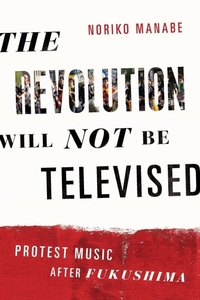
The Revolution Will Not Be Televised
Protest Music After Fukushima
Published on 14. January 2016
Book
Paperback/Softback
454 pages
978-0-19-933469-8 (ISBN)
Description
Nuclear power has been a contentious issue in Japan since the 1950s, and in the aftermath of the Fukushima nuclear power plant disaster, the conflict has only grown. Government agencies and the nuclear industry continue to push a nuclear agenda, while the mainstream media adheres to the official line that nuclear power is Japan's future. Public debate about nuclear energy is strongly discouraged. Nevertheless, antinuclear activism has swelled into one of the most popular and passionate movements in Japan, leading to a powerful wave of protest music.
The Revolution Will Not Be Televised: Protest Music After Fukushima shows that music played a central role in expressing antinuclear sentiments and mobilizing political resistance in Japan. Combining musical analysis with ethnographic participation, author Noriko Manabe offers an innovative typology of the spaces central to the performance of protest music--cyberspace, demonstrations, festivals, and recordings. She argues that these four spaces encourage different modes of participation and methods of political messaging. The openness, mobile accessibility, and potential anonymity of cyberspace have allowed musicians to directly challenge the ethos of silence that permeated Japanese culture post-Fukushima. Moving from cyberspace to real space, Manabe shows how the performance and reception of music played at public demonstrations are shaped by the urban geographies of Japanese cities. While short on open public space, urban centers in Japan offer protesters a wide range of governmental and commercial spaces in which to demonstrate, with activist musicians tailoring their performances to the particular landscapes and soundscapes of each. Music festivals are a space apart from everyday life, encouraging musicians and audience members to freely engage in political expression through informative and immersive performances. Conversely, Japanese record companies and producers discourage major-label musicians from expressing political views in recordings, forcing antinuclear musicians to express dissent indirectly: through allegories, metaphors, and metonyms. The first book on Japan's antinuclear music, The Revolution Will Not Be Televised provides a compelling new perspective on the role of music in political movements.
The Revolution Will Not Be Televised: Protest Music After Fukushima shows that music played a central role in expressing antinuclear sentiments and mobilizing political resistance in Japan. Combining musical analysis with ethnographic participation, author Noriko Manabe offers an innovative typology of the spaces central to the performance of protest music--cyberspace, demonstrations, festivals, and recordings. She argues that these four spaces encourage different modes of participation and methods of political messaging. The openness, mobile accessibility, and potential anonymity of cyberspace have allowed musicians to directly challenge the ethos of silence that permeated Japanese culture post-Fukushima. Moving from cyberspace to real space, Manabe shows how the performance and reception of music played at public demonstrations are shaped by the urban geographies of Japanese cities. While short on open public space, urban centers in Japan offer protesters a wide range of governmental and commercial spaces in which to demonstrate, with activist musicians tailoring their performances to the particular landscapes and soundscapes of each. Music festivals are a space apart from everyday life, encouraging musicians and audience members to freely engage in political expression through informative and immersive performances. Conversely, Japanese record companies and producers discourage major-label musicians from expressing political views in recordings, forcing antinuclear musicians to express dissent indirectly: through allegories, metaphors, and metonyms. The first book on Japan's antinuclear music, The Revolution Will Not Be Televised provides a compelling new perspective on the role of music in political movements.
Reviews / Votes
The Revolution Will Not Be Televised serves as a wonderful introduction into Japanese protest music culture for all audiences. Manabe writes in a manner fit for undergraduates, although the length of the book might make it unmanageable for a single semester. Chapter 3, "Musicians in the Antinuclear Movement: Motivations, Roles, and Risks", could best serve as an excerpted introductory piece for use in a classroom. As with many Oxford University Press titles, the monograph is paired with a very useful companion website with active links to many songs, live protest videos, and governmental reports mentioned throughout Manabe's writing. * MusiCultures * The Revolution Will Not Be Televised: Protest Music after Fukushima is a musical remembrance of the 3/11 disasters and the social protest that followed. The author offers important historical background, but the wealth of contemporary cultural information and the social analysis make the book very important for the fields of Japanese studies and ehtnomusicology. Cultural creation, musical celebration, and social complexities are explored, albeit in an overarching context of disaster and protest. With a skillful interpretive approach to crtical thought, the detail is fascinating and the analyses (music and social) are intriguing. Manabe has produced an outstanding work in the study of music and protest in Japan. * Journal of Japanese Studies * clearly and engagingly written ... fascinating. * James McNair, The National * In a creative, interdisciplinary study, Manabe connects spatial theory and musical analysis to a sociological argument about political protest. . . The book and accompanying website, which presents footage from the protests, are wonderful teaching resources, and they will also change how we think about performance and social change. . . This timely book reminds us of the spaces of possibility, community, and hope possible through mobilization, creativity, and music. * Hall Prize Committee * The committee was in awe of the scope, depth, and risk-taking of the author's research -- at demonstrations and festivals, and with both indie and major label recordings musicians and producers; and in cyberspace. Her command of policy and its legal implications was as strong as her expert performance ethnography and music analysis. This study teaches us a great deal about the techniques of messaging, and the ways music breaks through the walls of official and unofficial censorship. * Merriam Prize Committee * In this moment of heightened and anxious scrutiny of cyberspace as a forum for both activism and manipulation, Manabe's book offers a thoughtful ethnographic look at a specific context for music and political action, in a variety of spaces both physical and virtual. * Comments from the awards committee of the 2018 British Forum for Ethnomusicology Book Prize * Contrary to widely held stereotypes, Japan has a long and loud history of public protest. As Noriko Manabe shows in her important new book, the massive demonstrations in the wake of the Fukushima nuclear disaster belong to this tradition but also have produced their own distinct soundscape. Her detailed ethnographic and musical analysis of the parts numerous musicians have played in the movement vividly captures the sonic dimensions of this latest chapter from the history of Japanese street democracy. * Michael K. Bourdaghs, University of Chicago * [Manabe] was able to see the protests from the inside and make a very fine-grained analysis of the role of music in them ... the analysis of the spaces of contention can be extended to other forms of cultural dissent seen in recent protests, both in Japan and around the world. * Wesley Sasaki-Uemura, University of Utah, in Japanese Studies *More details
Language
English
Place of publication
New York
United States
Dimensions
Height: 234 mm
Width: 156 mm
Thickness: 27 mm
Weight
768 gr
ISBN-13
978-0-19-933469-8 (9780199334698)
Copyright in bibliographic data and cover images is held by Nielsen Book Services Limited or by the publishers or by their respective licensors: all rights reserved.
Schweitzer Classification
Other editions
Additional editions
Book
01/2016
Oxford University Press Inc
€211.70
Shipment within 15-20 days
E-Book
12/2015
1st Edition
OUP eBook
€24.99
Available for download
E-Book
11/2015
1st Edition
OUP eBook
€24.99
Available for download
Person
Noriko Manabe is Assistant Professor of Music at Princeton University. She has been conducting field research on the Japanese antinuclear movement since 2011 and on Japanese hip-hop, reggae, and EDM scenes since 2005. She was previously a ranked analyst researching the internet, media, and videogame industries at JP Morgan in Tokyo. She holds a PhD in Music from CUNY Graduate Center with concentrations in ethnomusicology and music theory.
Content
I Section One: The Background
1 Introduction: Analyzing political music under self-censorship
2 The nuclear past and present: Structures of power and civil resistance
3 Musicians in the antinuclear movement: Motivations, roles, and risks
II Section Two: Spaces of Protest
4 Cyberspace: Playback and participation
5.1 Demonstrations (1): Introduction to music in demonstrations
5.2 Demonstrations (2): Emergence of sound demonstrations
5.3 Demonstrations (3): The evolution of performance style in antinuclear demonstrations
5.4 Demonstrations (4): Urban geography, music, and protest
6 Festivals: Differing models of communication
7 Recordings: Allegories, metaphors, and metonyms
8 Conclusion: Protesting under (and against) constraints
Bibliography
1 Introduction: Analyzing political music under self-censorship
2 The nuclear past and present: Structures of power and civil resistance
3 Musicians in the antinuclear movement: Motivations, roles, and risks
II Section Two: Spaces of Protest
4 Cyberspace: Playback and participation
5.1 Demonstrations (1): Introduction to music in demonstrations
5.2 Demonstrations (2): Emergence of sound demonstrations
5.3 Demonstrations (3): The evolution of performance style in antinuclear demonstrations
5.4 Demonstrations (4): Urban geography, music, and protest
6 Festivals: Differing models of communication
7 Recordings: Allegories, metaphors, and metonyms
8 Conclusion: Protesting under (and against) constraints
Bibliography