

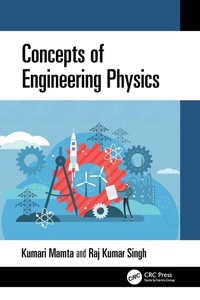
Concepts of Engineering Physics
1st Edition
Will be published approx. on 16. April 2026
Book
Paperback/Softback
464 pages
978-1-041-19183-4 (ISBN)
Description
Concepts of Engineering Physics offers readers an engaging and accessible reading to the Engineering Physics syllabus as per Indian National Education Policy 2020, and approved by the All India Council for Technical Education. The book demystifies and simplifies the complex concepts of Wave Optics, Lasers, Quantum Mechanics, Vector calculus, Electrostatics, Magnetostatics, Electromagnetic waves, Semiconductor and Electronic materials through relatable analogies and applications.
It contains more than 225 multiple choice questions with keys, 150 solved problems, a question bank of unsolved problems, 380 very short answer type questions, 200 short answer type questions and 130 descriptive questions in line with the Four-Year Undergraduate Programme examination curriculum. The book also contains around 100 diagrams and a few tables to aid the understanding of readers. A summary section, included at the end of each chapter, serves as a ready reckoner for the concepts in Engineering Physics.
This textbook caters to need of undergraduate students studying Physics as major and/or minor paper in the FYUGP of the Indian Universities and colleges. With lucid presentation and insightful explanations, this book is a must-have for aspiring engineers.
Key Features:
Covers the complete Engineering Physics syllabus for the Four-Year Undergraduate Programme (FYUGP).
Demystifies complex concepts through relatable analogies and practical applications.
Includes a rich question bank and practice materials to aid self-assessment and learning.
It contains more than 225 multiple choice questions with keys, 150 solved problems, a question bank of unsolved problems, 380 very short answer type questions, 200 short answer type questions and 130 descriptive questions in line with the Four-Year Undergraduate Programme examination curriculum. The book also contains around 100 diagrams and a few tables to aid the understanding of readers. A summary section, included at the end of each chapter, serves as a ready reckoner for the concepts in Engineering Physics.
This textbook caters to need of undergraduate students studying Physics as major and/or minor paper in the FYUGP of the Indian Universities and colleges. With lucid presentation and insightful explanations, this book is a must-have for aspiring engineers.
Key Features:
Covers the complete Engineering Physics syllabus for the Four-Year Undergraduate Programme (FYUGP).
Demystifies complex concepts through relatable analogies and practical applications.
Includes a rich question bank and practice materials to aid self-assessment and learning.
More details
Language
English
Place of publication
London
United Kingdom
Publishing group
Taylor & Francis Ltd
Target group
College/higher education
Postgraduate, Undergraduate Advanced, and Undergraduate Core
Illustrations
6 s/w Tabellen, 104 s/w Abbildungen, 104 s/w Zeichnungen
6 Tables, black and white; 104 Line drawings, black and white; 104 Illustrations, black and white
Dimensions
Height: 234 mm
Width: 156 mm
Thickness: 27 mm
Weight
769 gr
ISBN-13
978-1-041-19183-4 (9781041191834)
Copyright in bibliographic data and cover images is held by Nielsen Book Services Limited or by the publishers or by their respective licensors: all rights reserved.
Schweitzer Classification
Other editions
Additional editions
Kumari Mamta | Raj Kumar Singh
Concepts of Engineering Physics
E-Book
04/2026
1st Edition
CRC Press
€69.99
Available for download
Kumari Mamta | Raj Kumar Singh
Concepts of Engineering Physics
E-Book
04/2026
1st Edition
CRC Press
€69.99
Available for download
Kumari Mamta | Raj Kumar Singh
Concepts of Engineering Physics
Book
approx. 04/2026
1st Edition
CRC Press
€207.50
Not yet published
Persons
Kumari Mamta obtained her Ph.D. degree from Ranchi University, in the year 2011. Currently she is Associate Professor of Physics in the Department of Applied Science and Humanities, Nalanda College of Engineering, Nalanda, India. She has teaching experience of 21 years in Engineering colleges at undergraduate and postgraduate levels, and research experience of 18 years. Her research interest lies in the field of radiating structures using numerical methods, computations and virtual lab simulations. Dr. Mamta has been Erasmus Mundus India4EUII Post-Doctoral fellow funded by the European Commission with the Department of Electromagnetic Engineering at Politecnico di Torino, Italy, in the year 2014.
Raj Kumar Singh has obtained a Ph.D. degree in Physics from Ranchi University, Ranchi. He has teaching experience of 18 years at undergraduate and postgraduate levels. His research interests are in the field of microstrip patch radiating structures for mm wave communications, spintronics and high entropy perovskite. Dr. Singh has been Erasmus Mundus Post-Doctoral fellow at Politecnico di Torino, Italy, funded by the European Commission during the year 2013-14. He is a fellow of Institution of Electronics and Telecommunication Engineers (IETE), India, Member of IEEE and life member of Indian Science Congress Association (ISCA), Kolkata, Indian Association of Physics Teachers (IAPT), Kanpur, and Indian Physics Association (IPA), Mumbai.
Raj Kumar Singh has obtained a Ph.D. degree in Physics from Ranchi University, Ranchi. He has teaching experience of 18 years at undergraduate and postgraduate levels. His research interests are in the field of microstrip patch radiating structures for mm wave communications, spintronics and high entropy perovskite. Dr. Singh has been Erasmus Mundus Post-Doctoral fellow at Politecnico di Torino, Italy, funded by the European Commission during the year 2013-14. He is a fellow of Institution of Electronics and Telecommunication Engineers (IETE), India, Member of IEEE and life member of Indian Science Congress Association (ISCA), Kolkata, Indian Association of Physics Teachers (IAPT), Kanpur, and Indian Physics Association (IPA), Mumbai.
Content
1. Frame of reference and Oscillation 2. Wave Optics 3. Lasers 4. Quantum Mechanics 5. Vector Calculus 6. Electrostatics 7. Magnetostatics 8. Electromagnetic Waves 9. Introduction to Solids and Semi-Conductors 10. Electronic Materials