

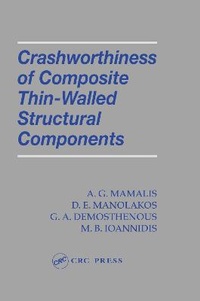
Crashworthiness of Composite Thin-Walled Structures
1st Edition
Published on 18. August 1998
Book
Hardback
270 pages
978-1-56676-635-7 (ISBN)
Description
FROM THE INTRODUCTION
Vehicle crashworthiness has been improving in recent years with attention mainly directed towards reducing the impact of the crash on the passengers. Effort has been spent in experimental research and in establishing safe theoretical design criteria on the mechanics of crumpling, providing to the engineers the ability to design vehicle structures so that the maximum amount of energy will dissipate while the material surrounding the passenger compartment is deformed, thus protecting the people inside.
During the last decade the attention given to crashworthiness and crash energy management has been centered on composite structures. The main advantages of fibre reinforced composite materials over more conventional isotropic materials, are the very high specific strengths and specific stiffness which can be achieved. Moreover, with composites, the designer can vary the type of fibre, matrix and fibre orientation to produce composites with proved material properties. Besides the perspective of reduced weight, design flexibility and low fabrication costs, composite materials offer a considerable potential for lightweight energy absorbing structures; these facts attract the attention of the automotive and aircraft industry owing to the increased use of composite materials in various applications, such as frame rails used in the apron construction of a car body and the subfloor of an aircraft, replacing the conventional materials used.
Our monograph is intended to provide an introduction to this relatively new topic of structural crashworthiness for professional engineers. It will introduce them to terms and concepts of it and acquaint them with some sources of literature about it. We believe that our survey constitutes a reasonably well-balanced synopsis of the topic.
Vehicle crashworthiness has been improving in recent years with attention mainly directed towards reducing the impact of the crash on the passengers. Effort has been spent in experimental research and in establishing safe theoretical design criteria on the mechanics of crumpling, providing to the engineers the ability to design vehicle structures so that the maximum amount of energy will dissipate while the material surrounding the passenger compartment is deformed, thus protecting the people inside.
During the last decade the attention given to crashworthiness and crash energy management has been centered on composite structures. The main advantages of fibre reinforced composite materials over more conventional isotropic materials, are the very high specific strengths and specific stiffness which can be achieved. Moreover, with composites, the designer can vary the type of fibre, matrix and fibre orientation to produce composites with proved material properties. Besides the perspective of reduced weight, design flexibility and low fabrication costs, composite materials offer a considerable potential for lightweight energy absorbing structures; these facts attract the attention of the automotive and aircraft industry owing to the increased use of composite materials in various applications, such as frame rails used in the apron construction of a car body and the subfloor of an aircraft, replacing the conventional materials used.
Our monograph is intended to provide an introduction to this relatively new topic of structural crashworthiness for professional engineers. It will introduce them to terms and concepts of it and acquaint them with some sources of literature about it. We believe that our survey constitutes a reasonably well-balanced synopsis of the topic.
More details
Language
English
Place of publication
Bosa Roca
United States
Publishing group
Taylor & Francis Inc
Target group
College/higher education
Professional Practice & Development
Dimensions
Height: 234 mm
Width: 156 mm
Weight
520 gr
ISBN-13
978-1-56676-635-7 (9781566766357)
Copyright in bibliographic data and cover images is held by Nielsen Book Services Limited or by the publishers or by their respective licensors: all rights reserved.
Schweitzer Classification
Other editions
Additional editions
A.G. Mamalis | D. E. Manolakos | G. A. Demosthenous
Crashworthiness of Composite Thin-Walled Structures
Book
09/2019
1st Edition
CRC Press
€101.00
Shipment within 15-20 days
A.G. Mamalis | D. E. Manolakos | G. A. Demosthenous
Crashworthiness of Composite Thin-Walled Structures
E-Book
11/2017
CRC Press
€92.49
Available for download
A.G. Mamalis | D. E. Manolakos | G. A. Demosthenous
Crashworthiness of Composite Thin-Walled Structures
E-Book
11/2017
CRC Press
€92.49
Available for download
Persons
Mamalis, A.G.; Manolakos, D. E.; Demosthenous, G. A.; Ioannidis, M. B.
Content
Preface
Introduction
Vehicle Crashworthiness
2.1 Aspects of Crashworthiness
2.2 Use of Composite Materials in Crashworthiness Applications
Failure Mechanisms of Composites
3.1 Notation
3.2 Failure Modes
3.3 Failure under Several Loading Conditions
3.4 Material Testing
3.5 Failure Criteria
3.6 Numerical Simulation
Energy Absorption Capability of Thin-Walled Composite Structural Components
4.1 Definition
4.2 Factors Affecting the Energy Absorption Capability
4.3 Failure Mechanisms/Mechanical Response
4.4 Predictive Techniques
4.5 Quantitative Data
Circular Tubes
5.1 Notation
5.2 General
5.3 Axial Collapse: Static and Dynamic
5.4 Bending
Square-Rectangular Tubes
6.1 Notation
6.2 General
6.3 Axial Collapse: Static and Dynamic
6.4 Bending
Circular Frusta
7.1 Notation
7.2 General
7.3 Axial Collapse: Static and Dynamic
Square Frusta
8.1 Notation
8.2 General
8.3 Axial Collapse: Static an Dynamic
Automotive Sections
9.1 Notation
9.2 General
9.3 Axial Collapse: Static and Dynamic
9.4 Bending
Classification of Macro- and Microfailure Modes and Quantitative Data
10.1 Common Defects in the Processing of Composite Materials
10.2 Common Defects in Loaded Composite Thin-Walled Structures
References
Subject Index
Author Index
Introduction
Vehicle Crashworthiness
2.1 Aspects of Crashworthiness
2.2 Use of Composite Materials in Crashworthiness Applications
Failure Mechanisms of Composites
3.1 Notation
3.2 Failure Modes
3.3 Failure under Several Loading Conditions
3.4 Material Testing
3.5 Failure Criteria
3.6 Numerical Simulation
Energy Absorption Capability of Thin-Walled Composite Structural Components
4.1 Definition
4.2 Factors Affecting the Energy Absorption Capability
4.3 Failure Mechanisms/Mechanical Response
4.4 Predictive Techniques
4.5 Quantitative Data
Circular Tubes
5.1 Notation
5.2 General
5.3 Axial Collapse: Static and Dynamic
5.4 Bending
Square-Rectangular Tubes
6.1 Notation
6.2 General
6.3 Axial Collapse: Static and Dynamic
6.4 Bending
Circular Frusta
7.1 Notation
7.2 General
7.3 Axial Collapse: Static and Dynamic
Square Frusta
8.1 Notation
8.2 General
8.3 Axial Collapse: Static an Dynamic
Automotive Sections
9.1 Notation
9.2 General
9.3 Axial Collapse: Static and Dynamic
9.4 Bending
Classification of Macro- and Microfailure Modes and Quantitative Data
10.1 Common Defects in the Processing of Composite Materials
10.2 Common Defects in Loaded Composite Thin-Walled Structures
References
Subject Index
Author Index