

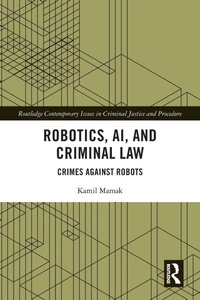
Robotics, AI and Criminal Law
Crimes Against Robots
1st Edition
Published on 30. July 2025
Book
Paperback/Softback
144 pages
978-1-032-36280-9 (ISBN)
Description
This book offers a phenomenological perspective on the criminal law debate on robots. Today, robots are protected in some form by criminal law. A robot is a person's property and is protected as property. This book presents the different rationale for protecting robots beyond the property justification based on the phenomenology of human-robot interactions. By focusing on robots that have bodies and act in the physical world in social contexts, the work provides an assessment of the issues that emerge from human interaction with robots, going beyond perspectives focused solely on artificial intelligence (AI). Here, a phenomenological approach does not replace ontological concerns, but complements them. The book addresses the following key areas: Regulation of robots and AI; Ethics of AI and robotics; and philosophy of criminal law.
It will be of interest to researchers and academics working in the areas of Criminal Law, Technology and Law and Legal Philosophy.
It will be of interest to researchers and academics working in the areas of Criminal Law, Technology and Law and Legal Philosophy.
Reviews / Votes
"Can you murder a robot? Kamil Mamak's recent book on robots - embodied and operating in our daily lives - argues the case. Based on his fascinating combination of philosophical concepts and criminal law theory with a grounding in Polish law, he implores what human-robot-interaction has in it for fleshy readers who think beyond the digital-analogue divide. The inquiry is a must for lovers of androids."Sabine Gless, Professor of Criminal Law and Criminal Proceedings at the University of Basel (Switzerland) and co-author of If Robots Cause Harm Who is to Blame?, 19 NCLR 412-436 (2016)
"This ground-breaking book flips the script on robots and criminal law. Instead of examining unlawful actions done with robots, it investigates improper acts perpetrated against robots. In doing so, author Kamil Mamak develops an innovative method for protecting embodied, socially interactive technology that both challenges and revolutionizes existing property law."
David J. Gunkel, Professor at Northern Illinois University (USA) and author of Robot Rights
"A unique selling point of this excellent book is that Kamil Mamak draws both on an extensive knowledge of the philosophical literature on the ethics of human-robot interaction and an equally extensive knowledge of legal theory. Using Polish law as an illuminating case study, Mamak expertly investigates potential crimes against robots."
Sven Nyholm, Professor of the Ethics of Artificial Intelligence at the Ludwig Maximilian University of Munich (Germany), and author of Humans and Robots: Ethics, Agency, and Anthropomorphism and This is Technology Ethics: An Introduction.
More details
Series
Language
English
Place of publication
London
United Kingdom
Publishing group
Taylor & Francis Ltd
Target group
College/higher education
Postgraduate
Illustrations
1 s/w Abbildung, 1 s/w Photographie bzw. Rasterbild
1 Halftones, black and white; 1 Illustrations, black and white
Dimensions
Height: 234 mm
Width: 156 mm
Thickness: 9 mm
Weight
245 gr
ISBN-13
978-1-032-36280-9 (9781032362809)
Copyright in bibliographic data and cover images is held by Nielsen Book Services Limited or by the publishers or by their respective licensors: all rights reserved.
Schweitzer Classification
Other editions
Additional editions
Book
09/2023
1st Edition
Routledge
€205.80
Shipment within 10-20 days
E-Book
09/2023
1st Edition
Routledge
€56.49
Available for download
E-Book
09/2023
1st Edition
Routledge
€56.49
Available for download
Person
Kamil Mamak is a philosopher and a lawyer. He is a postdoctoral researcher at the RADAR: Robophilosophy, AI ethics and Datafication research group at the University of Helsinki, Finland, and an assistant professor at the Department of Criminal Law at the Jagiellonian University, Poland. He is also a Member of the Board of the Cracow Institute of Criminal Law, Poland.
Content
1. Introduction 2. The Moral Status of Robots 3. Robots as Humans 4. Mistreatment of Robots 5. Sex Robots 6. Relations with Robots 7. Robots, Artificial Intelligence, and Religions 8. Police Robots