

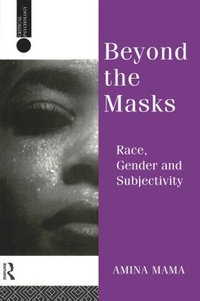
Beyond the Masks
Race, Gender and Subjectivity
1st Edition
Published on 10. August 1995
Book
Paperback/Softback
216 pages
978-0-415-03544-6 (ISBN)
Description
Psychology has had a number of things to say about black and coloured people, none of them favourable, and most of which have reinforced stereotyped and derogatory images. Beyond the Masks is a readable account of black psychology, exploring key theoretical issues in race and gender. In it, Amina Mama examines the history of racist psychology, and of the implicit racism throughout the discipline. Beyond the Masks also offers an important theoretical perspective, and will appeal to all those involved with ethnic minorities, gender politics and questions of identity.
More details
Series
Language
English
Place of publication
London
United Kingdom
Publishing group
Taylor & Francis Ltd
Target group
College/higher education
Dimensions
Height: 234 mm
Width: 156 mm
Weight
400 gr
ISBN-13
978-0-415-03544-6 (9780415035446)
Copyright in bibliographic data and cover images is held by Nielsen Book Services Limited or by the publishers or by their respective licensors: all rights reserved.
Schweitzer Classification
Other editions
Additional editions
E-Book
09/2002
Routledge
€67.49
Available for download
E-Book
09/2002
Routledge
€67.49
Available for download
Book
08/1995
Routledge
€81.84
Article exhausted; check different version
Person
Amina Mama is an academic who works with a range of African and European institutions. She holds a doctorate in psychology and teaches feminist studies and gender and development studies. Her earlier book The Hidden Struggle (1989) was the first published study of woman abuse in Britain's black communities. Married to Somali novelist Nuruddin Farah, she has a daughter and currently resides in Kaduna.
Content
1 Introduction 2 Enslaving the soul of the Other 3 Inventing black identity 4 Researching subjectivity 5 Locating the individual in history 6 Black British subjects 7 Psychodynamics of racialised subjectivity 8 Black femininity 9 Charting post-colonial subjectivities