

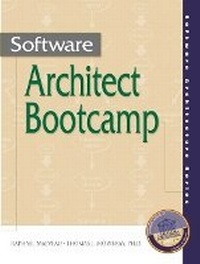
Software Architect Bootcamp
Published on 25. October 2000
Book
Paperback/Softback
352 pages
978-0-13-027407-6 (ISBN)
Description
*Become a great software architect-hands-on! *Define architectures that leverage today's best design patterns *Maximize scalability and technical flexibility *Lead your technical organization to successful implementation Your hands-on "field manual" for becoming a great software architect! This hands-on "field manual" gives developers the essential skills they need to survive and thrive as software architects! You'll find insightful, real-world coverage of everything from design patterns to prototyping, business case development to leadership. Leading software architects Raphael Malveau and Thomas Mowbray share profound insights and practical solutions for all the key challenges of architectures using objects, components, and distributed Internet computing, showing how to avoid time-consuming pitfalls and costly errors.You'll master proven methods for: *Identifying the best architectural model for any project *Executing heavyweight or lightweight approaches to software architecture *Addressing scalability and long-term business flexibility *Making the most of abstraction, refactoring, and architectural prototyping *Leveraging superior design patterns to improve your implementations With hands-on exercises, real-life war stories, and a take-no-prisoners attitude, Software Architect Bootcamp won't just help you become a great software architect: it'll help you become a true technical leader of your organization.
More details
Language
English
Place of publication
Upper Saddle River
United States
Publishing group
Pearson Education (US)
Target group
College/higher education
Dimensions
Height: 235 mm
Width: 178 mm
Thickness: 17 mm
Weight
569 gr
ISBN-13
978-0-13-027407-6 (9780130274076)
Copyright in bibliographic data and cover images is held by Nielsen Book Services Limited or by the publishers or by their respective licensors: all rights reserved.
Schweitzer Classification
Other editions
New editions
Thomas Mowbray | Raphael Malveau
Software Architect Bootcamp
Book
12/2003
2nd Edition
Prentice Hall
€50.12
Article is exhausted; no reprint
Persons
RAPHAEL MALVEAU is a hands-on software architect and consultant in Alexandria, Virginia, USA. Malveau formerly served as Chief Scientist at Eidea Labs and Component Management Group, where he established advanced component architecture best practices that led to the creation of several industry-leading software products. His component software development principles are the basis of advanced architecture courses taught worldwide through the Component Academy. Malveau has co-authored two previous technology books and numerous software publications.
DR. THOMAS MOWBRAY, Ph.D., is Chairman of Component Management Group, Founding Board Member of Worldwide Institute of Software Architects, and a practicing software architect who has worked on media asset management, geographic information systems, telecommunications systems, and financial accounting systems. As an Honorary Fellow of the Object Management Group, Dr. Mowbray co-authored the world's first software standard for computer accounting and is author of four books on distributed componentware and software architecture.
DR. THOMAS MOWBRAY, Ph.D., is Chairman of Component Management Group, Founding Board Member of Worldwide Institute of Software Architects, and a practicing software architect who has worked on media asset management, geographic information systems, telecommunications systems, and financial accounting systems. As an Honorary Fellow of the Object Management Group, Dr. Mowbray co-authored the world's first software standard for computer accounting and is author of four books on distributed componentware and software architecture.
Content
Preface.
Acknowledgments.
1. Introduction.
Advice for Software Architects. Software Architecture as a Discipline. Design Patterns and Software Architecture. Conclusions. Exercises.
2. Software Architecture: Basic Training.
Software Paradigms. Open Systems Technology. Client Server Technology. Software Application Experience. Technology and Application Architecture. Applying Standards to Application Systems. Distributed Infrastructures. Conclusions. Exercises.
3. Software Architecture: Going to War.
Software Architecture Paradigm Shift. Doing Software Wrong. Doing Software Right: Enterprise. Bottom Line: Time, People, and Money. Conclusions. Exercises.
4. Software Architecture: Drill School.
Architecture versus Programming. Managing Complexity Using Architecture. Systems Integration. Making the Business Case. Architecture Linkage to Software Development. Architectural Software Notation. Conclusions. Exercises.
5. Leadership Training.
Leadership Is a Necessary, Learnable Skill. The Architect as Team Builder. Always Insist on Excellence in Deliverables. Architect's Walkthrough. Conclusions. Exercises.
6. Software Architecture: Jump School.
Process. Creating New Processes. Teamwork. Conclusions. Exercises.
7. Communications Training.
Communications Challenges. Responsibility-Driven Development. Communication Responsibilities. Handling Feedback. Exercises.
8. Software Architecture: Intelligence Operations.
Architecture Mining. Architecture Iteration. Architecture Judgment. Conclusions. Exercises.
9. Software Architecture: Psychological Warfare. Alternative Learning. Internal Control. Expectation Management. Psychology of Truth. Perception Is Not Reality. Exploiting Human Weaknesses. Example: Reference Selling. Psychology of Ownership. Psychological Akido: Guarding. Intellectual Akido. Conclusions. Exercises.
Appendix A: Architecture Example: Test Results Reporting System.
Appendix B: Design Templates and Examples.
Appendix C: Glossary of Software Architecture Terminology.
Appendix D: Acronyms.
Appendix E: Bibliography.
Index.
Acknowledgments.
1. Introduction.
Advice for Software Architects. Software Architecture as a Discipline. Design Patterns and Software Architecture. Conclusions. Exercises.
2. Software Architecture: Basic Training.
Software Paradigms. Open Systems Technology. Client Server Technology. Software Application Experience. Technology and Application Architecture. Applying Standards to Application Systems. Distributed Infrastructures. Conclusions. Exercises.
3. Software Architecture: Going to War.
Software Architecture Paradigm Shift. Doing Software Wrong. Doing Software Right: Enterprise. Bottom Line: Time, People, and Money. Conclusions. Exercises.
4. Software Architecture: Drill School.
Architecture versus Programming. Managing Complexity Using Architecture. Systems Integration. Making the Business Case. Architecture Linkage to Software Development. Architectural Software Notation. Conclusions. Exercises.
5. Leadership Training.
Leadership Is a Necessary, Learnable Skill. The Architect as Team Builder. Always Insist on Excellence in Deliverables. Architect's Walkthrough. Conclusions. Exercises.
6. Software Architecture: Jump School.
Process. Creating New Processes. Teamwork. Conclusions. Exercises.
7. Communications Training.
Communications Challenges. Responsibility-Driven Development. Communication Responsibilities. Handling Feedback. Exercises.
8. Software Architecture: Intelligence Operations.
Architecture Mining. Architecture Iteration. Architecture Judgment. Conclusions. Exercises.
9. Software Architecture: Psychological Warfare. Alternative Learning. Internal Control. Expectation Management. Psychology of Truth. Perception Is Not Reality. Exploiting Human Weaknesses. Example: Reference Selling. Psychology of Ownership. Psychological Akido: Guarding. Intellectual Akido. Conclusions. Exercises.
Appendix A: Architecture Example: Test Results Reporting System.
Appendix B: Design Templates and Examples.
Appendix C: Glossary of Software Architecture Terminology.
Appendix D: Acronyms.
Appendix E: Bibliography.
Index.