

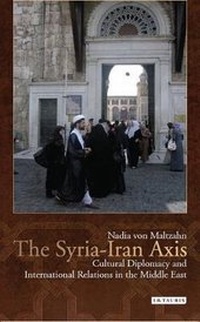
The Syria-Iran Axis
Cultural Diplomacy and International Relations in the Middle East
Published on 30. June 2013
Book
Hardback
272 pages
978-1-78076-537-2 (ISBN)
Description
Since the Iranian Revolution, the close alliance between Syria and Iran has endured for over three decades, based on geopolitical interests between the two states and often framed in the language of resistance. In view of their strong relationship at a state-level, what have Syria and Iran each been doing to foster popular exchange and employ cultural tools to build and image in the other country? The Syria-Iran Axis examines the motivations, content and reach of cultural diplomacy between Syria and Iran to determine to what degree that two partners have been successful in bridging their world views and political outlooks. Beginning with a historical background of relations between the two countries before the overthrow of the Shah, Nadia von Maltazahn offers an analysis of the process of policy formulation, and they key themes which characterize Syrian and Iranian foreign and cultural relations. Whilst the relations between the two countries were limited in the pre-revolutionary period, bilateral relations developed very quickly in the aftermath of the revolution.
Uniquely, The Syria-Iran Axis looks beyond the political and military cooperation between the leaders of these two countries, highlighting the economic and cultural connections between the populations. It therefore examines the scientific, academic, military, economic, industrial, telecommunications and cultural delegations that go back and forth between Damascus and Tehran. With key Shi'i shrines situated in Syria, such as the Sayyida Zaynab and the Sayyida Ruqayya mosques in Damascus, there has been for many years a significant level of religious tourism. Bearing in mind that these levels of inter-cultural connection have been threatened by the ongoing unrest in Syria, von Maltzahn also highlights the ways in which this key relationship has been affected by events in the wider geopolitical sphere. By examining the extent to which a state-directed cultural exchange can foster bilateral relations in the Middle East, von Maltzahn offers a unique analysis of the formation of foreign policy and diplomacy in the region.
Uniquely, The Syria-Iran Axis looks beyond the political and military cooperation between the leaders of these two countries, highlighting the economic and cultural connections between the populations. It therefore examines the scientific, academic, military, economic, industrial, telecommunications and cultural delegations that go back and forth between Damascus and Tehran. With key Shi'i shrines situated in Syria, such as the Sayyida Zaynab and the Sayyida Ruqayya mosques in Damascus, there has been for many years a significant level of religious tourism. Bearing in mind that these levels of inter-cultural connection have been threatened by the ongoing unrest in Syria, von Maltzahn also highlights the ways in which this key relationship has been affected by events in the wider geopolitical sphere. By examining the extent to which a state-directed cultural exchange can foster bilateral relations in the Middle East, von Maltzahn offers a unique analysis of the formation of foreign policy and diplomacy in the region.
Reviews / Votes
Nadia von Maltzahn's valuable book adds depth to our understanding of that most improbable of alliances, the Iran--Syria axis. She shows with great skill how the Ba'athists in Damascus and the theocrats in Tehran have used cultural policies to cement the ties between the two states, forging one of the most enduring alliances in the Middle East but ultimately failing to capture broad popular support. H.E. Chehabi, Professor of International Relations and History, Boston University. Nadia von Maltzahn's book adds a valuable dimension missing in other analyses of Syria--Iran relations; usually framed in terms of a strategic alliance of convenience against common enemies, she shows how, for Iran at least, there was also a public diplomacy effort to create a positive image among Syrian elites and publics. Benefiting from the writer's facility in Arabic and Persian, the work uses the press, documents, interviews, and participant observation in both countries to excavate such relatively "hidden" aspects as religious tourism, the world of cultural centres and language and exchange students in the forefront of developing the relationship. Von Maltzahn's analysis is of special relevance amidst the current "New Struggle for Syria" in which Iran remains a major participant. Raymond Hinnebusch, Professor of International Relations, University of St Andrews.More details
Series
Language
English
Place of publication
United Kingdom
Publishing group
Bloomsbury Publishing PLC
Target group
College/higher education
Illustrations
18 bw integrated
Dimensions
Height: 216 mm
Width: 134 mm
ISBN-13
978-1-78076-537-2 (9781780765372)
Copyright in bibliographic data and cover images is held by Nielsen Book Services Limited or by the publishers or by their respective licensors: all rights reserved.
Schweitzer Classification
Other editions
Additional editions
Nadia von Maltzahn
The Syria-Iran Axis
Cultural Diplomacy and International Relations in the Middle East
E-Book
06/2013
1st Edition
I.B. Tauris
€27.49
Available for download
Nadia von Maltzahn
The Syria-Iran Axis
Cultural Diplomacy and International Relations in the Middle East
E-Book
06/2013
1st Edition
I.B. Tauris
€27.49
Available for download
Person
Nadia von Maltzahn is a Research Associate at the Orient-Institut Beirut, and has in the past lived and researched in Damascus. She holds a DPhil in Middle Eastern Studies from St Antony's College, Oxford.
Content
Acknowledgements Note on Transliteration Introduction: The Role of Culture in Foreign Policy Chapter 1: Historical Backdrop: An Overview of Syrian-Iranian Relations Since 1946 Chapter 2: Policy and Values Chapter 3: Pre-1979 Cultural Diplomacy and Foundations for Post-Revolutionary Cultural Exchange Chapter 4: Iran's Cultural Diplomacy in Syria : The Iranian Cultural Centre in Damascus Chapter 5: Syria's Cultural Diplomacy in Iran: The Arab-Syrian Cultural Centre in Tehran Chapter 6: Students: Fostering the Bonds of the Future Chapter 7: Religious Tourism: The Blessedness of Cultural Ties Conclusion: Cultural Diplomacy, Soft Power and the Syria-Iran Axis Notes Bibliography Index