

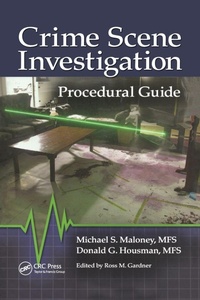
Crime Scene Investigation Procedural Guide
1st Edition
Published on 14. May 2014
Book
Paperback/Softback
348 pages
978-1-4665-5754-3 (ISBN)
Description
Those tasked with investigating crime scenes come from a variety of backgrounds and varying levels of experience. Crime Scene Investigation Procedural Guide gives the novice investigator the procedures for almost any crime scene imaginable while providing the seasoned pro a ready reference for crimes occurring even under the most unusual of circumstances. Designed as a stand-alone text or as a companion to Ross Gardner's Practical Crime Scene Investigation, the book details the precise steps that need to be taken when processing and analyzing a crime scene.
Using a bulleted format for quick, easy access, the authors provide hands-on, concise instruction in a style friendly to a range of professionals. Topics discussed in this practical manual include:
Preparation for response, initial response, scene management, and scene evaluation/analysis
Scene photography, videography, sketching, and search and processing procedures
Steps to be taken prior to releasing the scene
Response, documentation, processing, and collection of evidence for specific crimes against persons and property
Evaluation, processing, collection, and preservation of all items of evidence encountered at the scene, including friction ridge evidence, two- and three-dimensional impression evidence, and trace and biological evidence
Bloodstain pattern documentation and shooting incident documentation
Appendices include direction on working with potential blood-borne pathogens and worksheets for documenting and evaluating the scene and processing various types of evidence. A supplemental CD is included with downloadable forms for crime scene investigations. Adherence to the instructions provided in this guide will help ensure investigators that vital evidence is properly documented and preserved.
Using a bulleted format for quick, easy access, the authors provide hands-on, concise instruction in a style friendly to a range of professionals. Topics discussed in this practical manual include:
Preparation for response, initial response, scene management, and scene evaluation/analysis
Scene photography, videography, sketching, and search and processing procedures
Steps to be taken prior to releasing the scene
Response, documentation, processing, and collection of evidence for specific crimes against persons and property
Evaluation, processing, collection, and preservation of all items of evidence encountered at the scene, including friction ridge evidence, two- and three-dimensional impression evidence, and trace and biological evidence
Bloodstain pattern documentation and shooting incident documentation
Appendices include direction on working with potential blood-borne pathogens and worksheets for documenting and evaluating the scene and processing various types of evidence. A supplemental CD is included with downloadable forms for crime scene investigations. Adherence to the instructions provided in this guide will help ensure investigators that vital evidence is properly documented and preserved.
More details
Language
English
Place of publication
Bosa Roca
United States
Publishing group
Taylor & Francis Inc
Target group
College/higher education
Forensic technicians and law enforcement professionals in areas where crime scene units are not available, and forensic scientists.
Illustrations
106 s/w Abbildungen, 14 s/w Tabellen
14 Tables, black and white; 106 Illustrations, black and white
Dimensions
Height: 234 mm
Width: 156 mm
Thickness: 19 mm
Weight
532 gr
ISBN-13
978-1-4665-5754-3 (9781466557543)
Copyright in bibliographic data and cover images is held by Nielsen Book Services Limited or by the publishers or by their respective licensors: all rights reserved.
Schweitzer Classification
Other editions
Additional editions
Michael S. Maloney | Donald Housman | Ross M. Gardner
Crime Scene Investigation Procedural Guide
Book
12/2020
1st Edition
CRC Press
€282.26
Shipment within 10-20 days
Michael S. Maloney | Donald Housman | Ross M. Gardner
Crime Scene Investigation Procedural Guide
E-Book
05/2014
1st Edition
CRC Press
€86.99
Available for download
Michael S. Maloney | Donald Housman | Ross M. Gardner
Crime Scene Investigation Procedural Guide
E-Book
05/2014
1st Edition
CRC Press
€86.99
Available for download
Persons
Michael Maloney is a private consultant and trainer after retiring from a career in Federal Law Enforcement. He holds a Master of Forensic Science Degree from GWU with a Fellowship in Forensic Medicine. He has 20 years experience as a Special Agent with the Naval Criminal Investigative Service (NCIS) and Senior Instructor-Federal Law Enforcement Training Center for Death Investigations and Sex Crimes. He is the author of Death Scene Investigation: Procedural Guide and Crime Scene Investigation: Procedural Guide from CRC Press.
Don Housman is a private consultant, educator, and trainer. He retired from a career with the Naval Criminal Investigative Service (NCIS) where he was Chief of the Forensic Consultant Division. He holds a Master of Forensic Sciences degree from GWU with a Fellowship in Forensic Medicine. He has 23 years' experience as a Special Agent with NCIS, and the FBI. He has co-authored four Forensic related books for the Department of Defense and is the co-author of Crime Scene Investigation: Procedural Guide from CRC Press.
Ross M. Gardner worked for the United States Army Criminal Investigation Command (USACIDC) as a felony criminal investigator for nearly twenty years. He subsequently served four years as the Chief of Police for the City of Lake City, Georgia, a small suburban Atlanta police department. He is now retired and active in independent consulting. Mr. Gardner holds a Master degree in Computer and Information Systems Management from Webster University, a Bachelors degree in Criminal Justice from Wayland Baptist University and Associates degree in Police Science from Central Texas College. He graduated first in his class at the Scenes of Crime Officers Course, New Scotland Yard, Hendon England. He is a former President of the Association for Crime Scene Reconstruction (ACSR) and has served as the Chairmen of the Education Committee for the International Association of Bloodstain Pattern Analysts (IABPA). He was a charter member of the FBI's Scientific Workgroup on Bloodstain Pattern Analysis (SWGSTAIN) and chaired the Taxonomy and Terminology sub-committee for over ten years. Mr. Gardner was certified by the International Association for Identification as Senior Crime Scene Analyst from 1990-2012. He remains an active instructor and consultant throughout the United States and the world in crime scene analysis, bloodstain pattern analysis and crime scene investigation; teaching to a variety of groups ranging from investigative organizations to trial counsel professional development groups. He is co-author of Bloodstain Pattern Analysis, With an Introduction to Crime Scene Reconstruction, 3rd Edition and Practical Crime Scene Analysis and Reconstruction. Mr. Gardner also authored the text Practical Crime Scene Processing and Investigation 2nd Edition in 2004.
Don Housman is a private consultant, educator, and trainer. He retired from a career with the Naval Criminal Investigative Service (NCIS) where he was Chief of the Forensic Consultant Division. He holds a Master of Forensic Sciences degree from GWU with a Fellowship in Forensic Medicine. He has 23 years' experience as a Special Agent with NCIS, and the FBI. He has co-authored four Forensic related books for the Department of Defense and is the co-author of Crime Scene Investigation: Procedural Guide from CRC Press.
Ross M. Gardner worked for the United States Army Criminal Investigation Command (USACIDC) as a felony criminal investigator for nearly twenty years. He subsequently served four years as the Chief of Police for the City of Lake City, Georgia, a small suburban Atlanta police department. He is now retired and active in independent consulting. Mr. Gardner holds a Master degree in Computer and Information Systems Management from Webster University, a Bachelors degree in Criminal Justice from Wayland Baptist University and Associates degree in Police Science from Central Texas College. He graduated first in his class at the Scenes of Crime Officers Course, New Scotland Yard, Hendon England. He is a former President of the Association for Crime Scene Reconstruction (ACSR) and has served as the Chairmen of the Education Committee for the International Association of Bloodstain Pattern Analysts (IABPA). He was a charter member of the FBI's Scientific Workgroup on Bloodstain Pattern Analysis (SWGSTAIN) and chaired the Taxonomy and Terminology sub-committee for over ten years. Mr. Gardner was certified by the International Association for Identification as Senior Crime Scene Analyst from 1990-2012. He remains an active instructor and consultant throughout the United States and the world in crime scene analysis, bloodstain pattern analysis and crime scene investigation; teaching to a variety of groups ranging from investigative organizations to trial counsel professional development groups. He is co-author of Bloodstain Pattern Analysis, With an Introduction to Crime Scene Reconstruction, 3rd Edition and Practical Crime Scene Analysis and Reconstruction. Mr. Gardner also authored the text Practical Crime Scene Processing and Investigation 2nd Edition in 2004.
Content
Crime Scene Investigation. Initial Response. Crime Scene Management. Crime Scene Notes and Observation. Crime Scene Videography and Photography. Crime Scene Sketching. Crime Scene Search Procedures. Aquatic Recovery of Evidence. Releasing the Scene and Postscene Activities. Crimes against Property. Burglary and Housebreaking. Larceny. Larceny of a Motor Vehicle. Vandalism and Malicious Mischief. Fire and Arson Scenes. Postblast (Explosive Incident) Scenes. Crimes against Persons. Aggravated Assault. Robbery from an Individual. Robbery from a Business. Carjacking. Kidnapping and Missing Persons. Rape and Sexual Assault. Injuries Commonly Associated with Violent Crime. Child Sexual Assault or Abuse. Child Physical Abuse. Child Neglect. Evidence Processing and Documentation. Friction Ridge Evidence. Impression Evidence. Biological Evidence at the Scene. Trace Evidence at the Scene. Entomological Evidence at the Scene. Use of Light and Alternate Light Sources (Oblique, UV, ALS, and RUVIS). Documenting and Processing Bloodstain Patterns at the Scene. Documenting and Processing the Shooting Scene. Appendices. Index.