


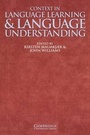
Context in Language Learning and Language Understanding
Published on 8. October 1998
Book
Hardback
208 pages
978-0-521-63337-6 (ISBN)
Description
The papers in this volume represent the views of a range of experts in a variety of language-related disciplines on the role which context plays in language learning and language understanding. The authors provide various theoretical constructs which help impose order on the apparent chaos of contextual factors which may have an influence on the production and comprehension of speech events. They focus on a variety of types of context, including the context established by different speech communities, interpersonal contexts, the classroom context, and the context provided by the linguistic code itself. The papers illustrate how the treatment of context varies across the disciplines of linguistics, historical stylistics, applied linguistics, and psycholinguistics. Each paper is prefaced by an editorial introduction to help the reader trace out common themes and points of conflict.
More details
Series
Language
English
Place of publication
Cambridge
United Kingdom
Target group
ELT/ESL
Illustrations
Worked examples or Exercises; 10 Printed music items
Dimensions
Height: 236 mm
Width: 158 mm
Thickness: 18 mm
Weight
445 gr
ISBN-13
978-0-521-63337-6 (9780521633376)
Copyright in bibliographic data is held by Nielsen Book Services Limited or its licensors: all rights reserved.
Schweitzer Classification
Other editions
New editions
Kirsten Malmkjaer | John Williams
Context in Language Learning and Language Understanding
Book
10/1998
Cambridge University Press
€52.01
Article exhausted; check different version
Additional editions
Kirsten Malmkjaer | John Williams
Context in Language Learning and Language Understanding
Book
10/1998
Cambridge University Press
€52.01
Article exhausted; check different version
Persons
Content
1.The conditions of contextual meaning; 2. Deixis and context; 3.The context for so-called 'discourse markers'; 4.Communal lexicons; 5.When words fail: From communication strategies to strategies for communication; 6. Contextual factors in classroom language learning: An overview; 7. The code as context: language-change and (mis)interpretation; 8. Context creation in discourse understanding.