

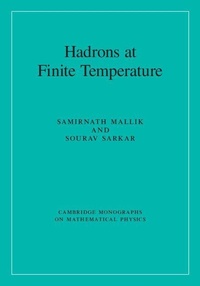
Hadrons at Finite Temperature
Published on 27. October 2016
Book
Hardback
262 pages
978-1-107-14531-3 (ISBN)
Description
High energy laboratories are performing experiments in heavy ion collisions to explore the structure of matter at high temperature and density. This elementary book explains the basic ideas involved in the theoretical analysis of these experimental data. It first develops two topics needed for this purpose, namely hadron interactions and thermal field theory. Chiral perturbation theory is developed to describe hadron interactions and thermal field theory is formulated in the real-time method. In particular, spectral form of thermal propagators is derived for fields of arbitrary spin and used to calculate loop integrals. These developments are then applied to find quark condensate and hadron parameters in medium, including dilepton production. Finally, the non-equilibrium method of statistical field theory to calculate transport coefficients is reviewed. With technical details explained in the text and appendices, this book should be accessible to researchers as well as graduate students interested in thermal field theory.
More details
Series
Language
English
Place of publication
Cambridge
United Kingdom
Target group
Professional and scholarly
Illustrations
6 Halftones, black and white; 26 Line drawings, black and white
Dimensions
Height: 250 mm
Width: 175 mm
Thickness: 19 mm
Weight
647 gr
ISBN-13
978-1-107-14531-3 (9781107145313)
Copyright in bibliographic data and cover images is held by Nielsen Book Services Limited or by the publishers or by their respective licensors: all rights reserved.
Schweitzer Classification
Other editions
Additional editions
Samirnath Mallik
Hadrons at Finite Temperature
E-Book
10/2016
Cambridge University Press
€98.49
Available for download
Samirnath Mallik | Sourav Sarkar
Hadrons at Finite Temperature
E-Book
09/2016
Cambridge University Press
€117.99
Available for download
Persons
Samirnath Mallik is an Emeritus Scientist at the Saha Institute of Nuclear Physics. He previously worked at the University of Bern, the University of Karlsruhe and the Tata Institute of Fundamental Research. His research interests are thermal field theory and heavy ion collisions. Sourav Sarkar is a scientist at the Variable Energy Cyclotron Centre, Kolkata, and an Associate Professor at the Homi Bhabha National Institute. His research interests concern the applications of thermal field theory, mainly to study transport phenomena and hadronic properties in a hot and dense medium.
Content
Preface; Notation; 1. Free fields in vacuum; 2. Spontaneous symmetry breaking; 3. Chiral perturbation theory; 4. Thermal propagators; 5. Thermal Perturbation Theory; 6. Thermal parameters; 7. Two-loop results; 8. Heavy ion collisions; 9. Non-equilibrium processes; Appendix A. General fields; Appendix B. Global symmetries; Appendix C. Exponential operator; Appendix D. Propagator at origin of coordinates; Appendix E. Reaction rates in vacuum and medium; Appendix F. Coupling constants; Appendix G. Imaginary time method; Appendix H. Quark condensate from partition function; Appendix I. Quark condensate from density expansion; Index.