

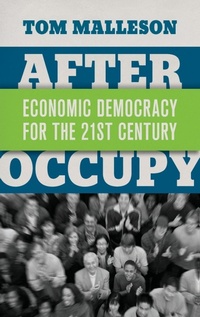
After Occupy
Economic Democracy for the 21st Century
Published on 29. May 2014
Book
Hardback
302 pages
978-0-19-933010-2 (ISBN)
Description
These days, it is easy to be cynical about democracy. Even though there are more democratic societies now (119 and counting) than ever before, skeptics can point to low turnouts in national elections, the degree to which money corrupts the process, and the difficulties of mass participation in complex systems as just a few reasons the system is flawed. The Occupy movement in 2011 proved that there is an emphatic dissatisfaction with the current state of affairs, particularly with the economy, but, ultimately, it failed to produce any coherent vision for social change. So what should progressives be working toward? What should the economic vision be for the 21st century?
After Occupy boldly argues that democracy should not just be a feature of political institutions, but of economic institutions as well. In fact, despite the importance of the economy in democratic societies, there is very little about it that is democratic. Questioning whether the lack of democracy in the economy might be unjust, Tom Malleson scrutinizes workplaces, the market, and financial and investment institutions to consider the pros and cons of democratizing each. He considers examples of successful efforts toward economic democracy enacted across the globe, from worker cooperatives in Spain to credit unions and participatory budgeting measures in Brazil and questions the feasibility of expanding each. The book offers the first comprehensive and radical vision for democracy in the economy, but it is far from utopian. Ultimately, After Occupy offers possibility, demonstrating in a remarkably tangible way that when political democracy evolves to include economic democracy, our societies will have a chance of meaningful equality for all.
After Occupy boldly argues that democracy should not just be a feature of political institutions, but of economic institutions as well. In fact, despite the importance of the economy in democratic societies, there is very little about it that is democratic. Questioning whether the lack of democracy in the economy might be unjust, Tom Malleson scrutinizes workplaces, the market, and financial and investment institutions to consider the pros and cons of democratizing each. He considers examples of successful efforts toward economic democracy enacted across the globe, from worker cooperatives in Spain to credit unions and participatory budgeting measures in Brazil and questions the feasibility of expanding each. The book offers the first comprehensive and radical vision for democracy in the economy, but it is far from utopian. Ultimately, After Occupy offers possibility, demonstrating in a remarkably tangible way that when political democracy evolves to include economic democracy, our societies will have a chance of meaningful equality for all.
Reviews / Votes
After Occupy is a stimulating book worth reading for anyone concerned with increasing inequalities and serious about investigating alternative ways to organize socio-economic cooperation * Thomas Ferretti, Ethical Perspectives *More details
Language
English
Place of publication
New York
United States
Target group
College/higher education
Professional and scholarly
Illustrations
2 b/w line
Dimensions
Height: 240 mm
Width: 161 mm
Thickness: 22 mm
Weight
675 gr
ISBN-13
978-0-19-933010-2 (9780199330102)
Copyright in bibliographic data and cover images is held by Nielsen Book Services Limited or by the publishers or by their respective licensors: all rights reserved.
Schweitzer Classification
Other editions
Additional editions
Book
09/2015
Oxford University Press Inc
€37.10
Shipment within 15-20 days
E-Book
04/2014
1st Edition
OUP eBook
€9.49
Available for download
E-Book
04/2014
1st Edition
OUP eBook
€9.49
Available for download
Person
Tom Malleson is a Social Sciences and Humanities Research Council (SSHRC) Postdoctoral Research Fellow at York University, Canada. He is the co-editor of Whose Streets? The Toronto G20 and the Challenges of Summit Protest (Between the Lines, 2011) and the author of Stand Up Against Capitalism (Between the Lines and New Internationalist, 2014).
Content
Acknowledgements ; Part One: Introduction ; 1. Introduction ; 2. Economic Democracy: Beginning Orientations ; Part Two: Workplaces ; 3. Should Workplaces be Democratized? ; 4. Worker Cooperatives in Practice ; Part Three: The Market System ; 5. Democracy and the Market System ; 6. Democratizing the Market System ; Part Four: Finance and Investment ; 7. Should Finance and Investment be Democratized? ; 8. Finance and Investment Democracy in Practice: Capital Controls, Public Banks, and Participatory Budgeting ; Part Five: Conclusion ; 9. Towards a Feasible Socialism for the 21st Century ; Bibliography